


A tribute to craftsmanship
Exhibition highlights exquisite skills and technical knowledge of ancient artifacts, Yang Feiyue reports.









This innovation gave rise to painted pottery, where vibrant designs contrasted beautifully with the unadorned clay, creating a distinct aesthetic, they add.
Another treasure showcased at the exhibition is a remarkable painted pottery jar unearthed from the Dadianzi site in Aohan Banner, Inner Mongolia. This artifact is a stunning example of the Lower Xiajiadian culture, which dates back between 4,000 and 3,400 years.
"Painted pottery is one of the most representative inventions of the Lower Xiajiadian culture," Liu Guoxiang says.
At the Dadianzi cemetery, a total of 420 painted pottery pieces have been discovered, accounting for about 25 percent of the burial pottery. Analysis shows that these painted pottery pieces used carbon-infused black or dark gray surfaces as the base, adorned with patterns in white, red, and orange-yellow, Liu notes.
The clay surface was polished to a smooth finish, which, after firing, proved ideal for painting, while the dark base enhanced the visibility and aesthetic appeal of the bright-colored designs, he explains.
Experts highlight that the invention of painted pottery marked a groundbreaking innovation that spread from the East to the West, serving as a primary channel for early cultural exchanges between East and West and is considered a precursor to the Silk Road.
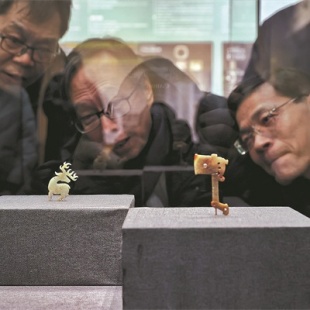
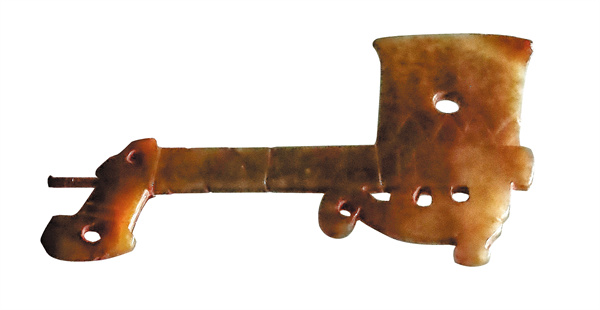
The jade unit features 70 artifacts, tracing nearly 10,000 years of craftsmanship in China. Highlights include a set of three hooks from different eras, including the late Neolithic Hongshan culture, around 6,500 to 4,900 years ago, marked by its use of delicate jade ware.
They illustrate the evolution and cultural exchange of jade artifacts across millennia.
The Splendor of Textiles section presents five artifacts, focusing on ancient textile craftsmanship, featuring advanced braiding, twisting, and weaving skills of textile artisans.
Toward the end of the exhibition is the laboratory archaeology display area, where a glass-enclosed workspace offers visitors a rare opportunity to witness the meticulous process of artifact restoration up close.
Inside, Fan Rongnan is focusing on the virtual 3D reconstruction of a Tang Dynasty (618-907) dragon head, unearthed from the ancient city of Xiongzhou, located in what is today's Xiong'an New Area, Hebei province. Fragments of the dragon head are carefully arranged on the table, showcasing the painstaking effort required to piece together history.
"The dragon head artifact we're showcasing is a classic example of laboratory archaeology," says Fan, a second-year graduate student under the researcher Liu Yong from the archaeological science and cultural heritage protection lab, at the Chinese Academy of Social Sciences.
"Based on stratigraphic and typological analysis, we've determined that it dates back to the Tang Dynasty. This artifact is a ceramic architectural component, originally placed on a roof," Fan explains.
The dragon head isn't just a dull gray — it retains traces of colorful paint. For example, the left eye is black, surrounded by a faint green eyeliner, Fan adds.
Archaeologists have employed a variety of advanced techniques to study the dragon head, including 3D laser scanning, multi-angle 3D imaging, and surface fluorescence analysis, which captured detailed information about the fragments' morphology and painted components.
The data collected provided a scientific foundation for the preservation and restoration of the dragon head, Fan says.
She has been demonstrating the piecing together of fragments at the exhibition. "The numbered fragments in the tray show the initial condition of the artifact. These pieces have already been cleaned and desalinated, and now the task is to assemble them," Fan explains.
Liu Yu says the exhibition not only celebrates "the ingenuity of our ancestors" but also highlights the transformative role of technology in "preserving and understanding our shared heritage".
"Through the power of technological archaeology and cultural heritage preservation, we can decode the fragments of the past, unlocking the secrets of the past and bringing their brilliance back to life," Liu says.