


Painted pottery provide glimpses of sophisticated civilization









The extraordinary accomplishments of Majiayao culture not only demonstrate the advanced social organization and civilizational maturity of China's western highland communities but also enrich the "diverse-yet-integrated" paradigm explaining the origins of Chinese civilization. These findings provide concrete evidence of Chinese civilization's profound depth and enduring continuity.
Interestingly, the glory of painted pottery craftsmanship was not exclusive to the Majiayao culture at the eastern end of Eurasia. Simultaneously, the Cucuteni-Trypillia culture spanning the northwestern Black Sea coast achieved comparable sophistication in ceramic art, representing the zenith of prehistoric cultural development in that region.
Dating to the same period as the Miaodigou phase of Yangshao culture and the Majiayao culture, the stylistic similarities between their painted pottery had already drawn attention during Johan Gunnar Andersson's excavation of Yangshao sites over a century ago. While extensive archaeological evidence over the past 100 years has confirmed the indigenous origin and westward expansion of painted pottery traditions along China's Yellow River basin, the striking parallels between Eurasian terminal cultures remain an indisputable academic phenomenon.
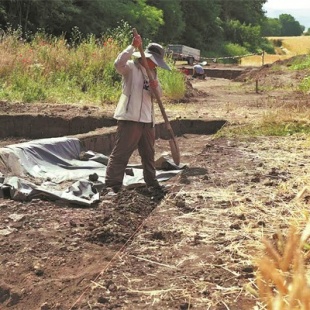
Since 2019, Chinese archaeologists have extended their research beyond national borders to western Eurasia, collaborating with Romanian counterparts at the Dobrovat site near Iasi — a Cucuteni cultural settlement. I am honored to be part of this precious opportunity of academic exchange.
Our excavations revealed numerous burnt clay house foundations, ash pits, and pottery kilns alongside abundant ceramic, stone, and bone artifacts, including exquisite painted pottery fragments displaying motifs remarkably similar to those from Yangshao and Majiayao cultures. Beyond ceramic parallels, Cucuteni-Trypillia culture shares multiple characteristics with Yangshao and Majiayao cultures: mixed economies prioritizing dryland agriculture supplemented by hunting-gathering; relatively egalitarian social structures lacking pronounced stratification; and standardized settlement layouts featuring surrounding ditches and centripetal organization.
Current evidence identifies the Cucuteni-Trypillia people as Black Sea coastal dwellers who similarly built agricultural societies with exceptional emphasis on painted pottery craftsmanship, representing the developmental apex of western Eurasian prehistoric ceramic culture.
The synchronous sophistication and striking similarities between painted pottery cultures at opposite ends of Eurasia provoke profound contemplation. Moreover, as representatives of prehistoric agricultural civilizations in their respective regions, both cultural complexes experienced near-contemporaneous decline, followed by widespread population movements and social transformations that profoundly influenced subsequent regional development and cross-cultural interactions.
These parallels raise critical questions: Do they reflect convergent evolutionary paths where early humans in separate regions developed analogous survival strategies when confronting similar environmental conditions and agricultural resources? Do they suggest contacts and mutual influences between eastern and western Eurasian populations thousands of years ago? The answer may involve both factors. Prehistoric sheep, cattle, and wheat species found in China are generally recognized as originating from West Asia, while recent discoveries of 3,500-year-old millet (a Chinese-domesticated crop) at Romania's Dobrovat site provide reciprocal evidence of early Eurasian cultural exchange.
In the 21st century, under the frameworks of the Belt and Road Initiative and the vision of "a community with a shared future for mankind", examining the universal natures and particularities of global civilizations while exploring historical processes of cultural interaction and mutual enrichment carries not only academic significance but profound contemporary relevance. The comparative study of Yangshao, Majiayao and Cucuteni-Trypillia cultures exemplifies how prehistoric populations across vast distances developed brilliant civilizations through both independent innovation and cross-cultural fertilization, offering historical wisdom for modern civilization dialogues.
These archaeological revelations ultimately affirm that the diversity of human civilization constitutes our most precious shared heritage, while innovation, communication and mutual learning remain the fundamental drivers of social progress.
Guo Zhiwei is an associate researcher at the Institute of Archaeology, Chinese Academy of Social Sciences.