China hits back at US tariffs to defend rules-based trade









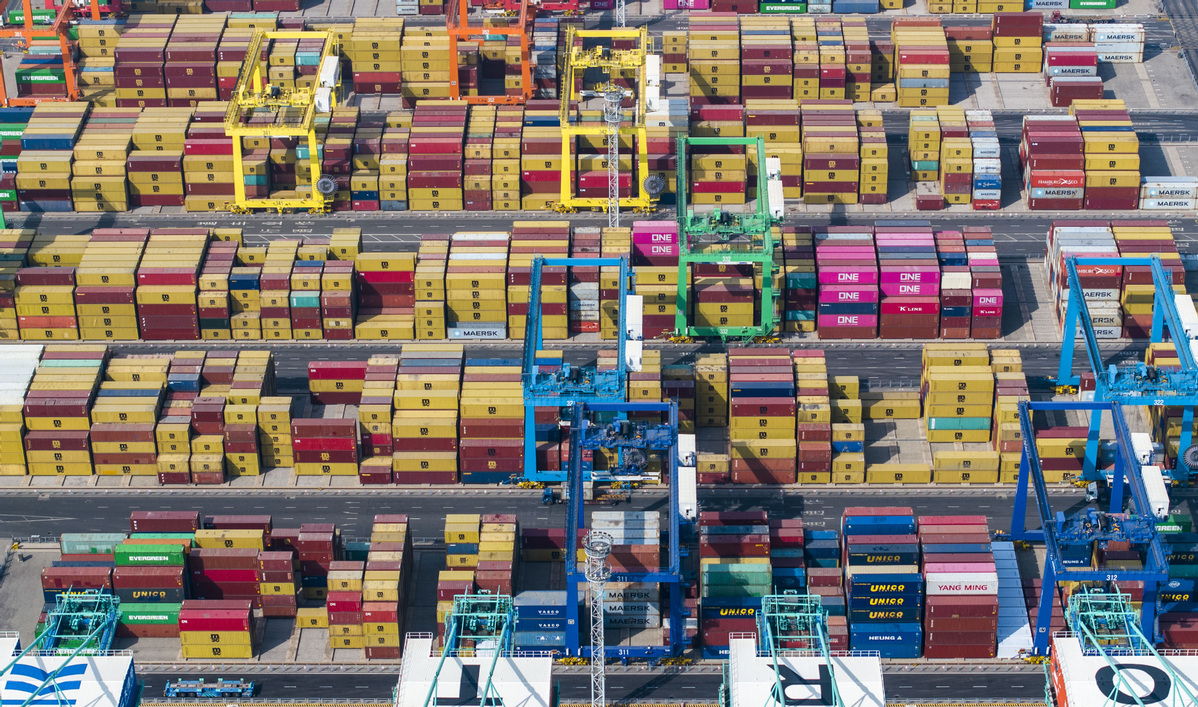
China will raise additional tariffs on all goods imported from the United States to 84 percent, starting at 12:01 am on Thursday, and has added 18 US entities to its export control and unreliable entity lists in order to counter the US' unilateral tariff hikes.
Analysts said the countermeasures send a clear message that China, the world's second-largest economy, is prepared to stand firm in defense of its legitimate interests and the rules-based multilateral trading system.
On Wednesday evening, the Ministry of Culture and Tourism and the Ministry of Education issued separate risk alert to tourists and students planning to go to the US.
Beijing's latest moves follow Washington's decision to increase its so-called "reciprocal tariffs" on Chinese goods to 84 percent, bringing the total additional tariffs imposed by the current Trump administration to 104 percent.
The Customs Tariff Commission of the State Council, China's Cabinet, said in a statement on Wednesday that the US' decision to increase tariffs on Chinese goods is "a mistake upon a mistake".
The US' tariff hikes, which severely infringe on China's legitimate rights and interests, damage the rules-based multilateral trading system and destabilize the global economic order, are "a clear example of unilateralism, protectionism and economic coercion", the commission said.
Also on Wednesday, the Ministry of Commerce announced that it has included 12 more US entities, including American Photonics and BRINC Drones, on China's export control list, thereby effectively banning the export of dual-use items — goods that can be used for both civilian and military purposes — from China to these entities.
The ministry said it has also added six more US companies, including Shield AI and Cyberlux Corp, to China's unreliable entity list. It means these companies are banned from trading or investing in the country.
Furthermore, China has filed a complaint with the World Trade Organization over the latest US tariff hikes, the ministry added.
Guo Kai, executive president of CF40 Institute, a research center affiliated with the think tank China Finance 40 Forum, said Beijing's strong countermeasures have proved that Washington's expectations of China succumbing to the pressure of US tariffs were miscalculated.
It may take some time, but Beijing's firm stand to "fight until the end" will make Washington realize that it underestimated China's endurance to tariffs, Guo said, underscoring that the realization would eventually bring the US back to the negotiation table.
"And when that time comes, it (the negotiation) will be on China's terms, not on the US' terms," Guo added.
Lin Meng, director of the modern supply chain research institute at the Chinese Academy of International Trade and Economic Cooperation in Beijing, noted that China's countermeasures reflect its firm opposition to US hegemony and underscore its commitment to upholding a fair, rules-based global trading system.
"This offers other countries a reference for defending their interests through multilateralism and reinforces the importance of a rules-based global trading system amid rising unilateral pressures," Lin said.
Li Haidong, a professor at China Foreign Affairs University's Institute of International Relations, said the White House is playing the tariff card to advance its domestic political agenda and secure gains in the upcoming midterm elections.
"Given that China is a staunch proponent of globalization, the Trump administration is escalating the 'tariff war' in an attempt to overturn the multilateral trading system of the past decades and recast it in a way that preserves the US' dominance and allows it to continue draining the rest of world," Li said.
However, global consulting firm PwC told China Daily that the US' "reciprocal tariff" policy may only encourage other countries to strengthen regional economic cooperation by establishing regional free trade zones and enhancing trade agreements, thereby reducing trade costs and improving supply chain stability.
Su Jian, a professor of economics at Peking University, said that for the next step, it is essential for Chinese companies to minimize related risk exposure by adjusting trade partner selection, managing order cycles, reassessing key supply chain interdependency, strengthening communication with US market partners, and preparing for future supply security and pricing mechanisms.