China deploys world's first three-satellite constellation on distant retrograde orbit









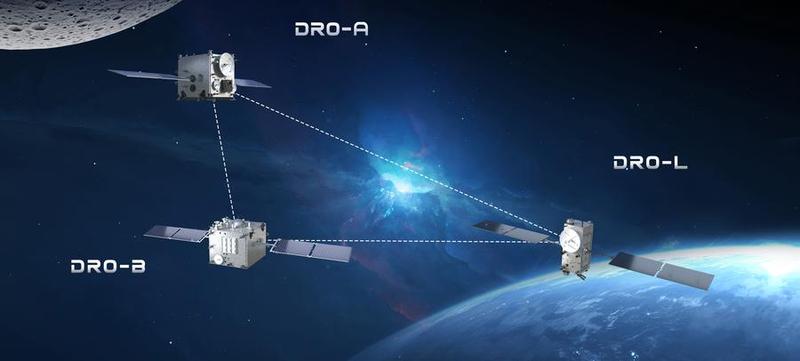
China has successfully deployed the world's first three-satellite constellation on the distant retrograde orbit (DRO) of the Earth-Moon system, marking a milestone in the country's deep-space exploration capabilities, scientists announced at an academic symposium in Beijing on Monday.
The DRO-A/B satellites, developed under the Chinese Academy of Sciences' (CAS) priority research program "DRO Exploration", recently linked with the previously launched DRO-L satellite in low-Earth orbit, forming an interconnected network after a journey of 8.5 million kilometers, according to the Technology and Engineering Center for Space Utilization (CSU).
"The achievement positions China at the forefront of DRO utilization — a strategic orbital region considered a 'natural spaceport' for future lunar and deep-space missions," said Wang Wenbin, a CAS researcher and chief architect of the program at the CSU.
"DRO's unique position allows spacecraft to enter Earth-Moon space with minimal energy expenditure while maintaining stable positioning and full-domain accessibility," he said.
"This three-satellite system lays crucial infrastructure for maintaining continuous human activities in the Earth-Moon sphere," Wang said.
Important activities could include building future lunar bases, deep-space observatories and interplanetary mission support stations, he added.
"The constellation provides essential navigation, communication and logistical support — much like building harbors and supply depots along new maritime routes during the Age of Exploration," he said.
The program overcame significant technical challenges, including an upper-stage rocket anomaly during the launch of DRO-A/B in March last year. Engineers executed multiple emergency orbital adjustments over four months to salvage the mission.
"Our low-energy transfer strategy, exchanging extended flight time for fuel efficiency, enabled successful orbital insertion using just 20 percent of traditional fuel consumption," explained Zhang Jun, chief engineer at the Innovation Academy for Microsatellites, CAS.
Cutting-edge innovations were validated through the constellation, including the world's first K-band inter-satellite communication across 1.17 million kilometers and a novel satellite-to-satellite-tracking orbital determination system.
"Our space-based navigation method achieves the equivalent precision of two days of ground tracking with just three hours of inter-satellite data," Wang said.
Since achieving full operation in late August, the constellation has conducted multiple scientific experiments demonstrating DRO's potential as a staging point for lunar bases, deep-space observatories and interplanetary missions, according to the CSU.
Wang Qiang, deputy director of CSU, emphasized that the breakthroughs "fundamentally transform our approach to cislunar infrastructure, dramatically lowering access barriers for sustained space exploration."
The CAS initiative, launched in 2022, builds on six years of preliminary DRO research dating to 2017. With CSU overseeing payload development and ground systems, and the Beijing Aerospace Control Center managing flight operations, the program exemplifies China's systematic approach to securing leadership in next-generation space technologies.





- Nobel laureate in chemistry: Give young scientists more independence
- Are Asians really better at math?
- How to navigate the potential competition engendered by AI?
- Xi to attend opening ceremony of National Games, declare Games open
- Rare bird spotted for second time in Hainan county
- Deep-sea AI tool powers up marine research, poised for global use