Researchers develop flash memory device









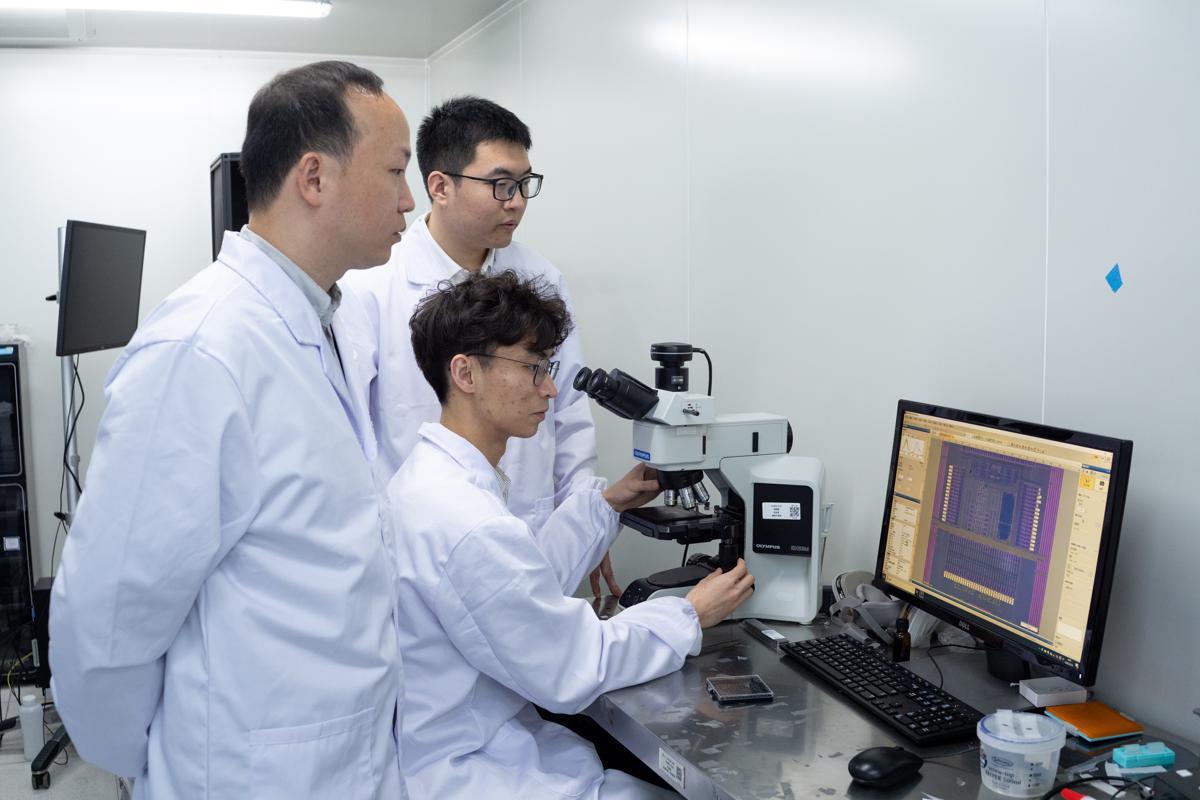
Researchers from Shanghai-based Fudan University have developed a picosecond-level flash memory device with an unprecedented program speed of 400 picoseconds, equivalent to operating 25 billion times per second, shattering the existing speed limits in information storage.
It became the fastest semiconductor charge storage device currently known to humanity, and scientists said such a breakthrough will have important application values to assist the ultra-fast operation of large artificial intelligence models.
"This is like the device can work 1 billion times in the blink of an eye, while a U disk (a hard drive in USB form) can only work 1,000 times. The previous world record for similar technology was 2 million," said Zhou Peng, a researcher from Fudan University's State Key Laboratory of Integrated Chips and Systems and a leading scientist on the research team.
A paper about their research on the flash memory device named PoX was published on the website of the journal Nature on Wednesday.
The speed limit of information storage has long been a crucial fundamental scientific issue in the field of integrated circuits. Charge has been proven to be the optimal storage medium, capable of carrying vast amounts of data at remarkable speeds and reliability, laying the foundation for the prosperity of the information age.
However, with the advent of the AI era, the paradigm of computing is shifting towards data-driven models, requiring a breakthrough in storage technology to meet the high computational power and energy efficiency demands.
Because of the computing power and energy efficiency requirements required for AI computing, the speed of information access directly determines the upper limit of computing power, and non-volatile storage technology has become the key to achieving ultra-low power consumption. Therefore, the breakthrough lies in overcoming the limit of non-volatile access speed, said researchers.
Today's fastest memories are volatile, such as static random access memory (SRAM) and dynamic random access memory (DRAM). The speed limit of such types of memories is about three times the transistor switching time, which is less than 1 nanosecond. However, the data loss after the power failure of such memories limits their application in low-power scenarios.
In contrast, although non-volatile memory represented by flash memory has the advantage of extremely low power consumption, it is difficult to meet the needs of AI computing for extremely high-speed data access because its electric-field-assisted program speed is much lower than the switching speed of transistors, scientists explained.
Based on innovative device physics mechanisms, the Fudan University team has been dedicated to the research and development of high-speed, non-volatile flash memory technology.
By combining the two-dimensional Dirac band structure and the ballistic transport characteristics, and modulating the Gaussian length of the two-dimensional channel, the researchers realized the super-injection of channel charge into the storage layer.
"The traditional injection behavior has an injection extreme point, while the super-injection is an infinite injection. The two-dimensional super-injection mechanism pushed the non-volatile memory speed to its theoretical limit, redefining the boundaries of existing storage technologies," said Liu Chunsen, another researcher on the team.
Known for its cost-effectiveness and widespread application, flash memory has always been a cornerstone of technological strategies for international tech giants.
"Our technology breakthrough is expected to not only reshape the global storage technology landscape, drive industrial upgrades, and foster new application scenarios, but also provide robust support for China to lead in relevant fields," said Zhou.





- World's longest expressway tunnel opens to traffic in Xinjiang by year-end
- Xinjiang opens world's longest expressway tunnel
- Beijing's Tongzhou Railway Station to open Dec 30
- Frozen Yellow River waterfall captivates tourists
- Sixth-gen clay figurine heir focuses on spirit over color
- China's high-speed rail mileage tops 50,000 km