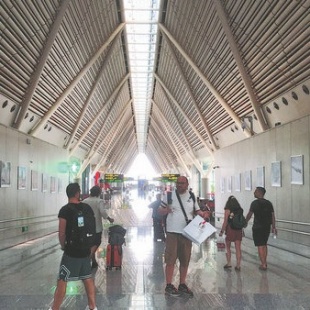



Flying display of cultural ties at Siem Reap's airport









Animal images play significant roles in every civilization. In Cambodia, the Naga, a snake deity shared by Hinduism, Buddhism and Jainism, is seen as the guardian of national prosperity, and symbolizes auspiciousness and peace. In Yunnan province just across the border, cattle enjoyed similar cultural connotations of prosperity and wealth during the Dian kingdom, which existed from the Warring States Period (475-221 BC) to the Han Dynasty (206 BC-AD 220).
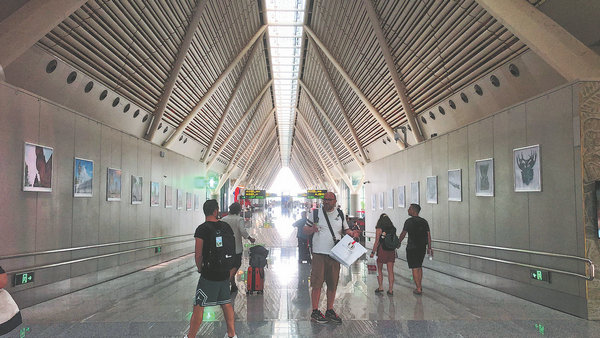
An ongoing exhibition by the Yunnan International Communication Center for South and Southeast Asia and the Yunnan Provincial Museum in Cambodia's Siem Reap Angkor International Airport's China-Cambodia cultural corridor shines a light on the two symbolic animals through 70 photos and 55 items of handicrafts, highlighting a link between Yunnan and Cambodia.
The photos are of artifacts and folk customs, and the handicrafts include replicas of artifacts and the cultural and creative products derived from them.
According to Zhang Ruogu, deputy director of the Yunnan International Communication Center for South and Southeast Asia, the display not only highlights the beauty of Dian bronze culture in Yunnan, but also the beauty of ancient Cambodian civilization.
"Through the two elements of the auspicious cattle and the spirit snake, the exhibition explores the spiritual beliefs associated with them and illustrates the rich history and culture of Yunnan and Cambodia to passengers using the airport," says Zhang.
He adds that the cultures of parts of Southeast Asia and Yunnan are closely connected, laying a foundation for dialogue and understanding.
"China and Cambodia share close geographical proximity and cultural affinity. From the Maritime Silk Road facilitating trade exchange, to Ming Dynasty (1368-1644) Admiral Zheng He's seven voyages (during which he landed in present-day Cambodia), the two countries have a deep friendship cultivated over millennia that exemplifies cultural exchange," he says.
Guo Jia, director of the research and exchange department at the Yunnan Provincial Museum, says one of the highlights of the exhibition is a replica bronze animal ritual vessel, one of the museum's most famous exhibits, which is believed to have been used for sacrifices.
The vessel is in the form of a large cow, its tail in the grip of a tiger, with a baby cow beneath its belly. It appears to depict a mother cow protecting its calf from attack. "The shape illuminates the ancient Dian people's concepts of life and death and their mastery of advanced bronze casting techniques," says Guo.
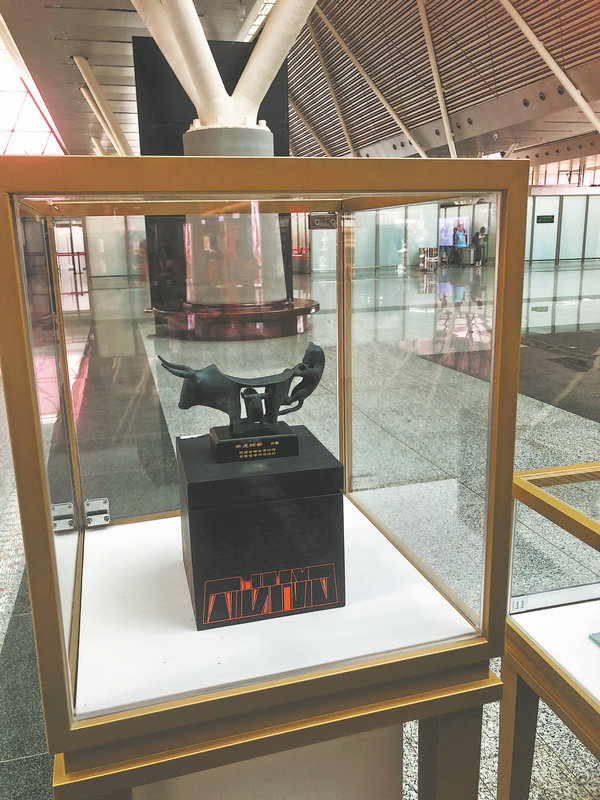
She adds that as important source of labor in farming, the Dian viewed cattle as symbols of family wealth. Appearing often on Dian bronzes, they are viewed as symbols of Yunnan's Bronze Age civilization and this artifact is an outstanding example.
Likewise in Cambodia, a nation rooted in agriculture, cattle enjoy prominence. They play essential roles in Buddhist culture, and prominently feature on artifacts and in everyday life.
Snake patterns can be seen at most temples in Cambodia, while the Dian also used snake depiction on their artifacts.
Siem Reap is famous for the Angkor Wat temple complex, and the Cambodian artifacts on display, including wooden carvings, Buddhist statues and lacquerware, are mostly related to the site.
"Through the exhibition we are showing the connections and comparisons between the culture around snakes and cattle in Yunnan and Cambodia," says Zhang.
The China-Cambodia cultural corridor is located in the international arrival and departure areas of the airport, which was put into use in August last year. From Aug 1 to Jan 31, the corridor received more than 780,000 visits, according to Yang Shaokai, general manager of Yunnan Airinvestment (Cambodia) Airport Management, which runs the airport.
Neth Pheaktra, Cambodia's Minister of Information, says the airport "is the first gate through which international passengers enter Siem Reap". He believes the exhibition will surprise and inform tourists from around the world.