


Subtle insights add to classic tale's appeal
La Traviata production gives audiences a more intense and intimate experience, Chen Nan reports.









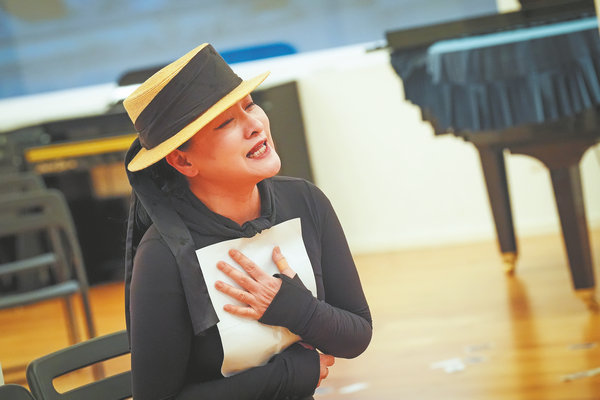
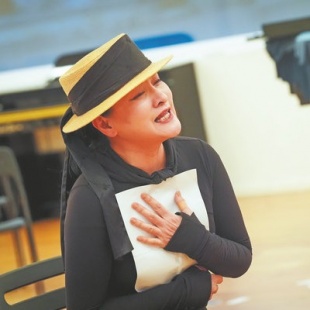
In 1992, a year after joining the China National Opera House, Chinese soprano Yao Hong took on her first leading role as Violetta in Giuseppe Verdi's La Traviata. The heroine of this classic opera — a Parisian courtesan who is beautiful, passionate, and independent, living a luxurious yet emotionally detached life surrounded by wealthy admirers — has become one of Yao's most frequently performed roles.
Over the past three decades, Yao has played Violetta 79 times.
"Almost every year, I perform as Violetta, and she continues to inspire me," Yao says.
On Friday and Saturday, the 57-year-old soprano will once again take on the role for the 80th and 81st times in Beijing, in a new adaptation of La Traviata, which she is directing herself.
This version, in contrast to the large-scale productions Yao typically performs in, will feature a smaller cast — just six opera singers — and simpler sets.
Yao's vision is to make opera more accessible in terms of cost, logistics, and intimacy.
"This production will allow more people to enjoy opera and make it easier to tour nationally," she explains.
"One of the biggest challenges for opera is its elitist reputation — the perception that it's an expensive, inaccessible art form reserved for a specific class," Yao adds. "Smaller productions, using fewer resources, help break down this barrier. By bringing opera into more intimate settings like small theaters, we can reach a broader audience, allowing them to experience opera without the intimidation of large, extravagant productions.
"When you strip away the grandiose aspects of a classic opera, such as massive orchestras and complex sets, the core of the piece — the music, emotions and characters — often comes into sharper focus," she says. "Without the distractions of a large stage or intricate visuals, the raw emotion conveyed by the singers and the music takes center stage. This leads to a more intense and personal experience for the audience."
Born in Shenyang, Liaoning province, Yao graduated from the Central Conservatory of Music in Beijing in 1991.
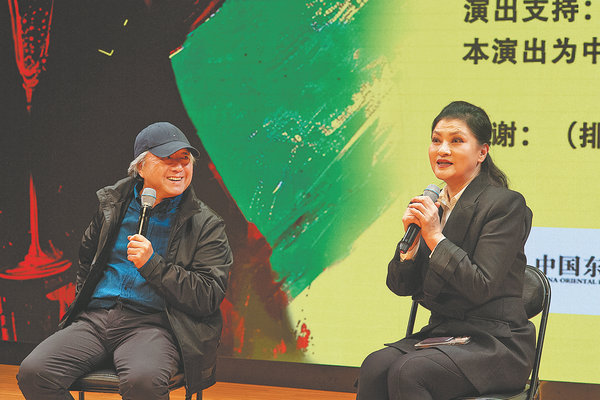
Yao's husband, renowned stage designer Gao Guangjian, has adopted a minimalist and abstract design concept for the production. Through simple stage sets and props, he aims to spark the audience's imagination.
According to Gao, two frames — one large and one small — are suspended at varying heights on the stage. These frames can serve as doors, windows or mirrors, dividing the stage into different spaces. This design not only enhances the flexibility of the stage but encourages the audience to engage actively with the imaginative aspects of the drama.
"We place great importance on layered lighting and highly saturated colors to facilitate scene transitions and subtly depict the emotional changes within Violetta, deepening the visual impact of the stage," says Gao, the former director of set design at the National Centre for the Performing Arts.
Gao is also known for working on the 1998 production of Giacomo Puccini's Turandot at the Forbidden City in Beijing, directed by Chinese filmmaker Zhang Yimou.
"The connection between theaters and their audiences is a dynamic, symbiotic relationship that plays a crucial role in the success of a performance," Gao explains. "It goes beyond the simple act of watching a show; it's an exchange of energy, emotions and experiences between the performers and the audience. The sense of intimacy that small venues create is unique, and it can be particularly attractive to people who have never experienced opera before."
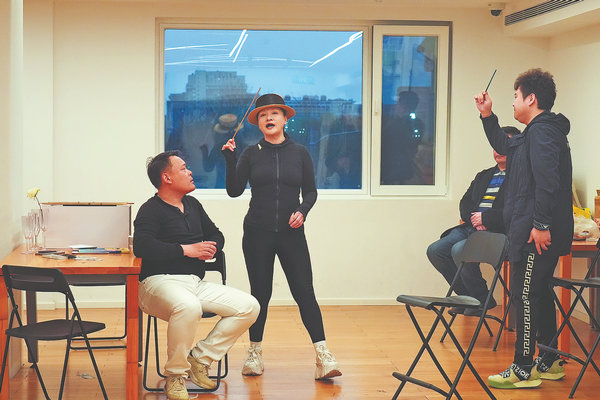
What inspired Yao to adapt Verdi's La Traviata for a smaller production was a concert she gave earlier this year in Beijing's Sanlitun, a vibrant commercial district. Unlike the vast theaters with capacities of over 1,000 seats, she enjoyed the immersive experience of performing in a venue with hundreds of seats.
"It was more like a salon-style concert. With a simple yet elegant stage design and lighting, a piano, no chorus, and just three singers performing intimately among the audience. The experience was completely different from anything I had done in my career," recalls Yao.
After the show, the enthusiastic praise and encouragement from her friends inspired her to explore the idea of staging an opera in a smaller venue.
After researching smaller theaters in Beijing and Shanghai, she decided to present her version of La Traviata at the Shijingshan Cultural Center, which has fewer than 400 seats.
Yao also chose La Traviata for its broad popularity with Chinese audiences and her personal connection to the opera. In 1956, La Traviata was staged at Beijing's Tianqiao Theatre, becoming one of the first foreign classical operas introduced to China.
"At the heart of La Traviata is a deeply human story: love, sacrifice, societal pressure, and tragedy. It speaks to the struggle between personal happiness and societal expectations, a theme that resonates across cultures and time periods," Yao says.
For the upcoming performances, five Chinese opera singers will join Yao, including tenor Xue Haoyin, baritone Sun Li and baritone Zhang Peng.
"Even with a simplified setting, the core of the piece remains intact. It's still Verdi's La Traviata — the same plot, the same music," Yao says.
"While the number of cast members may be smaller, the vocal demands for the roles don't change. You still need exceptional voices," she adds.