AI reshaping hardware while creating growth opportunities, challenges









BEIJING — China, once deemed "factory of the world" for churning out low-cost products and serving as a contract manufacturing hub for multinational brands, is now seeing its consumer electronics enterprises ride the AI wave to move up the value chain and cash in on the high-end market.
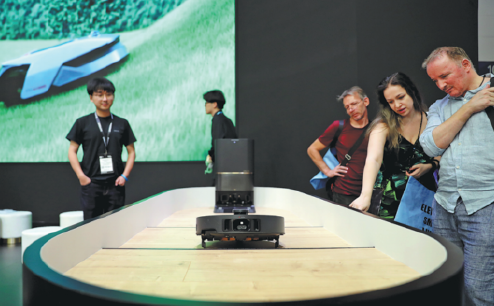
Among the rising stars is Dreame Technology, known as a leading manufacturer of smart vacuum cleaners. The company, based in Suzhou, Jiangsu province, is now expanding into the broader home appliances market. Founded in 2015, the company sold 3.96 million robotic vacuum cleaners last year, a year-on-year growth of nearly 60 percent, with its products reaching over 100 countries and regions.
At a product launch event in March, Dreame unveiled 11 new products, including its first AI-powered windowcleaning robot. Among the standout innovations was a robotic vacuum featuring a bionic, multi-joint arm capable of extending up to 33 centimeters and cleaning narrow spaces with the help of cleaning tools. Another notable feature is its ability to automatically change mop cloths, allowing for dedicated mopping in specific zones.
Dreame's latest robotic vacuum cleaners integrate DeepSeek to enable smart voice interaction. The company's AI model can recognize more than 200 types of obstacles, enabling its robotic vacuums with the latest generation of robotic arms to perform tasks such as tidying up obstacles and trash on the floor.
"AI technology can make the vacuum cleaners think more like humans," said Meng Jia, president of Dreame's robotic vacuum business. "Embodied AI will pave the way for the introduction of home service robots."
Meng said Dreame could make home service robots with robotic arms and wheels for feet to step over common doorsills as early as next year, with the potential for humanoid robots to be capable of climbing stairs in the future.
Algorithms and computing power are important, he explained. "For products that can tidy up rooms, offer emotional companionship, or assist in caring for children and the elderly, we need to harness AI and develop related software," Meng said.
Dreame's focus on research and development has been crucial to its rise, with research staff comprising 60 percent of its workforce. Moreover, R&D spending accounts for 7 percent of its total revenue, significantly higher than that of traditional home appliance makers.
To tap the premium segment, Dreame has introduced large smart home appliances and smart kitchen solutions. It plans to leverage its global resource advantages to increase sales of smart home appliances.
"Technological innovations and the development of product functions according to the usage habits of local consumers are key to penetrating the market," Meng said.
Indeed, Chinese enterprises are moving toward high-end development, boosted by the country's eye-catching achievements in the global technology and innovation-driven fields, said Gary Cai, head of the macroeconomic research institute of KPMG China research center.
MiMouse Technology, a startup established in 2015 in Hefei, Anhui province, serves as yet another outstanding example of how Chinese consumer electronics enterprises are leveraging AI to transform traditional hardware.
Within a year of its launch, MiMouse developed a smart voice mouse with a speech recognition speed of 400 words per minute and an accuracy rate of 98 percent.
"In the beginning, we wanted to help people with typing difficulties. Later, we added machine translation and then smart writing features powered by large language models," said Feng Haihong, founder of MiMouse. Since 2015, the company has rolled out nearly 200 major updates to improve functionality and user experience.
In 2023, MiMouse launched its first smart mouse powered by a large language model. Leveraging major AI models like DeepSeek and ChatGPT, the smart mouse allows users to create PowerPoint presentations, articles, code, poems and more using simple voice commands.
Over 100,000 units were sold within one month of its launch and has consistently topped the sales charts on China's leading e-commerce platforms.
"The AI era is reshaping hardware, bringing growth opportunities and challenges," said Feng, noting that the company has doubled its R&D investment to more than 20 million yuan ($2.74 million) annually.
The company sold more than 400,000 AI mice in 2024, hitting a sales revenue of nearly 100 million yuan. A proportion of sales came from overseas markets, including the United States, Japan and India. In February this year, the company received two orders from US customers totaling 10,000 units.
"Going global is now our key strategy," said Feng, adding that "China's competitive edge in consumer electronics comes from its strong R&D workforce and comprehensive supply chain, which enables better products at lower costs."
He said that the company has upgraded its software to support multiple languages and set up overseas AI servers to improve user experience.
MiMouse also plans to expand its smart office lineup with new products, such as AI pens and transcription-enabled recording cards, aiming to integrate AI into everyday work and life.
To accelerate the adoption of smart, high-end home appliances in more households, Chinese policymakers have introduced a range of measures, including subsidies for trading in old appliances and green energy-saving consumption vouchers, to lower the barrier of accessing premium products.
A recent trade-in campaign organized by the China Household Electrical Appliances Association focused on smart products equipped with AI technology, covering cutting-edge categories such as smart refrigerators, self-adaptive air conditioners and kitchen appliances with AI voice interaction, said Zhao Jie, vice-president of the association.
"The campaign is expected to unleash consumption potential worth over 100 billion yuan, drive industrial upgrading through high-end supply, and facilitate China's manufacturing industry to transform from traditional manufacturing to smart manufacturing," Zhao said.
Xinhua




Today's Top News
- Manufacturing rebounds in December
- PLA wraps up military drills around Taiwan
- Ties with Russia expected to bear fruits
- Confidence, resolve mark China's New Year outlook
- Xi urges solid work for more progress
- Confidence, resolve mark China's New Year outlook: China Daily editorial