Latest tariffs to speed up nation's semiconductor innovation drive









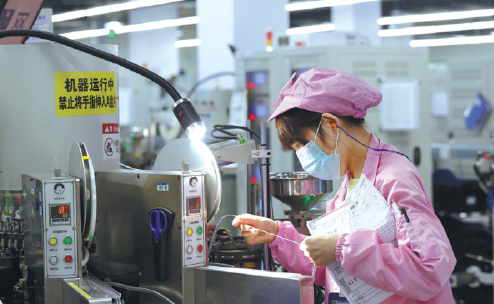
While the broader economic fallout of the US tariff policies remains uncertain, China's semiconductor industry is poised to emerge stronger in the long run, particularly in upstream sectors like chip equipment and components, despite short-term disruptions, analysts said.
Highlighting China's steady progress in chips for smartphones, artificial intelligence and automobiles, they said Washington's bullying tariffs and increasingly tightened chip restrictions will motivate Chinese companies to double down on research and development to achieve tech breakthroughs and even build semiconductor supply chains independent of US technologies.
Jack Gold, principal analyst at the consulting company J.Gold Associates, said "What's actually happening is that the US government right now is handing China a big win as it tries to get their own chip business going."
Once Chinese companies are competitive, they'll start selling around the world and people will buy their chips, Gold added.
The comments came after US chip companies Nvidia and AMD said they need to follow new US licensing requirements for semiconductors exported to China earlier this month.
Nvidia anticipates that the new regulations will lead to a $5.5 billion financial hit, while AMD estimates the rules could reduce its earnings by as much as $800 million, as reported in filings submitted to the US Securities and Exchange Commission.
Nvidia CEO Jensen Huang also acknowledged, during his trip to Beijing last week, that there are significant business impacts from the tightened US chip export controls.
In the shadow of US export restrictions on Nvidia chips, Chinese tech companies are expanding their cooperation with Huawei Technologies Co Ltd to use the latter's AI chips for training of large language models.
iFlytek, for instance, said on Sunday that its proprietary deep reasoning model Spark X1 is the industry's only large language model trained entirely on China's domestic computational infrastructure.
iFlytek said it is partnering with Huawei's AI chip research team to create better domestic computing solutions for AI training, and that Spark X1 demonstrates significant improvements across general AI tasks, including mathematics, coding, logical reasoning, text generation, language understanding and knowledge-based Q&A.
Semiconductor research company ICwise said in a report that Washington's tariffs could accelerate China's shift toward non-US chips, squeezing US players.
"China's mature-node semiconductors, meaning chip-processing technology using 28 nanometers and above, are already competing with US rivals in automotive micro control units, power devices, memory chips and mid-to-low-end chips. While these products primarily target cost-sensitive markets, tariffs could amplify their price advantages, hastening the displacement of US components," ICwise added.
Meanwhile, China's semiconductor exports to the US are minimal, insulating the sector from immediate tariff shocks. This structural resilience allows Chinese firms to focus on import substitution rather than scrambling to mitigate export losses, ICwise said.
Xiang Ligang, director-general of the Zhongguancun Modern Information Consumer Application Industry Technology Alliance, a telecom industry association, said, "China's semiconductor industry, tempered by years of US sanctions, now boasts a near-complete supply chain."
"Previous restrictions ironically catalyzed China's progress in chips. The latest tariffs may similarly drive upgrades, particularly in high-value upstream segments like lithography machines and specialty chemicals. While short-term disruptions are inevitable, the sector's strategic focus could transform external pressure into a catalyst for innovation," Xiang added.
Wei Shaojun, president of the integrated circuit design branch of the China Semiconductor Industry Association, said: "The more others suppress us, the more we need to be self-reliant. But self-reliance does not mean self-isolation. It is about finding ways to break the containment."
"China needs to promote the re-globalization of the semiconductor industry by achieving self-reliance in crucial technologies as well as by teaming up with countries and enterprises that are willing to cooperate," said Wei.



Today's Top News
- Confidence, resolve mark China's New Year outlook: China Daily editorial
- Key quotes from President Xi's 2026 New Year Address
- Full text: Chinese President Xi Jinping's 2026 New Year message
- Poll findings indicate Taiwan people's 'strong dissatisfaction' with DPP authorities
- Xi emphasizes strong start for 15th Five-Year Plan period
- PLA drills a stern warning to 'Taiwan independence' separatist forces, external interference: spokesperson