Joint venture debunks theories about universe









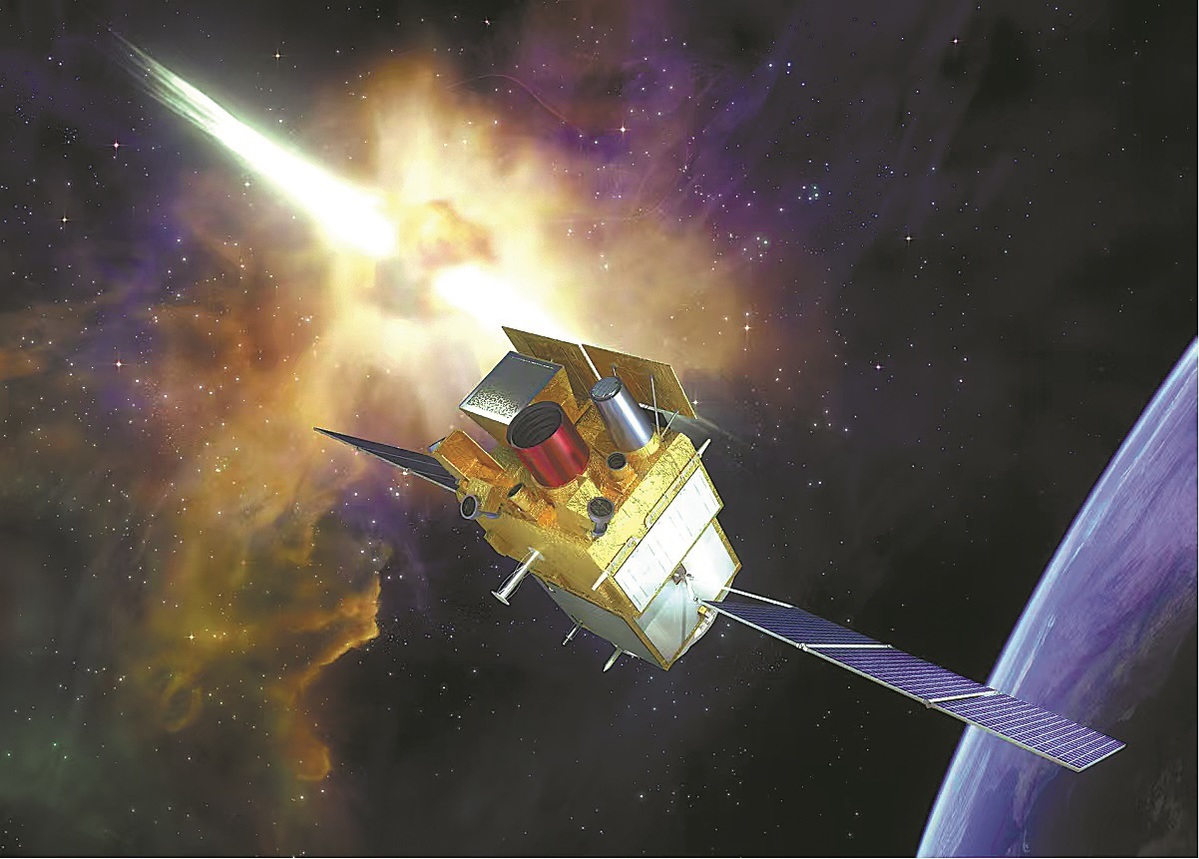
A cutting-edge astronomical satellite jointly developed by Chinese and French scientists has captured the attention of the global scientific community with groundbreaking discoveries, just 10 months after entering orbit.
The Space-based Multi-band Variable Object Monitor, or SVOM, unveiled its initial scientific achievements during China's 10th Space Day celebration in Shanghai, marking a major step forward in the study of gamma-ray bursts — the most violent explosions in the universe since the Big Bang. These bursts occur during the collapse of massive stars or the merger of compact stellar remnants such as neutron stars and black holes.
Launched on June 22, 2024, after nearly two decades of collaboration between the China National Space Administration and France's National Center for Space Studies, SVOM has already detected more than 100 gamma-ray bursts. The results affirm the satellite's status as the most powerful "gamma-ray burst catcher" in the world.
Among its most notable findings is GRB250314A, a gamma-ray burst originating from just 730 million years after the birth of the universe — about 13 billion years ago. Scientists believe it may have been caused by the collapse of one of the universe's earliest stars into a black hole or neutron star, offering valuable clues about the cosmic dawn.
SVOM also observed GRB241105A, now considered the most distant short-duration gamma-ray burst ever recorded, highlighting the satellite's unprecedented capabilities.
"These discoveries not only affirm the exceptional performance of the satellite, but also offer a fresh perspective on exploring topics such as the formation of early stars and the genesis of black holes," said Wei Jianyan, SVOM's principal investigator on the Chinese team and a researcher at the National Astronomical Observatories of the Chinese Academy of Sciences.
Wei said SVOM has also enabled the discovery of several peculiar gamma-ray bursts, posing new challenges to established theories in high-energy astrophysics.
Bertrand Cordier, principal investigator for the French team, emphasized the satellite's sensitivity to rich X-ray gamma-ray bursts, which were previously difficult to detect, thus expanding the scientific frontier in the field.
The SVOM project, launched in 2005, has brought together scientists and engineers from institutions including the Research Institute in Astrophysics and Planetology in Toulouse, France, the Institute of High Energy Physics in Beijing and Xi'an Institute of Optics and Precision Mechanics in Shaanxi province.
Weighing 930 kilograms, the satellite was built by the Chinese Academy of Sciences' Innovation Academy for Microsatellites in Shanghai. It is equipped with four scientific payloads jointly developed by Chinese and French teams.
Zhang Yonghe, SVOM's project manager and a researcher at the academy, said the satellite is the centerpiece of a rapid, sophisticated observation system that connects with more than 40 ground communication stations worldwide. Once a gamma-ray burst is detected, the system can coordinate space and ground-based observations in less than 10 minutes.
"The system can relay observation commands to SVOM in the time it takes to enjoy a cup of coffee," Zhang said.
With a minimum operational life of three years, SVOM is expected to play a key role in advancing high-energy astrophysics. Scientists anticipate it will deepen understanding of how the first stars formed and died, clarify the mechanics behind black hole formation, identify electromagnetic counterparts to gravitational wave events and refine theories on the early evolution of the universe.
The satellite was officially handed over to the National Astronomical Observatories of the Chinese Academy of Sciences on Wednesday.
linshujuan@chinadaily.com.cn





- US defense policy act fuels Taiwan tensions
- New Year holiday to bring peak in travel
- China's top 10 sci-tech news events unveiled
- Over 700 generative AI large model products complete filing in China
- Beijing accuses Lai of 'kowtowing' to US
- Hong Kong's global standing boosted with increasing presence of intl organizations: justice secretary