China unveils new cargo spacecraft









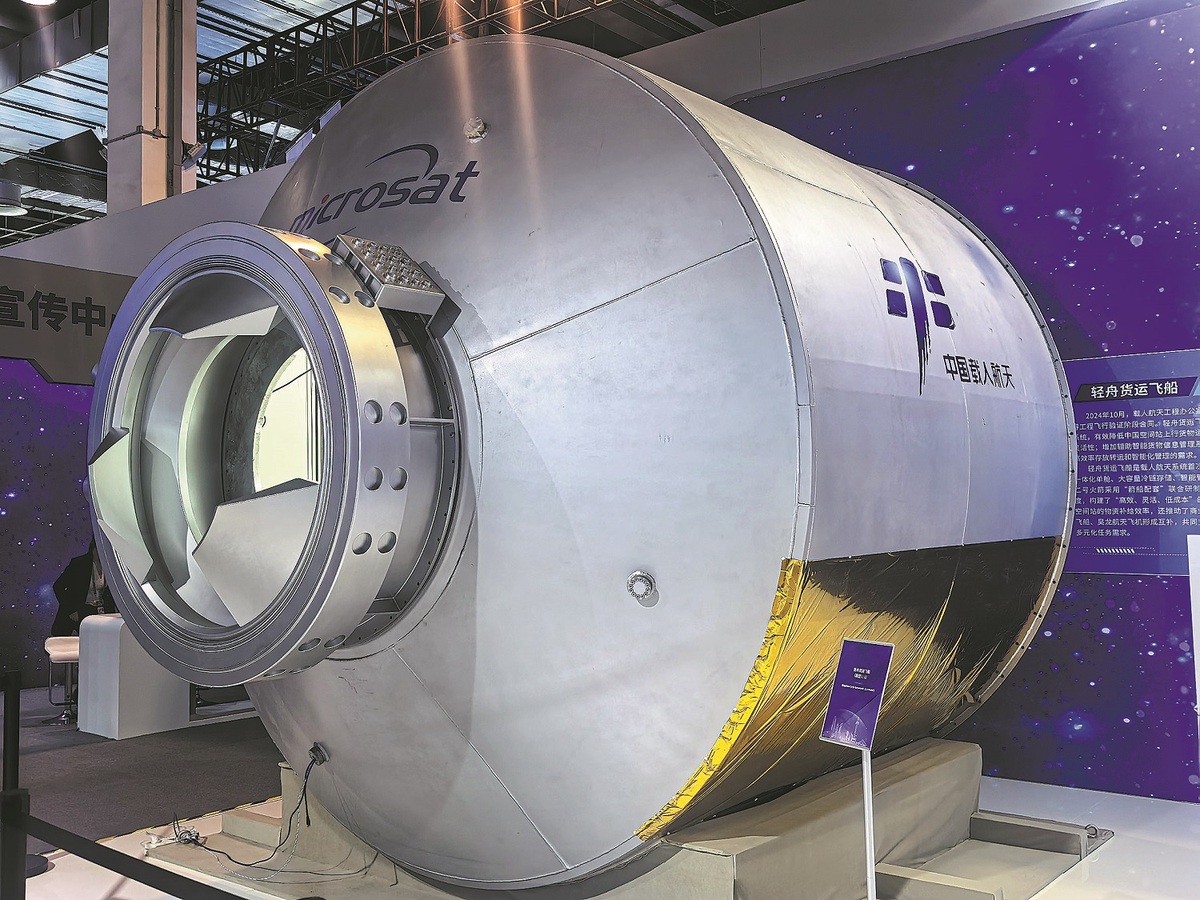
Qingzhou, China's next-generation cargo spacecraft designed for future in-orbit supply deliveries, including missions to China's Tiangong space station, took center stage in Shanghai this week as it made its public debut.
The unveiling of a life-size model of the spacecraft at an ongoing aerospace science exhibition at Shanghai World Expo Exhibition & Convention Center, served as part of the celebrations of this year's Space Day of China, which fell on Thursday.
Developed by the Innovation Academy for Microsatellites of the Chinese Academy of Sciences, Qingzhou is poised to embark on its maiden flight later this year, with the development team currently focused on finalizing the spacecraft's design and software for the initial test phase. Production is already underway for the subsystems and components of the test spacecraft, as confirmed by Chang Liang, the spacecraft's chief designer.
Literally meaning "Light Ship" in Chinese, Qingzhou features an integrated single-capsule configuration with a cargo volume of 27 cubic meters and a capacity up to 2 metric tons. It is designed to transport scientific research and experimental equipment, various scientific payloads and living supplies for Chinese astronauts.
It features a four-tier shelving system with 40 compartments and interfaces for special cargo needs, ensuring it can meet various demands during missions.
Notably, it can transport up to 300 liters of cold-chain products, ensuring that astronauts have access to fresh produce during their space missions.
"Qingzhou is a swift and nimble spacecraft, following a design which is astronaut-centered, of low-cost, high-reliability, high-flexibility and high-intelligence," said Shu Rong, the commander of the Qingzhou project.
The cargo spacecraft incorporates intelligent payload schemes and designs to optimize cargo delivery, retrieval and handling processes for astronauts, he said.
In addition to servicing the Tiangong space station, Qingzhou aims to offer commercial cargo services in the future, with a focus on generating economic and social benefits, Shu added.
Chang emphasized that Qingzhou embraces commercial spaceflight concepts and technical approaches, highlighting the spacecraft's cost-effectiveness achieved through technological innovations and streamlined launch procedures.
At the design stage, Chang said, the development team studied cargo spacecraft, both domestically and internationally, including the US' SpaceX Dragon spacecraft, Europe's Automated Transfer Vehicle named Jules Verne, Japan's H-II Transfer Vehicle (HTV) known as Kounotori and China's Tianzhou series. Ultimately, based on the spatial requirements issued by the China Manned Space Agency, they independently designed and developed the compact, integrated Qingzhou cargo spacecraft.
"We've opted for an integrated single-capsule design for greater flexibility in launch vehicle selection, making it compatible with multiple rocket types and supporting rapid launch needs," Chang said.
For its maiden flight, Qingzhou will launch aboard Lijian-2, a reusable rocket developed by CAS Space, a commercial spaceflight company under the Chinese Academy of Sciences.
China's commercial aerospace sector saw rapid development in 2024, with the Qingzhou cargo spacecraft being selected as one of two winners in the China Manned Space Agency's solicitation for a low-cost cargo transportation system. The Haoloong space cargo shuttle, a reusable cargo spaceplane designed by Chengdu Aircraft Design and Research Institute in Sichuan province, was the other winner.
"Qingzhou represents a milestone in the commercial development of China's manned space program," Chang said. "The flexibility of commercial aerospace, its cost control, and its pursuit of innovation are inherent advantages that will effectively strengthen China's overall space capabilities."
linshujuan@chinadaily.com.cn



- Mainland slams recent Japanese govt statement on Taiwan
- Former vice-education minister sentenced to 15 years for bribery
- China urges Japan to punish perpetrators of attack on Taiwan compatriots
- New soccer pitch inspires girls at Ningxia primary school
- The wall of silver cups: A tribute to courage and gratitude
- Chinese scientists develop artificial tongue to measure spiciness