Master the art down to a tea










Everyday etiquette
In 2022, China's traditional tea-processing techniques and associated social practices were added to UNESCO's Representative List of the Intangible Cultural Heritage of Humanity.
Since around the 3rd century, tea has been drunk in China, initially among the upper class as an elegant spiritual enjoyment and art, and later becoming popular in the Ming Dynasty (1368-1644) as Emperor Zhu Yuanzhang reformed the method to make tea.
The Dragon Well is said to have been discovered during the Three Kingdoms period (220-280), known as one of the three famous springs in the West Lake areas.
During the Tang Dynasty (618-907), tea cultivation around the West Lake in Hangzhou was mainly concentrated in the vicinity of Lingyin Temple and Tianzhu temples. At that time, monks in the temples cultivated tea on the nearby mountains for self-consumption and treating guests. Gradually, the tea ceremony transitioned from Buddhist rituals to everyday etiquette in the secular society.
In the Song Dynasty (960-1279), Lingyin Temple and Tianzhu temples remained the main tea-producing areas around the West Lake. At that time, several varieties of tea produced in the areas were widely praised, including the Baiyun tea from Shangtianzhu Baiyun Peak, a variety favored by Master Biancai, who served as the abbot at Shangtianzhu Temple.
At nearly 70 years old, Biancai retired to Dragon Well, bringing the Baiyun tea from Shangtianzhu Temple with him. Together with other monks and disciples, he planted tea bushes at the foot of Shifeng Mountain to meet the needs of the temple. The tea planted by Biancai was the precursor of Longjing tea, marking the beginning of a legendary tea story.
During the Yuan Dynasty (1271-1368), tea produced in the Dragon Well area began to appear in poetry. The line, "Drinking the tea made by boiling the golden buds ... one can hardly bear to rinse the mouth after swallowing three times", vividly depicts the lingering taste of the tea in poet Yu Ji's mouth.
In the Ming Dynasty, Longjing tea gradually became a commodity, whose fame was further expanded in the Qing Dynasty (1644-1911).
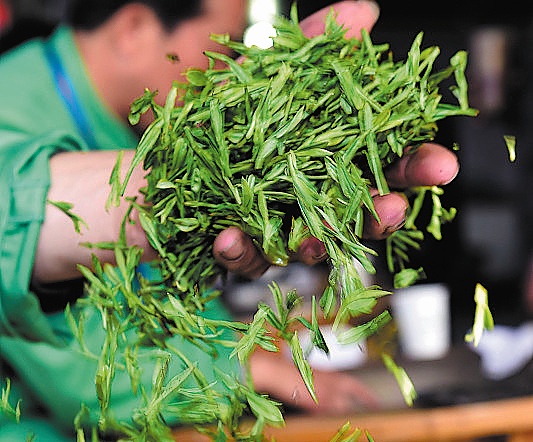
According to Fan, West Lake Longjing tea has four unique characteristics: sweet taste, beautiful appearance, green color and a rich fragrance reminiscent of orchids.
Fan and his team are currently working for 13 to 14 hours until 2 am every day to make sure that all the fresh tea leaves picked during the day complete the roasting process.
The period between the solar terms Clear and Bright (qing ming), falling usually on April 4 or 5, and Grain Rain (gu yu), 15 days later, is the busiest time of the year for tea production.