


Grottoes bear the enduring touch of Tang
Through the hands of artists and craftsmen, the world-famous caves become a mirror to the splendor of a glorious age in ancient China, Zhao Xu reports.









Almost anyone who visits the Mogao Caves in Dunhuang, Gansu province, finds themselves — quite literally — standing at the feet of a colossal 35.5-meter-high Buddha, carved from the region's iconic sandstone. Looking upward, visitors follow the gentle drape of his robe — its lower edge adorned with intricate dragon patterns, past the platform of his protruding knees where his lower arms rest, and up to his broad chest, softly folded chin, and tranquil visage. This awe-inspiring statue, which took 12 years to complete, stands as a silent testament to the power and ambition of one remarkable woman: Wu Zetian (624-705), the only female monarch to rule China.
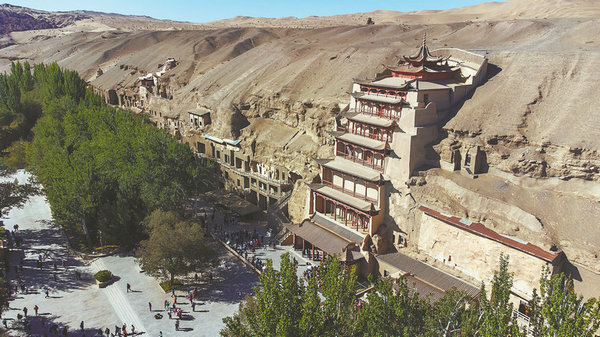
In 690, after seven years of wielding power behind the scenes, Wu boldly seized the throne for herself, deposing her own son. To cement her legitimacy, her supporters portrayed her as the living embodiment of Maitreya Buddha, believed to be the future Buddha of the world in all Buddhist traditions. Temples were erected, and grottoes carved in his honor, serving as powerful symbols of visual propaganda. Against this backdrop, the construction of the monumental Buddha began in 695.
According to the local tourism bureau, with its towering height, the statue is today the tallest in Dunhuang and the third-tallest of all stucco sitting Buddhas in China.
Many believe that Wu Zetian was as much a product of her own ambition and political acumen as she was of her time. She rose to power during the Tang Dynasty (618-907), a golden era in Chinese history noted for its cultural brilliance, military strength, and exceptional openness. The Tang empire's military prowess ensured the stability and security of the vast ancient Silk Road network, allowing trade and travel to flourish.
Dunhuang, a vital oasis along this route, thrived as a cosmopolitan hub where merchants, pilgrims, and envoys converged.
"It's no surprise that, although grotto carving in Dunhuang began in the mid-fourth century, it wasn't until the Tang Dynasty that large-scale, fervent construction truly took off," says Zhong Na, a senior on-site tour guide, referring to the fact that out of the 735 existing Buddhist caves in Dunhuang, 236 have been dated to the time of Tang. "Many of these caves were commissioned by individuals involved in Silk Road trade. For them, carving a grotto was an act of devotion — an offering to the Buddha in hopes of securing divine protection on the unpredictable and often perilous journeys they faced."
This collective endeavor — carried out by legions of artists and craftsmen, many likely trained in workshops in the Tang capital of Chang'an (modern-day Xi'an in Shaanxi province) — transformed Dunhuang's caves into a vivid, enduring photo book of the Tang Dynasty, preserving its splendor long after the glow of its prestige dimmed.
"We have every reason to believe that as the muralists brushed visions of paradise onto the plastered sandstone walls of Dunhuang, they were not only reaching for the celestial, but recalling the earthly splendor of Chang'an," says Zhong. "There, magnificent Buddhist temples rose amid the heady scent of incense — burned by the devout and brought there by Sogdian merchants, along with glittering jewels, exotic spices, and their spirited dances."
These wooden-structured temples found their way into the murals of Dunhuang, along with imperial canopies once used to shield emperors from the sun, ornate incense burners, and tree-shaped lampstands aglow with flickering candles. Such details, depicted on the walls of Cave 172 (all existing Dunhuang caves are numbered), have led some to speculate that the scene portrays Chang'an on the 15th day of the Chinese New Year, bathed in festival lights as it celebrated the Lantern Festival.