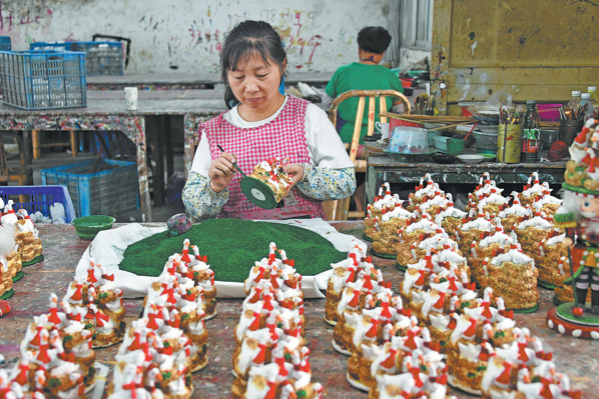
Trade unions' new role in tech revolution









This year marks the 100th anniversary of the founding of the All-China Federation of Trade Unions. On Monday, in his important speech to mark the anniversary on May 1, President Xi Jinping highlighted the need to comprehensively enhance the quality of the workforce amid the new round of technological revolution and industrial transformation.
What Xi pointed out is the right direction for the federation at a time when productive forces and the relations of production are undergoing profound changes. The federation is poised to make significant contributions to Chinese modernization by cultivating highly skilled workers and uniting workers under the leadership of the Communist Party of China.
As the main force of the working class in China, industrial workers are a pillar for promoting the innovation and application of new technologies. To accelerate industrial upgrading and enhance the core competitiveness of enterprises, efforts should be made to deepen reform of industrial workers and cultivate workers with new strengths.
In October, the central authorities issued a guideline to promote the reform and cultivation of first-class industrial technical workers, helping them cope with the challenges brought by the rapidly evolving new technologies and new business models. As a bridge between the Party and the working people, trade unions play a crucial role in employee education, among others.
In recent years, the federation has continuously promoted improvement in the quality of workers and their status to cultivate more master craftsmen and high-skilled workers. It has also organized talent training camps, helped build a system for schools that are training craftsmen across the nation, and built platforms specialized in imparting intelligent skills, boosting learning and broadening the channels of training.
In particular, with the rapid progress of the digital economy and prevalent smart-manufacturing, the federation attaches significant importance to improving the digital literacy and skills of industrial workers to proficiently use new intelligent tools and adapt to the progress of new quality productive forces.
Focusing on the upgrading of manufacturing, new technologies and the new occupations brought by them, the federation innovatively hosts professional skills competitions, selecting master craftsmen while supporting the progress of diligent youngsters, skilled workers and hard-working personnel.
Trade unions at all levels are also fully leveraging their strengths to organize skills competitions in various sectors or those related to particular positions, helping the participants share the benefits of competition. The Wenzhou Federation of Trade Unions in Zhejiang province has hosted skills competitions for five consecutive years, all aimed at improving the skills of employees.
Similarly, Beijing, Tianjin and Hebei province have jointly hosted contests focused on four categories — cybersecurity, new applications of blockchain technology, aerospace model processing and robotic system integration — to promote new quality productive forces. These contests encouraged a large number of workers to learn new skills and hone their abilities.
By organizing national, regional and sectoral competitions, trade unions at all levels are motivating enthusiasm and inspiring the innovation of workers. By focusing on digital empowerment, they help employees enhance their skills and optimize the classification and tiered development of talents.
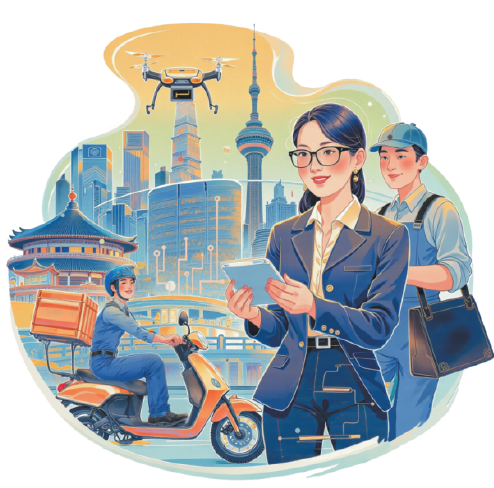
In addition to talent cultivation, trade unions are continually expanding their range of services. With new employment forms appearing with the rise of the platform economy, they aim to provide their services to those in the new sectors, such as food delivery riders and ride-hailing drivers, who are troubled by ambiguous employment relations with employers and the absence of social guarantees.
In order to help these employees register with trade unions, enjoy corresponding services, and safeguard their legitimate rights, the All-China Federation of Trade Unions has initiated a three-year action plan to urge more relevant enterprises to set up trade unions and provide services. The practice of Nanjing in Jiangsu province and Zhejiang province provides beneficial reference.
Nanjing has introduced digital methods to provide "collective and one-stop registration" for those with new labor relations, while Zhejiang is promoting the establishment of trade unions in emerging sectors, thereby expanding services for van drivers, livestreamers and household service providers, among others.
Once established, these trade unions should fulfill their functions, take advantage of their connections with the people and provide services and assistance centered around labor standards, collective consultation and collective contracts for workers in emerging employment forms.
Continual efforts have been made to build a rights protection system for these workers. Employers are encouraged to buy insurance policies for accidents or injuries their employees might suffer at work or to provide them medical assistance through trade unions. Platform enterprises are required to establish a consultation mechanism with trade unions and representatives of employees.
Take Alibaba Group's Ele.me, a food delivery giant in China, for example. Its trade union has established a comprehensive employee representative conference system to improve negotiation and coordination. The platform company also operates various dispute resolution methods, such as the trade union's labor law supervision committee, dispute mediation center and round table meetings.
These efforts continuously enrich mechanisms to prevent disputes at the source, comprehensively upgrade rider rights protection and promote mutual benefit between the company and the riders.
Local progress drives overall progress. With the ongoing advancement of trade unions nationwide, the protection of workers' rights will be strengthened, and their skills evolve with the development of the digital economy, driving new advancements contributing to Chinese modernization.
The views don't necessarily represent those of China Daily.
The author is a member of the Standing Committee of the Party Committee, China University of Labor Relations, vice-president of the same university, and dean of the School of Labor Union.



Today's Top News
- SOEs post stable revenue, profits in Jan-Nov
- First brew in Lhasa
- PLA fully capable of crushing secessionist attempts
- China holds central rural work conference
- President Xi to deliver New Year's message to ring in 2026
- Xi's diplomacy in 2025: Shedding light on a world at crossroads