High-tech facility in Huairou aids cutting-edge research
Split-second laser pulses create 'high-speed camera for the quantum realm'









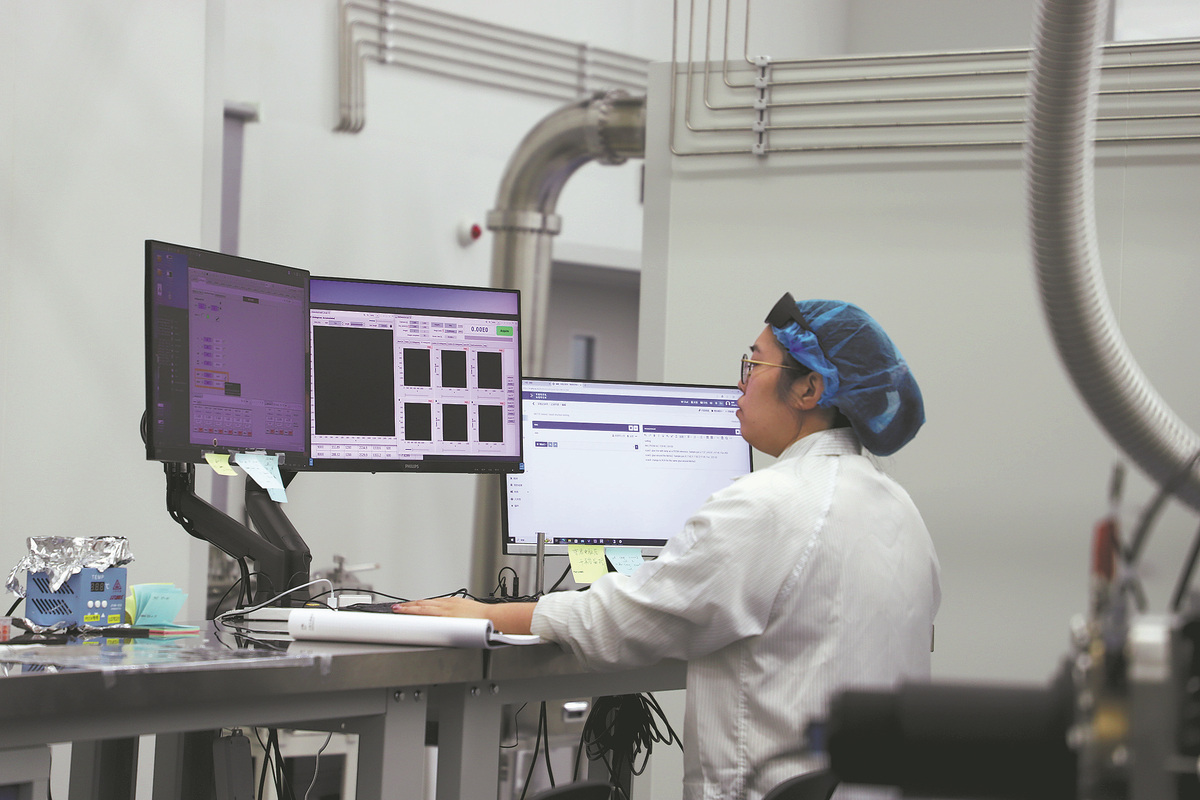
Amid the forested hills and mirror-like lakes of Beijing's Huairou district, a scientific revolution is unfolding at ultrafast timescales.
Within the Synergetic Extreme Condition User Facility — a crown jewel of China's Big Science Infrastructure — experimental setups pulse with red and green lasers, their beams threading through vacuum chambers with micron-level precision.
Here, associate professor Dong Shuo from the Institute of Physics, Chinese Academy of Sciences, orchestrates a symphony of light and material, deploying split second laser pulses to freeze-frame the frenetic dance of electrons within quantum materials.
"Think of it as a high-speed camera for the quantum realm," explained Dong, her eyes tracking real-time waveforms on a diagnostic screen. Her specialization in ultrafast material science enables unprecedented observation of microscopic particles like electrons, excitons and phonons. These capabilities are rewriting textbooks across disciplines, from photovoltaics to quantum biology.
From doubt to discovery
When Dong returned to China in early 2023 after completing her postdoctoral research in ultrafast optics at the Max Planck Institute in Germany, she had concerns.
"The commercial electron analyzer I needed for my experiment only became available in 2019," she said. "My German colleagues were the pioneers, and I worried whether I could rebuild that level of capabilities here."
Her apprehension stemmed from the field's steep requirements — infrastructure gaps that once hindered China's ultrafast research.
The game-changer materialized at the 2.8-billion-yuan ($394 million) Synergetic Extreme Condition User Facility, which was commissioned in 2022 as part of China's 14th Five-Year Plan for major sci-tech infrastructure.
"It wasn't just the experimental hardware," Dong said. "The entire ecosystem — low-vibration laser table, zero underground transit interference, even humidity-stabilized cleanrooms — matches world-leading facilities just like the Max-Planck Institute or in some respects, is even better."
Beyond experimental facilities, Huairou Science City exemplifies China's holistic approach to research innovation. Since last year, the district has added three bilingual schools and two researcher-focused kindergartens within 5 kilometers of the facility.
"The children's school nearby has a 'Young Scientist Program' taught by CAS postdocs," Dong said. "It's about creating generational continuity in scientific exploration."
The facility is also attracting global talent. Over 23 percent of its users last year hailed from international institutions, drawn by open-access policies and collaborative networks.
Dong has observed transformative trends in China's scientific ethos.
"Early-career researchers now pay more attention to the potential applications," she noted, referencing CAS's 2023 initiative linking ultrafast labs with semiconductor and battery manufacturers. This shift from purely lab-based work to applied innovation reflects national priorities.
Yet the path remains challenging. Despite producing 37 percent of global ultrafast research papers in 2023, China contributes only 12 percent of key technique patents.
"We're transitioning from followers to architects," Dong said. Her team's current project — developing ultrafast dynamics and imaging spectroscopy for quantum materials — epitomizes this ambition. "Scientific publication is not the only goal; we must create tools that redefine what's possible."
Nurturing the next wave
The human factor remains pivotal. Ultrafast science demands interdisciplinary mastery spanning from materials science and laser engineering to big-data analytics — a skill set gap persisting across academia. CAS reports only 160 Chinese researchers specializing in such ultrafast techniques as of last year, compared to 380 in the European Union.
Dong champions grassroots science communication to ignite interest. Her team's program has brought 1,200 high schoolers to the facility since 2023.
"We show them how tracking electron motions helps design better solar cells or diagnose disease earlier," she explained. Preliminary tracking shows 19 percent of participants now pursue physics majors — triple the national average.
Looking ahead, Dong envisions such ultrafast technology permeating diverse fields. Collaborations with Peking University Health Science Center are exploring ultrafast laser-based early cancer detection, while partnerships with Sinopec aim to optimize catalytic reactions.
"If we can map those steps, we enable rational material design rather than trial-and-error," she said.
As dusk settles over Yanqi Lake, casting golden ripples across the facility's glass facade, Dong prepares for a night shift capturing electron dynamics in topological insulators — a material class that could revolutionize quantum computing.
"In Germany, I learned the techniques," she said. "Here in Huairou, we're building tomorrow's toolkit and exploring more possibilities."
Fang Biling contributed to this story.