China's brands rev up efforts to broaden intl presence
Widespread surge in NEV sales propels growth for domestic powerhouses









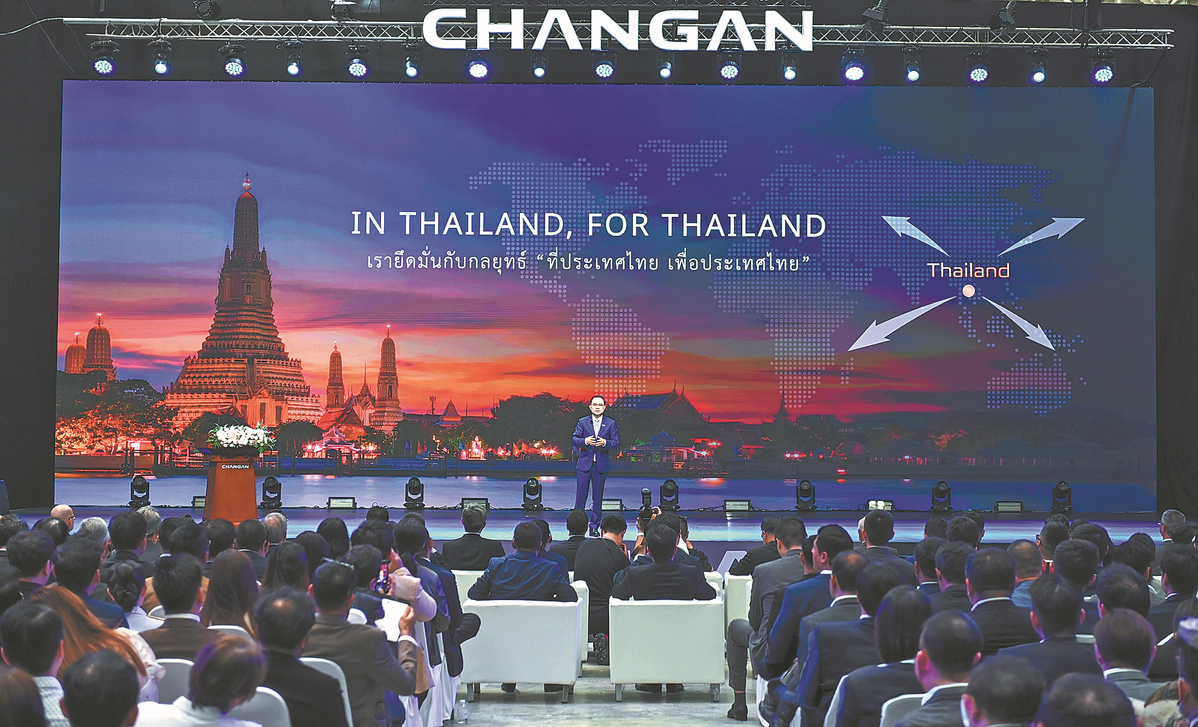
Changan Automobile unveiled its first overseas new energy vehicle manufacturing plant in Thailand on Friday, a sign of how Chinese automakers are deepening their efforts to explore overseas markets amid intense competition at home and growing demand abroad for cutting-edge NEVs.
The factory, located in Rayong province, has an initial production capacity of 100,000 vehicles annually, with plans to double that figure, and is a key component of Changan's long-term regional strategy.
In a meeting with Thai Prime Minister Paetongtarn Shinawatra two days earlier, Changan Chairman Zhu Huarong pledged the company's commitment to "deep localization and long-term investment" in the Thai market.
He also promised to contribute to the development of local supply chains while fulfilling corporate social responsibilities.
Changan, with an annual overseas sales goal of 1.2 million vehicles by 2030, has already introduced several models to Thailand, including one from its upmarket brand Avatr.
The Thailand plant, the latest of Changan's global production network, is the most recent example of how Chinese carmakers are racing to build production capacity and grow brand presence across Asia, Europe, and the Middle East.
Global markets are still dominated by legacy automakers like Toyota and EV giant Tesla, but China's carmakers are getting increasingly competitive on cost, technology, and speed to market.
Statistics from the China Association of Automobile Manufacturers show that China shipped 1.94 million vehicles overseas from January to April, up 6 percent year-on-year. Of these, NEV exports reached 642,000 units, surging by 52.6 percent year-on-year.
In Malaysia, Tan Chong Motor Group announced earlier this month a strategic alliance with SAIC-GM-Wuling, one of China's most successful budget carmakers, to launch the TQ WULING brand.
Its debut model, the Bingo EV, designed for daily urban commuting, will be launched in the fourth quarter.
It will be assembled locally in Segambut, Kuala Lumpur, and priced under 100,000 yuan ($21,000) — a price tag aligned with Malaysian government ambitions to popularize green mobility, said Tan Chong Motor Group.
"With our expertise in EVs, combined with Tan Chong Group's strong market presence and manufacturing strength, we are excited to support Malaysia's green mobility transition and bring sustainable driving solutions to local consumers," said Tang Wensheng, president of PT SGMW Motor Indonesia.
Like Changan's efforts in Thailand, SAIC-GM-Wuling's local assembly strategy reinforces a broader shift among Chinese automakers toward deeper integration with host markets to reduce costs and meet local regulations.
As Southeast Asia becomes a key area, Chinese carmakers are also moving aggressively into the Middle East, where high fuel prices, rising environmental awareness, and policy support are starting to reshape demand.
Chinese NEV brand Voyah, under Dongfeng Motor, held two major launches in the Gulf region this month — first in Abu Dhabi and then in Doha just four days later.
The Abu Dhabi showroom, located along the city's picturesque Corniche, is designed to blend Chinese minimalism with Arabic architectural elements.
Voyah claims it reflects its ambition to be more — to be a lifestyle brand appealing to affluent, tech-savvy Middle Eastern consumers.
"Chinese automakers are bringing vehicles that are not only high-tech but also adapted to the harsh climate and road conditions of the region," said Syed Faiz Karim, CEO of Abu Dhabi Motors, Voyah's partner.
Voyah aims to enter 60 global markets by 2030. It already has a footprint in over 40, including most of Europe, and it is using the Belt and Road framework to accelerate its expansion into emerging economies.
While Southeast Asia and the Middle East offer volume and growth, Europe remains the gold standard for automotive legitimacy.
That's why XPeng, a technology-forward NEV maker, chose Milan Design Week late last month to announce its Italian market entry.
The company showcased its flagship sedan P7+, a humanoid robot, and the X2 flying car, in a bid to associate its brand with Italy's rich design legacy and progressive energy agenda.
"We believe in technology with artistry," XPeng's President Brian Gu said in a video message. "Just as Marco Polo once bridged East and West, XPeng brings intelligent innovation from China to Milan."
With EV sales in Italy surging nearly 60 percent year-on-year and public charging infrastructure expanding rapidly, XPeng sees an opening — particularly in northern cities like Milan and Bologna, where climate-conscious consumers are driving early adoption.
The company exported over 7,600 vehicles in the first quarter this year, up 370 percent year-on-year.
Analysts see the multifront expansion as both a necessity and an opportunity.
"Despite China's large market, slowing growth is prompting automakers to look abroad for higher returns," said Ron Zheng, a senior partner at Roland Berger.
"Emerging markets in Southeast Asia, the Middle East, and Latin America are especially important," said Zheng, who is also Asia head of automotive practice at the consultancy.
Zheng emphasized that Chinese carmakers already have strengths in quality, cost control, and technological innovation, so ultimate success depends on tailoring strategies to local market conditions.
"In Latin America, price is key. In Southeast Asia, it's about product capability. In Europe and the Middle East, brands must balance advanced tech with a reasonable price tag," he said.
He estimates Chinese automakers could see their overseas sales grow 10 to 20 percent year-on-year in 2025 to hit 7 to 7.5 million units.