


New York event celebrates life of modern Chinese philosophy giant









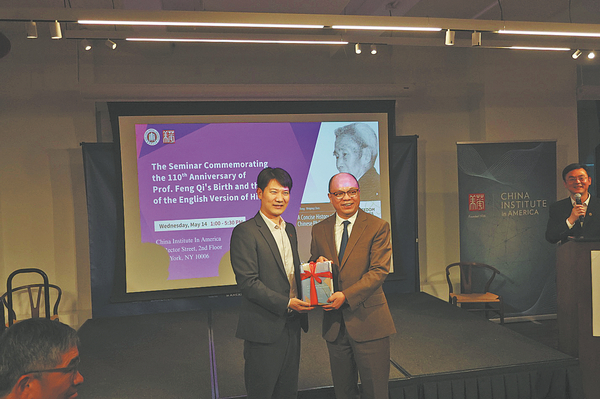
The English-language debut of Feng Qi's works in New York marked a new step in bringing Chinese philosophy into the global academic dialogue.
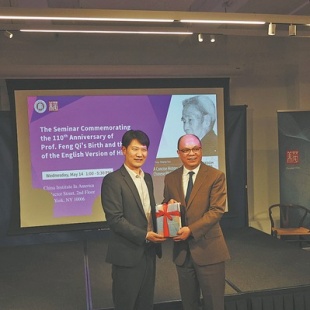
International scholars from China and the United States gathered at the China Institute on Wednesday for a symposium and book launch event titled "The Light of Wisdom Across Borders", marking the 110th anniversary of the birth of Chinese philosophical giant Professor Feng Qi (1915-95).
Feng, regarded as a towering figure in contemporary Chinese philosophy, is renowned for his "Wisdom Theory" and studies of Chinese philosophical history. His lifelong pursuit of "transforming knowledge into wisdom" led to the development of a "broad epistemology" that integrates Marxist, Chinese and Western philosophical traditions in the quest for the values of truth, goodness and beauty.
His "Wisdom Trilogy" and two monumental works on philosophical history have injected original vitality into Chinese philosophy and also offered profound insights into global philosophy. Over the past two decades, Feng's philosophy has sparked global interest, with numerous monographs and more than 500 multilingual articles devoted to his work.
The release of these English translations marks a significant step in bringing Feng's thoughts to a broader international audience, said Wu Jian, vice-president of East China Normal University.
Wu also highlighted Feng's foundational role in establishing the university's philosophy department and his pioneering contributions to modern Chinese philosophy. He emphasized its continued commitment to fostering academic exchange and dialogue with the international community.
Wu added that faculty and scholars at ECNU have been dedicated to compiling, editing and revising Feng's works. Through initial translations and close collaboration with former American doctoral students at ECNU, they have worked to present Chinese philosophical texts to international audiences with clarity, accuracy and cultural nuance.
"This will help bring Chinese philosophy to a wider international readership and encourage more meaningful academic exchange across philosophical traditions," he said.
"This is one of the most enjoyable pieces I've ever translated," said Chad Meyers, the translator of Feng's work and a former student at ECNU. He noted that while translation can be challenging, he found the process rewarding and has translated more than 20 books to date.
George Geh, CEO of the China Institute, said the event was not only a tribute to Feng's intellectual legacy but also an opportunity to promote deeper philosophical dialogue between the East and the West.
"Feng Qi's philosophy shows the forward-looking potential of cross-cultural conversations," he said.
Yu Yougen, education counselor at the Chinese Consulate General in New York, said the symposium is a valuable platform for US-China academic and cultural exchanges.
"Feng's work also reflects a shared need for philosophical engagement amid global challenges," Yu said. The English editions of Feng's works, co-translated by Chinese and American scholars, are expected to open new channels for international engagement with Chinese philosophy and further energize the academic dialogue between higher education institutions and academia.
"Feng's philosophy, rooted in Chinese tradition, offers a distinctive voice in contemporary philosophical discourse," said Tong Shijun, chancellor of NYU Shanghai and professor of philosophy at ECNU.
"His theory of wisdom contributes to ongoing conversations about knowledge, ethics and human values," Tong said.
Participants from ECNU, the University of California, Riverside, and Loyola Marymount University also discussed the cross-cultural relevance of Feng's philosophical ideas, as they examined how his "Wisdom Theory" can contribute to contemporary discussions in areas such as artificial intelligence, ethics and ecological philosophy.
"The symposium provided an opportunity to further understand Feng's work and to consider possible directions for future philosophical exchange between China and the West," Tong said.
mingmeili@chinadailyusa.com