A researcher's journey to greener roads









Throughout history, roads have played a critical role in shaping civilizations and economies by facilitating trade, cultural exchange, and territorial expansion. The ancient Silk Road, for example, connected distant empires and enabled the flow of goods, ideas, and technologies. Today, road infrastructure continues to evolve, with China at the forefront of creating innovative and sustainable solutions for modern transportation.
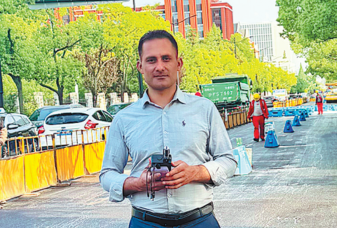
On May 1 this year, while most people were enjoying the Labor Day holiday, I proudly attended a special event — the launch of the paving of a 1.3-kilometer section of Cangyuan Road in Shanghai's Minhang district, right beside Shanghai Jiao Tong University (SJTU), where I work as a researcher.
What made this project unique was the material: recycled tire rubber. Traditional asphalt roads tend to crack and deteriorate over time due to aging and brittleness, which leads to high maintenance costs. In contrast, roads paved with tire rubber — using a specially formulated binder made from recycled tires — offer significantly improved durability, flexibility, and cost-effectiveness.
This project is one I've been working on since joining Professor Wang Shifeng's team after completing my PhD in 2023.
I first came to China in 2017 to pursue advanced research in polymer materials at SJTU. Before then, I thought of roads simply as materials mixed and laid down by laborers. But in our team, the focus is on developing low-carbon road technologies to make roads more sustainable and resilient.
I had the opportunity to be deeply involved in every stage of the project and received invaluable guidance from Professor Wang. For example, when I began working on degrading crumb tire rubber to create a new binder, he helped me understand the complex thermooxidative reactions involved in the process. His rich knowledge of rubber chemistry and years of experience with asphalt modifiers in the Chinese infrastructure context shaped my approach to both lab-scale formulation and field application.
The lab also introduced me to state-of-the-art research tools, such as the Low Temperature Impact Test for analyzing low-temperature flexibility and X-ray Photoelectron Spectroscopy for tracking chemical changes during devulcanization — equipment I had limited access to back home in Pakistan.
From lab to impact
My journey — from a young student in Pakistan to a growing scientist contributing to cutting-edge research in China — has been nothing short of transformative. But what made it truly meaningful was seeing our lab work applied in real-world projects across China.
In 2023, I witnessed our binder being used on roads in the Western Sichuan Plateau in Southwest China, helping prevent cracking under extreme weather conditions. In 2024, it was applied to the Yichun high-speed railway subgrade in Heilongjiang province in Northeast China, where it improved long-term stability. Most recently, it was used in paving Cangyuan Road in Shanghai, where I worked alongside my Chinese colleagues Yao Hongru, Wang Hanbing, and Wang Shanshan to monitor air emissions — specifically volatile organic compounds and odors — during the five-day construction process.
Standing at the construction site, I realized that my research was no longer confined to the lab — it was now influencing the very infrastructure people rely on every day. That moment broadened my perspective on how infrastructure development can be both technologically advanced and environmentally responsible — offering solutions that benefit both society and the planet.
The success of these rubberized roads is a testament to the dedication of Professor Wang's research team, which has spent more than 20 years advancing sustainable road materials. We hope this innovation will not only set new standards for road construction in China but also inspire infrastructure projects around the world.
I still remember a lunch conversation with Professor Wang where we discussed the future of rubber recycling. I mentioned that waste tire management remains a major challenge in Pakistan. He listened carefully and then said, "Maybe one day, you'll help bring this technology there."
It was a simple comment, but it shifted my mindset — from just doing research to thinking about how that research could cross borders and make a real impact.
Written by Zaheer ul Haq, a Pakistani scholar who has been living in China since 2017. He completed his PhD in chemistry at Shanghai Jiao Tong University and is currently working as a postdoctoral researcher at the School of Chemistry and Chemical Engineering. In addition to his lab work, he is a passionate badminton player and an active member of the school's badminton team.