China, ASEAN trade to benefit from deal
New agreement to boost cooperation, mitigate risks from unilateralism









The implementation of Version 3.0 China-ASEAN Free Trade Area agreement will further bolster supply chain cooperation and catalyze industrial upgrading, experts said on Sunday, just a few days after negotiations on the deal were completed.
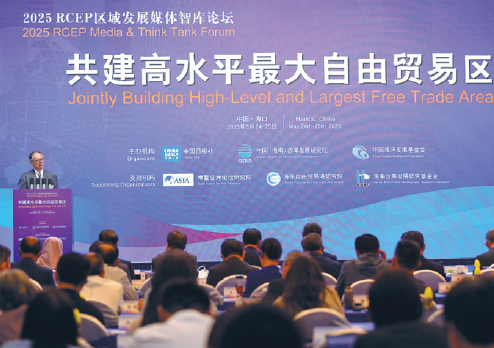
Speaking at a thematic dialogue of the 2025 RCEP Media & Think Tank Forum held in Haikou, Hainan province, they said CAFTA 3.0 will not only upgrade the cooperation in the Regional Comprehensive Economic Partnership, but also mitigate risks brought by unilateralism.
Economic and trade ministers from China and the 10 Association of Southeast Asian Nations member states announced last week the full completion of CAFTA 3.0 negotiations.
Both sides will move forward with their domestic signing and ratification processes, aiming to formally sign the CAFTA 3.0 upgrade protocol by the end of this year, according to China's Ministry of Commerce.
CAFTA 3.0 will help both China and ASEAN reconfigure global value chains, deepen mutual openness and boost cooperation in emerging industries, said Zhang Lijuan, a professor of international trade and world economy at Shandong University.
"As both sides are member economies of the RCEP, this will also inject fresh momentum into the pact's growth in the next stage," Zhang said.
China-ASEAN trade reached 2.38 trillion yuan ($329.62 billion) in the first four months of this year, up 9.2 percent year-on-year, accounting for 16.8 percent of China's total foreign trade, according to statistics from the General Administration of Customs.
CAFTA 3.0 will establish an inclusive, modern, comprehensive and mutually beneficial free trade framework. It incorporates nine new chapters on areas such as the digital economy, green economy, supply chain connectivity, and economic and technical cooperation.
Huang Qunhui, a member of the economic committee of the 14th National Committee of the Chinese People's Political Consultative Conference, said these additions will enable both sides to strengthen regional economic integration under new conditions, significantly enhance industrial and supply chain collaboration, and serve as a pioneering step for other bilateral or multilateral free trade deals.
For instance, despite significant progress, disparities in infrastructure development between China and ASEAN countries persist, with the digital divide posing a challenge to integration.
The CAFTA 3.0 framework will help bridge this gap and support more balanced, inclusive growth, said Huang, who is also a senior research fellow at the Institute of Economics at the Chinese Academy of Social Sciences.
Echoing this sentiment, Alvin Ang, senior researcher at Brunei's Centre for Strategic and Policy Studies, said small economies like Brunei integrate into trade agreements not just for foreign capital, but also for guidance and support, ensuring these investments yield meaningful results.
The upgrade of free trade agreements benefits not only individual countries, but also strengthens the broader regional trade community, he said.
Supreme Intelligent Technology Co, a Ningbo, Zhejiang province-based manufacturer of sewing machine equipment, welcomed the conclusion of the CAFTA 3.0 talks as a positive step forward.
"Our products are in high demand in Southeast Asian countries such as Vietnam, Myanmar and Cambodia," said Luo Qian, the company's president.
Supreme Intelligent Technology Co saw its exports to the ASEAN market surge 30 percent year-on-year to 80 million yuan between January and April, data from Ningbo Customs showed.
As an increasing number of manufacturers in Southeast Asia are keen to adopt advanced robotics systems and automated production lines to reduce their reliance on manual labor, Luo said that the implementation of CAFTA 3.0 will further enable more Chinese companies to seize new opportunities in the region.