Xi Story: The ancient stone slab etched on Xi's memory









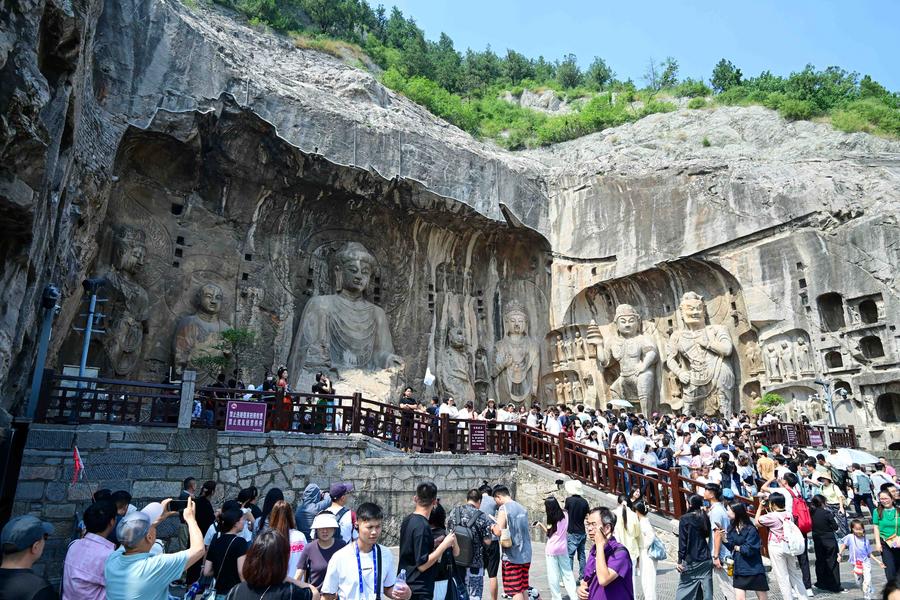
BEIJING -- During a May inspection tour of Henan province, President Xi Jinping stood before the ancient stone carvings of the Longmen Grottoes, a UNESCO World Heritage site. He paused in silence.
The limestone cliffs, into which over 110,000 Buddhist figures were carved more than 1,500 years ago, have withstood dynasties and the passage of time. As Xi, who is also general secretary of the Communist Party of China Central Committee and chairman of the Central Military Commission, gazed at the weathered inscriptions, they appeared to stir a distant memory.
It reminded him of another stone, from another time — a quiet emblem of Xi's steadfast dedication to preserving China's cultural and natural legacy over the years.
In the 1980s, when he was a young official in Zhengding, a historical county in Hebei province, Xi exhibited rare foresight on cultural preservation. He made field visits to centuries-old temples chronicled in county annals, and took concrete steps to protect them.
During one such visit to Longxing Temple, Xi came upon a timeworn stone slab from the Sui Dynasty (581-618). The bold, elegant calligraphy carved into its surface was slowly fading, at risk of being lost to the elements.
Recognizing its value, Xi ordered immediate measures to shield the monument from further damage. It was later hailed as an important artifact in the field of Chinese calligraphy.
And it wasn't just this Sui-era slab that Xi was concerned about. "Every ancient building, artifact and cultural site in Zhengding was given a designated protection zone, each marked with a clear sign. That was Xi's instruction," said He Yu, who was the county's deputy head in charge of culture and education at the time.
Under Xi's lead, a countywide survey of cultural relics was launched, laying the groundwork for more systematic and far-reaching preservation efforts.
His vigilance was in sharp contrast to the national backdrop. At that time, China's reform and opening-up had just begun. Across the country, local governments were focused on jump-starting economic growth, while cultural heritage, hampered by limited funding and weak public awareness, was sadly overlooked.
On another occasion, he delivered a sharp rebuke to a local official in Zhengding for neglecting cultural relics, warning, "If we fail to protect our cultural relics, we are at fault. We will have failed the generations that follow."
This concern for cultural heritage didn't fade as Xi's responsibilities grew.
In Zhejiang province, the archaeological ruins of Liangzhu, now also a UNESCO World Heritage site, were once surrounded by noisy mining operations. In the early 2000s, industrial dust and blasting left the area, in the words of one local official, "something like a war zone."
After becoming aware of the situation in July 2003, Xi, who was then Party secretary of Zhejiang, ordered the immediate shutdown of the mines. His commitment to protecting Liangzhu continued in the years that followed. When archaeologists confirmed the site's significance as evidence of the 5,000-year-old Chinese civilization, Xi issued detailed instructions to ensure its preservation.
These efforts mirrored a nationwide shift. In 2006, China introduced Cultural Heritage Day to raise public awareness. By 2017, it had evolved into Cultural and Natural Heritage Day, reflecting a wider commitment to preservation. This year, it falls on Saturday.
Since taking the helm of the Party in 2012, Xi has kept cultural preservation high on the national agenda. He has issued a steady stream of directives on the protection of relics, archaeology and intangible heritage, and made frequent visits to historical and cultural sites across the country.
To him, China's cultural legacy is not just a glimpse into the past; it is also a powerful force that continues to influence the present and inspire the future. As the world's only uninterrupted civilization, it provides spiritual strength in the country's quest for national rejuvenation.
That vision has been backed by a broad set of national policies and initiatives. Authorities have provided guidelines to improve the protection and use of cultural relics, while also promoting the use of technology as a preservation tool.
Today, China counts more than 767,000 immovable cultural relics and 59 UNESCO World Heritage sites.
Broader efforts, such as preserving ancient texts, tracing early Chinese civilization and expanding archaeological work, have deepened public engagement with the country's cultural heritage further.
At the Longmen Grottoes, President Xi met travelers from across the country, including elderly visitors and clusters of curious, wide-eyed young people.
"We came to see the place we studied in our textbooks," one of the visitors said.
"The Chinese civilization is broad and deep," Xi said. "It's worth exploring in person."




- Xi chairs meeting on ideological work, draft ethnic unity law
- Cave basketball in Southwest China's Guizhou goes into limelight
- Global allies' contributions to China's resistance recognized at symposium
- Egyptians laud TCM veterinary summer program
- New war memorials honor sacrifices home, abroad
- Closer ties highlighted for regional energy security