Along ancient Silk Road, Xi cultivates stronger bonds with Central Asia
Leaders to bolster links of trade, security and connectivity at Astana summit









Reviving historical route
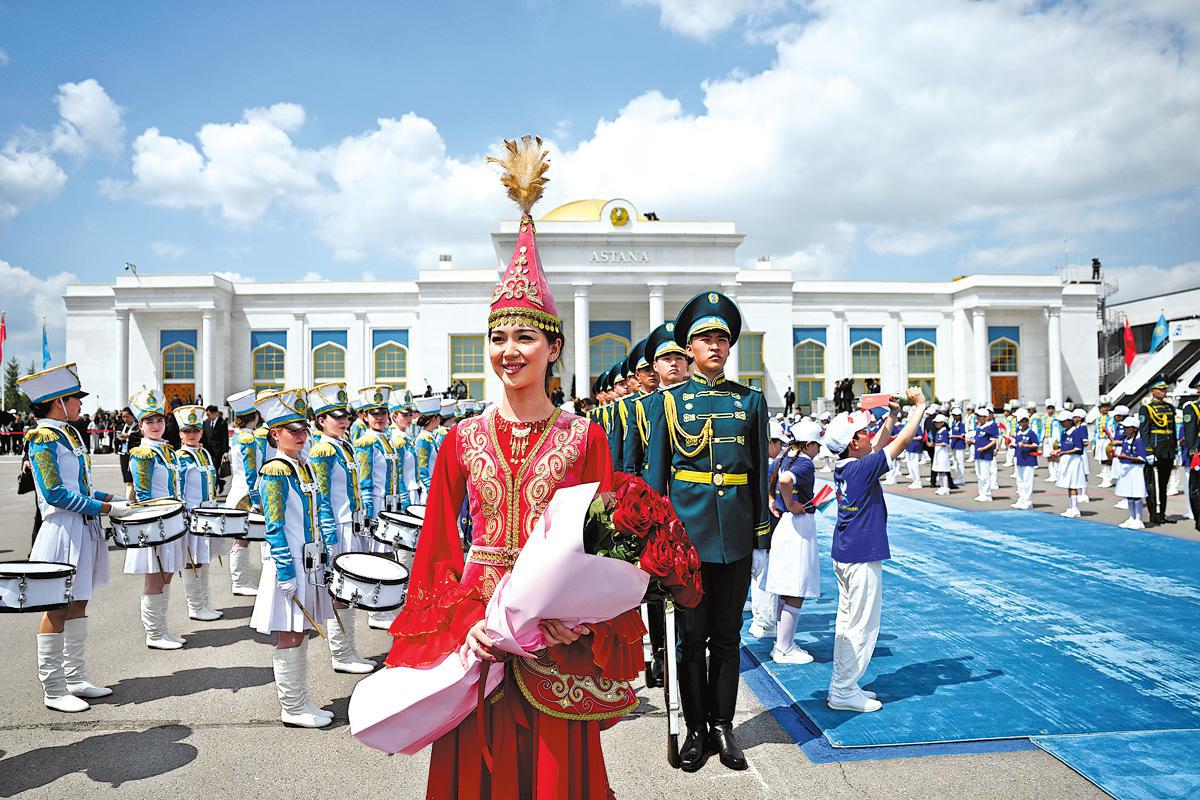
"Start the shipment!" With this command, Xi and Tokayev jointly launched the China-Europe Trans-Caspian Express Route at a ceremony in Astana in July 2024.
The occasion marked the formal establishment of a multidimensional connectivity network, integrating highways, railways, air routes and pipelines, to better link Asia with Europe via the Caspian Sea. It is expected to become a vibrant artery of the Belt and Road Initiative.
While the ancient Silk Road witnessed robust trade and cultural exchanges between China and Central Asia, Xi sees in the region an important partner in modern-day Belt and Road cooperation.
In September 2013, Xi delivered a landmark speech at Astana-based Nazarbayev University, where he first laid out his vision for building the Silk Road Economic Belt — a key component of the BRI.
"We can actively discuss the best way to improve cross-border transportation infrastructure and work toward a transportation network connecting East Asia, West Asia and South Asia to facilitate economic development and travel in the region," he said.
Over the years since then, that vision has steadily become a reality. In a recent instance, a commencement ceremony for the China-Kyrgyzstan-Uzbekistan railway project was held late last year in the Kyrgyz border city of Jalalabad. In a congratulatory letter, Xi called for building the railway into a "new demonstration project "under Belt and Road cooperation.
The line will originate from the ancient Silk Road hub of Kashgar, in China's Xinjiang Uygur autonomous region, cross the Torugart Pass into Kyrgyzstan, proceed westward through Jalalabad, and reach the eastern Uzbek city of Andijan.
Kyrgyz President Sadyr Japarov said that this railway is not merely a transport corridor, but serves as an important strategic bridge connecting countries of the East and the West.
Belt and Road cooperation has effectively boosted trade, travel and exchanges in the region. In 2024, China's trade with Central Asia reached a record $94.8 billion, fueled in part by a booming cross-border e-commerce sector. China now stands as Central Asia's top trading partner and major investment source.
In 2014, Tajikistan became the first country to sign a memorandum of understanding with China regarding the Silk Road Economic Belt. Collaboration has since produced tangible outcomes, ranging from new highways and power plants to new city landmarks, many of which have been personally championed by Xi.
Tajikistan is also home to Central Asia's first Luban Workshop — a Chinese vocational training center that has already equipped more than 1,500 students with practical skills in engineering, architecture, water management and environmental protection, preparing talent for the nation's future development.
In a state visit to the country in 2024, Xi said to Tajik President Rahmon: "I have seen a more prosperous Tajikistan."
Weaving cultural tapestries
In the autumn of 2022, while visiting the storied Silk Road city of Samarkand, Xi presented Uzbek President Mirziyoyev with a special gift: a miniature of Khiva, a historic Silk Road outpost.
Khiva is China's first cultural heritage preservation project in Central Asia. Thanks to years of restoration led by Chinese experts, the ancient city has taken on a new look.
"The preservation and restoration of historical sites in Khiva, a project launched during my visit to Samarkand in 2013, has been successfully concluded, further augmenting the charm of this ancient city," Xi wrote in a signed article ahead of his 2022 visit to Uzbekistan.
During an earlier trip to the country in 2016, Xi met with the Chinese experts working on the project and urged them to protect the cultural relics well.
Over the years, joint archaeological efforts between Chinese and Central Asian scholars have expanded across the region, including the ancient city of Rahat in Kazakhstan and an ancient Buddhist temple in Krasnaya Rechka, Kyrgyzstan.
Xi has repeatedly emphasized that the China-Central Asia friendship is one that is steeped in history. On multiple occasions, he invoked the legacy of Zhang Qian, the Han Dynasty (206 BC-AD 220) envoy who traveled westward more than 2,100 years ago and opened the door to enduring friendship and exchanges between China and the region. The president has also highlighted the need to "carry forward our traditional friendship".
During his state visit to Kazakhstan in 2024, Xi, together with President Tokayev, unveiled the Kazakhstan branch of Beijing Language and Culture University, the very institution where the Kazakh president studied Chinese in the 1980s. Xi expressed his hope that the new school would enhance mutual understanding between the two peoples, especially the young generation.
As part of the visit, Xi met a group of schoolchildren who greeted him in Mandarin and sang a Chinese song. Some among them expressed their dream of one day studying at Tsinghua University, Xi's alma mater.
"I also wish, with all my heart, that you will be able to attend good universities in the future. And you are very welcome to pursue your studies in China," the Chinese president said.
Commenting on the broader impact of such exchanges, Uzbek political observer Sharofiddin Tulaganov said that under the China-Central Asia cooperation mechanism, mutual learning among civilizations will be significantly enhanced.
In today's complex international environment, institutionalized people-to-people exchanges like these will inject valuable cultural momentum into efforts at safeguarding regional peace and promoting shared development, he added.
Xinhua



- China becoming key contributor to cosmic understanding, academician says
- Xi's special envoy to attend inauguration of Seychelles' president
- Commemorating Taiwan's restoration reflects Chinese people's shared will
- China's top anti-graft body convenes to study principles of CPC plenum
- Major strontium ore deposit found in Jiangsu
- Sierra Leone hails Chinese investment as 'pivotal' to mining growth