China's development aligns with human future









The advancement of artificial intelligence and automation will likely curb job growth. How should China address this challenge?
To begin with, China can leverage growing Chinese national pride to boost the consumption of Chinese products, which in turn will promote innovation and high-quality development. Together with non-traditional jobs, such as developing online education, to primarily benefit communities living in China's remote areas but also people across the world, this has the potential to boost the country's technological advancement.
China's political system is characterized by efficient decision-making, which can help better address problems.
Africa, Latin America, the Caribbean and India need low-carbon and low-cost standard-of-living solutions, which China has already realized. The total effective demand for housing alone across the world is worth $1.9 trillion, which, given its productive capacity, trade interests, price points and the Belt and Road Initiative, China can meet. No propaganda can alter this fact. As a matter of fact, China could help reduce the "global carbon footprint" even as it addresses global poverty and housing demand.
China can cultivate trade in tandem with internationalization and cultural exchanges. Building "enterprise global cities" is an effective way of inviting foreigners to travel and work in China, and a means for absorbing imports of cultural artifacts.
Besides, China's success on the education front should not be allowed to go to waste. The advancement of education, and science and technology can be used to facilitate decades of economic and cultural development.
China's approach to innovation, social system management, enterprise technology and innovation city laboratories could become a curriculum to promote future development. In Africa alone, 9.5 million new classrooms and 9 million new teachers will be required between now and 2050. That's more than $4 trillion in infrastructure and technological/AI architecture — plus corollary investments in future development.
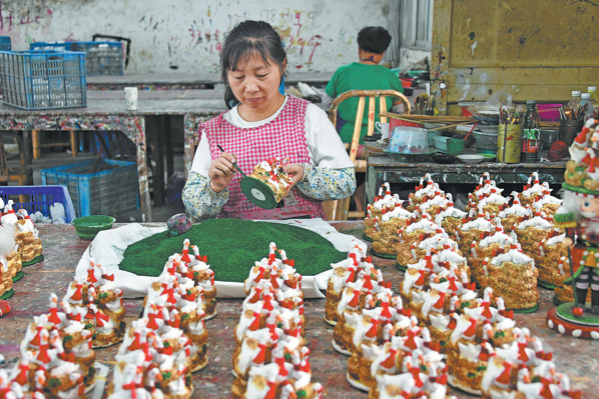
Given that China does not use the Belt and Road Initiative to interfere in the internal affairs of other countries, African nations can develop a vision to improve the continent's future, by removing internal trade barriers while setting prudent deal terms — which Malaysia has shown can be done. Also, China may extend the BRI beyond infrastructure development to ensure deeper and wider positive impacts, and use the "Yiwu international trade city" model of light manufacturing zones to reconstitute trade and development options, which is a $1 trillion opportunity for the world's youngest people in Africa, Latin America, the Caribbean and even India.
Moreover, China is underperforming in tourism. In 2024, France recorded more than 100 million person visits — in comparison, China records only about 60 million foreign person visits. In this regard, traditional Chinese hospitality and (non-commercialized) rituals could open more doors of opportunities in tourism, which would align with growing cultural interests among travelers.
The concept of a community with shared future for humankind highlights the needs of people across the world. The vision, diligence and accomplishments advancing China's national rejuvenation are exactly in line with the requirement of the youths in the developing world.
The investments made by the United States and other Western countries in developing countries have been exploitative and extractive. The question is whether countries across the world, long neglected and abused, can examine alignment imperatives now to strike prudent deals with measurable targets and according to their capacities.
Kishore Mahbubani, Singaporean scholar and former diplomat, has said that serious thinkers, diplomats and strategists should see China's development as a great spectacle of human creativity, innovation and mastery. There is a Chinese principle, tianxia, which emerged during the transition from the Shang (c. 1600 BC-c. 1046 BC) to the Zhou (c. 1046 BC-256 BC) dynasty. It is a principle of harmony among all under heaven. Confucius infused this concept with philosophical force — a concept that aligns with a multipolar, rule-based world order based on mutual respect and human dignity. These rubrics are reiterated in President Xi Jinping's speeches on national rejuvenation.
If China pursues this goal, the world will experience its greatest transition to a civilization based on human dignity and mutual respect.
The views don't necessarily represent those of China Daily.





Today's Top News
- China holds central rural work conference
- President Xi to deliver New Year's message to ring in 2026
- Xi's diplomacy in 2025: Shedding light on a world at crossroads
- China to apply lower import tariff rates to unleash market potential
- China proves to be active and reliable mediator
- Three-party talks help to restore peace