Eyeing new ways to curb myopia among students









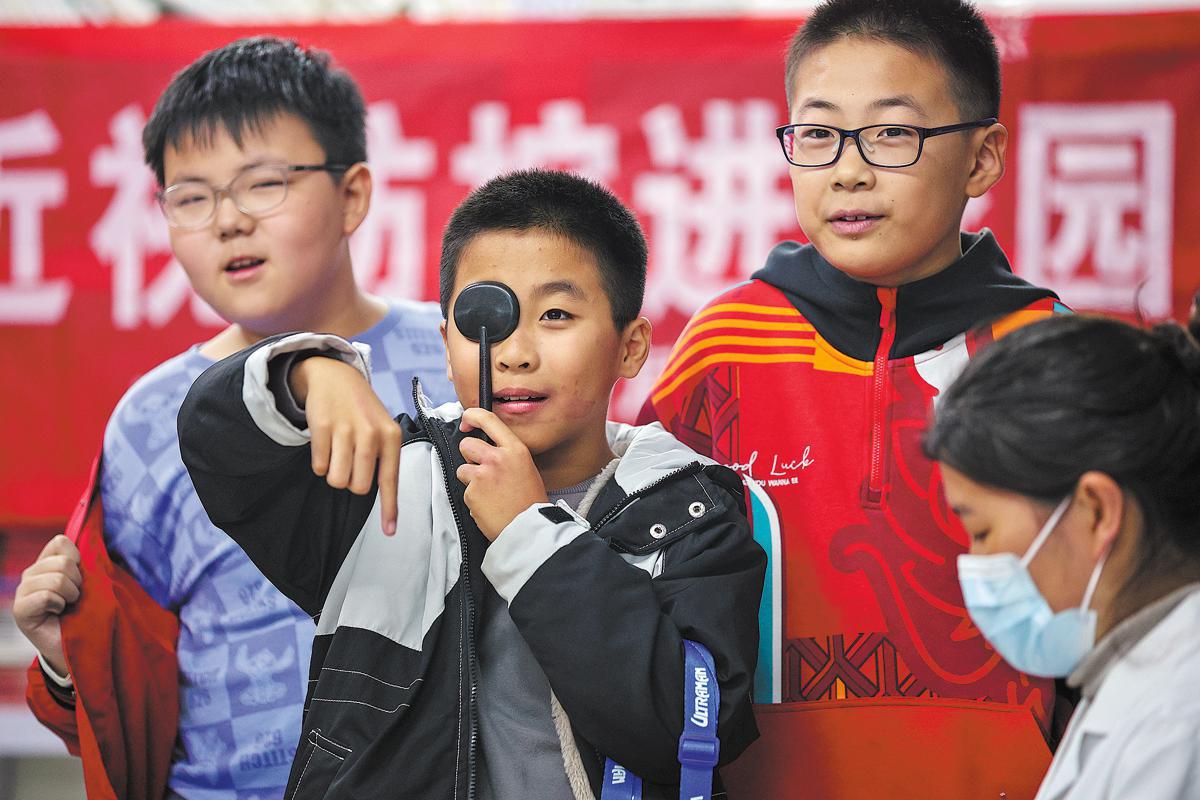
At a primary school in Jinan, Shandong province, students are undergoing routine vision checks with the help of an innovative tool, namely a headphone-like smart monitoring device powered by artificial intelligence.
This device collects real-time data concerning students' reading distance, sitting posture, light exposure and screen time, and then generates systematic evaluations and personalized recommendations. This technology not only tracks vision changes but also promotes healthier eye habits.
"This is a dynamic monitoring process that is more objective and direct than traditional questionnaires," said Huo Huanhuan, a doctor with the Shandong Prevention and Control Center for Child and Adolescent Myopia, as she scrolled through her phone to display trend analysis charts produced by the device.
So far, more than 200 schools in Shandong have partnered with the center, leveraging big data and AI to enhance early monitoring and myopia prevention.
This effort comes as China strives to address its pressing public health challenge of high myopia rates among children and adolescents. According to the latest official statistics, 51.9 percent of Chinese children and adolescents are nearsighted, despite a slight decline in recent years.
To combat this challenge, China has set ambitious targets: by 2030, the country aims to keep the myopia rate among 6-year-olds at around 3 percent and ensure that no more than 38 percent of primary school students develop myopia. Achieving these goals requires a multipronged approach.
A key strategy involves increasing outdoor time. A 2024 government document mandates that primary schools organize outdoor recess and ensure at least one hour of daily physical activity for students.
Scientifically, sunlight exposure during outdoor play stimulates the retinas to release more dopamine, a chemical that helps slow excessive eyeball elongation — a major contributor to myopia.
Leading the way is Shenzhen in Guangdong province. This city rolled out a groundbreaking policy at the end of 2023, which stipulates that all its primary and middle schools must offer one physical education class a day. A year later, Shenzhen's myopia rate among children and adolescents had dropped by 1.2 percentage points, meaning that over 20,000 students were prevented from needing glasses.
"One year of implementation has proven that the 'one-PE-class-a-day' policy significantly boosts the physical and mental health of students," said Zheng Xiuyu, director of the Shenzhen Education Bureau.
Inspired by Shenzhen's success, provincial-level regions like Yunnan, Anhui and Tianjin have introduced similar policies. Meanwhile, other regions, including Beijing, Shandong and Fujian, have extended school break times from 10 to 15 minutes to encourage more physical activity.
At 9 am, upon hearing the bell, Wang Jiahui, a fifth-grade student in Shandong, picked up a soccer ball and immediately rushed toward the playground. "With five more minutes, we can organize a small match or do some specialized soccer skills practice."
"Longer breaks give students more opportunities to exercise, leading to better fitness levels," said Liu Shansong, an official from Licang district in Shandong's Qingdao city, where the extended recess policy was piloted.
The results speak for themselves. Last year, the district saw an 8-percentage-point increase in the "excellent" and "good" physical fitness rates among primary school students, alongside a 4-percentage-point drop in myopia rates.
In addition to promoting physical activity, education authorities nationwide are also upgrading school facilities to support eye health. Adjustable desks and chairs, along with lighting equipment beneficial to eye health, are being introduced to create vision-friendly learning environments.
Notably, in Hubei province, primary schools have installed an intelligent prompt system in teachers' electronic whiteboards, setting a 12-minute usage limit per class session. Once the time limit is reached, an eye-protection reminder automatically pops up, prompting teachers to discontinue electronic device usage.
Huo Pengfei, a parent of a fourth-grade student at one of the schools, is delighted with the restriction on electronic screen use.
"This significantly alleviates children's eye strain, and we sincerely applaud and support this initiative," said Huo.


- Guangdong urged to drive high-quality development
- Shanghai hosts 6th intl 3E talent fair
- Xi's special envoy attends inauguration of Bolivian president
- Countdown to 15th National Games: On-site warm-up entertains audience
- Eight missing after cargo ship collides with fishing vessel near Shandong
- Investing in people: a worthwhile investment