Domestic chip firms riding out tariff storm
Executives from US, China tech sector point to unintended consequences of policies










Semiconductor research company ICwise said in a report that Washington's tariffs could accelerate China's shift toward non-US chips, squeezing US players.
"China's mature-node semiconductors, meaning chip-processing technology using 28 nanometers and above, are already competing with US rivals in automotive micro control units, power devices, memory chips and mid-to-low-end chips. While these products primarily target cost-sensitive markets, tariffs could amplify their price advantages, hastening the displacement of US components," ICwise added.
Meanwhile, China's semiconductor exports to the US are minimal, insulating the sector from immediate tariff shocks. This structural resilience allows Chinese firms to focus on import substitution rather than scrambling to mitigate export losses, ICwise said.
Xiang Ligang, director-general of the Zhongguancun Modern Information Consumer Application Industry Technology Alliance, a telecom industry association, said: "China's semiconductor industry, tempered by years of US sanctions, now boasts a near-complete supply chain.
"Previous restrictions ironically catalyzed China's progress in chips. The latest tariffs may similarly drive upgrades, particularly in high-value upstream segments like lithography machines and specialty chemicals. While short-term disruptions are inevitable, the sector's strategic focus could transform external pressure into a catalyst for innovation," Xiang added.
Ren Zhengfei, founder of Huawei, said there is no need for the company to worry about chip challenges, as using innovative methods can produce computational results that are comparable to the most advanced levels in the world, despite the US government restrictions.
Ren made the comments in an interview with People's Daily.
In the face of external blockades and suppression: "There is no need to think too much about difficulties. Just take action and move forward step by step," Ren said.
He said the software-related challenges that China faces are manageable. "Software is built on mathematical symbols, codes and layers of cutting-edge algorithms. There are no shackles here," he said.
"The real challenge lies in our education system and talent development. In the future, China will have hundreds, or even thousands, of operating systems supporting its progress across industry, agriculture, healthcare and beyond," he added.
Ren underscored the importance of theoretical research. "Without fundamental research, we lack roots. Even if the leaves appear lush and thriving, a single gust of wind can make them fall," he said.
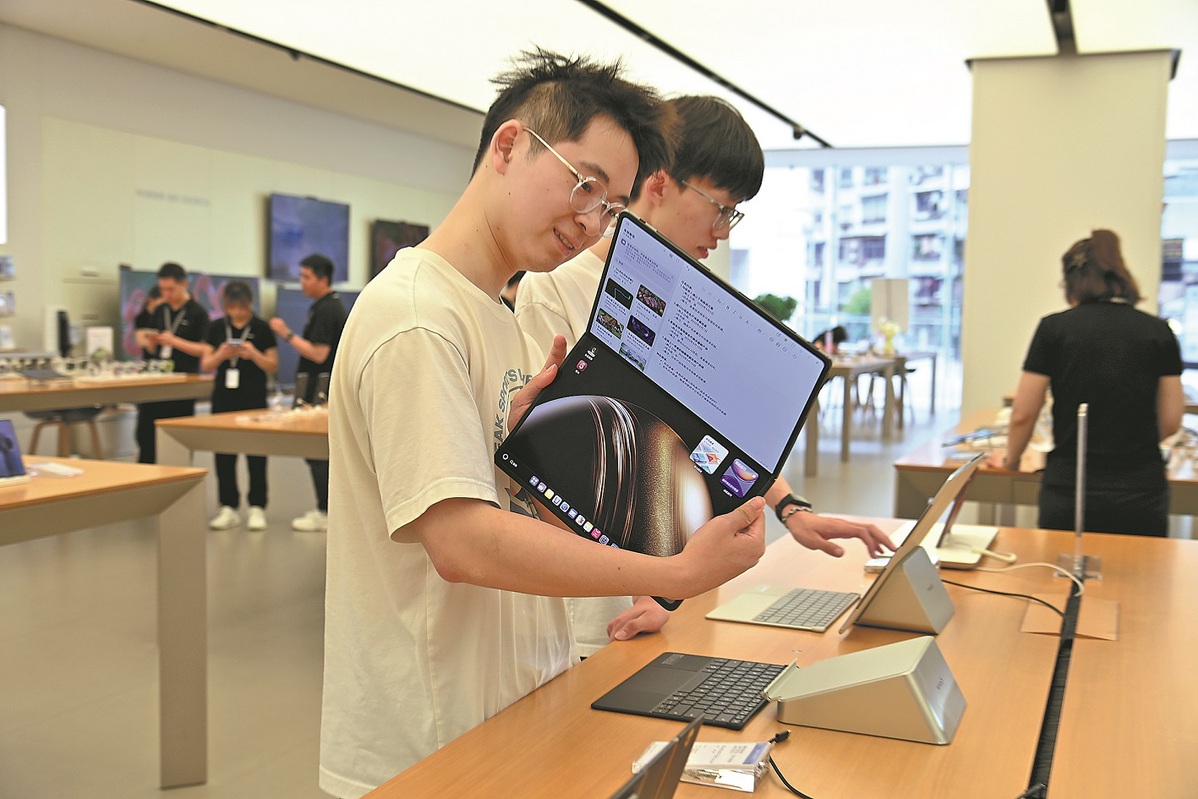
In May, Huawei officially unveiled personal computers powered by its self-developed operating system, challenging Microsoft's Windows and Apple's macOS in the desk operating system sector.
For decades, the global PC operating system market has been dominated by Microsoft's Windows and Apple's macOS, while domestic alternatives have largely relied on Linux-based modifications. Huawei wants to break this paradigm by developing its own PC operating system — HarmonyOS.
Huawei Executive Director Yu Chengdong said the company remains committed to forging the "difficult yet right path" by advancing its self-developed HarmonyOS.
"Every line of code you write is rewriting the history of China's software industry," Yu said, adding that HarmonyOS integrates hardware, software, chips and cloud capabilities to deliver breakthroughs in AI-powered features and cross-device collaboration.
Meanwhile, other Chinese companies such as Xiaomi Corp are also ramping up research and development spending to bolster their semiconductor prowess. Xiaomi, for example, unveiled its 3-nanometer XRing O1 chip for smartphones in May.
The new chip, a result of over four years of intensive R&D efforts, will position Xiaomi to compete directly with leading foreign chip designers, though it remains to be seen how the actual products will perform on handsets, experts said.
Lei Jun, chairman and CEO of Xiaomi, said the company will invest 200 billion yuan ($27.8 billion) in R&D from 2026 to 2030.
Lei said Xiaomi now has a 2,500-strong semiconductor R&D team driving innovation, enforcing its position among China's top three chip design firms in both R&D spending and team scale.
XRing O1 is Xiaomi's dramatic comeback in the high-stakes arena of advanced chip design after an 11-year journey marred by setbacks and reinvention. In 2014, Xiaomi launched its inaugural semiconductor project — code-named Surge — targeting mid- to-high-end mobile chips, Lei said.
In 2017, Xiaomi debuted its Surge S1 System-on-Chip for smartphones, but commercial challenges forced a strategic retreat from large-scale chip development. After the setback, Xiaomi shifted focus to "small chips", releasing over a dozen specialized semiconductors for fast charging, imaging, battery management and 5G connectivity, while quietly honing R&D expertise.
Concurrent with its electric vehicle venture, Xiaomi secretly greenlit the XRing project in 2021 to reboot flagship SoC development, vowing to conquer cutting-edge process nodes.
"If Xiaomi aims to become a world-class hardcore technology company, mastering chip tech is a summit we must conquer. This is a battle we cannot avoid," Lei added.