Grouping at a crossroad of multipolarity









As the international order transitions from Western unipolarity to an era of renewed multipolarity, BRICS — now expanded and re-energized — finds itself at a pivotal historical juncture. No longer simply an acronym for five emerging economies, BRICS+ is increasingly aspiring to become the principal platform through which the Global South asserts its voice, defines its interests, and proposes alternative paradigms of global governance. But with greater ambition comes a heavier burden: the need for internal coherence, institutional maturity and strategic clarity.
The lesson from the G77 is instructive: aspirations alone do not produce outcomes. Institutional weakness allowed the G77 to be outmaneuvered. BRICS+ must heed this warning and move decisively toward institutional consolidation. The creation of a BRICS+ secretariat, a council of ministers, and dedicated mechanisms for coordination across key areas — energy, technology, trade, development finance and healthcare — are not bureaucratic luxuries, but prerequisites for political viability.
BRICS+ must maintain the integrity of its founding political and economic agenda. Restructuring of the international financial architecture, greater South-South cooperation, and the establishment of alternative financing tools remain central to the grouping's raison d'être. These are not outdated slogans but still-unmet demands in a system that continues to marginalize the majority world. BRICS' expansion should not dilute these priorities. Instead, it must elevate them, backed by a chorus of increasingly assertive voices from Africa, the Middle East and Latin America.
To achieve this, BRICS+ members need to resist the tendency to work on the bilateral level within the multilateral framework, and should not prioritize narrow national interests at the cost of collective alignment, for unity in diversity is the only path forward. Consensus must not be confused with uniformity. But since the absence of strategic convergence will be fatal, there is a need to sustain diplomatic craftsmanship and a renewed spirit of solidarity.
The grouping should give substance to the oft-invoked yet poorly defined Global South agenda. BRICS+ can present an alternative vision. This entails championing equitable climate financing rooted in historical responsibility, inclusive trade arrangements that protect the policy space of emerging industries, digital sovereignty frameworks that challenge monopolistic data regimes, and development-oriented approaches to the Fourth Industrial Revolution.
On the last point, governance of artificial intelligence stands as a frontier domain. The time has come to propose a "BRICS+ AI Charter", a charter that integrates ethical pluralism, linguistic and cultural diversity, and the developmental imperatives of the Global South. In a world where algorithms shape access, identity and power, the absence of an alternative voice would be a strategic abdication of responsibility.
The consolidation of BRICS+ must not occur solely at the state level. Genuine global leadership requires a foundation of human connection. A proposal for an Erasmus BRICS+ initiative — facilitating exchanges among students, researchers, professionals and cultural artists and activists — would be a powerful investment in long-term integration. Just as the Erasmus program anchored European identity in shared experience, its Global South equivalent could lay the epistemic and cultural groundwork for a genuinely multipolar world.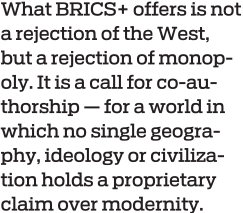
Finally, BRICS+ needs to cultivate the diplomatic maturity necessary to manage internal differences without derailing the collective agenda. Frictions between major members are likely to persist. But such tensions are not insurmountable. Even within the G7, deep divisions remain, from industrial policy to military engagement. What matters is not the absence of disagreement, but the presence of mechanisms that allow disagreement to be managed, contained, and ultimately transcended in the pursuit of greater common goals.
What BRICS+ offers is not a rejection of the West, but a rejection of monopoly. It is a call for co-authorship — for a world in which no single geography, ideology or civilization holds a proprietary claim over modernity. It is an invitation to pluralize progress.
Whether BRICS+ rises to the occasion will not only shape its future, but also the global geopolitical landscape. Its institutional depth, normative consistency, strategic adaptability and human connectivity will determine whether it becomes a strategic pillar of multipolarity — or a historical footnote in the long arc of missed opportunities. The future of BRICS+ is not predetermined. Instead, it is in the hands of those who understand its potential and are willing to work to fully unleash it.
The author is a visiting professor at China Foreign Affairs University, and a senior fellow at the Policy Center for the New South.
The views don't necessarily reflect those of China Daily.




Today's Top News
- China to apply lower import tariff rates to unleash market potential
- China proves to be active and reliable mediator
- Three-party talks help to restore peace
- Huangyan coral reefs healthy, says report
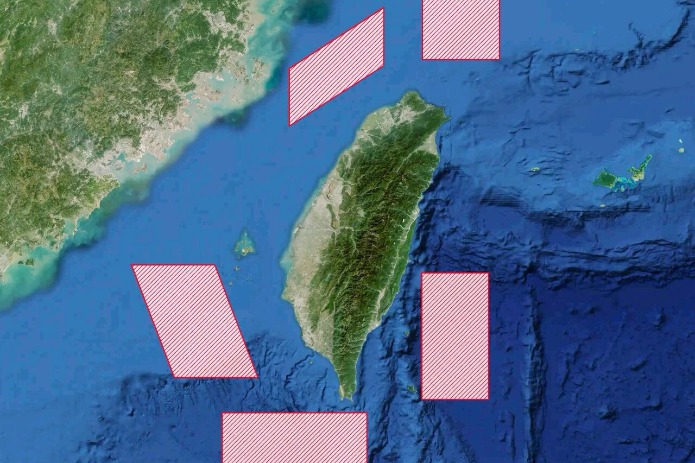
- PLA conducts major drill near Taiwan
- Washington should realize its interference in Taiwan question is a recipe it won't want to eat: China Daily editorial