Why US finger-pointing won't solve its fentanyl crisis









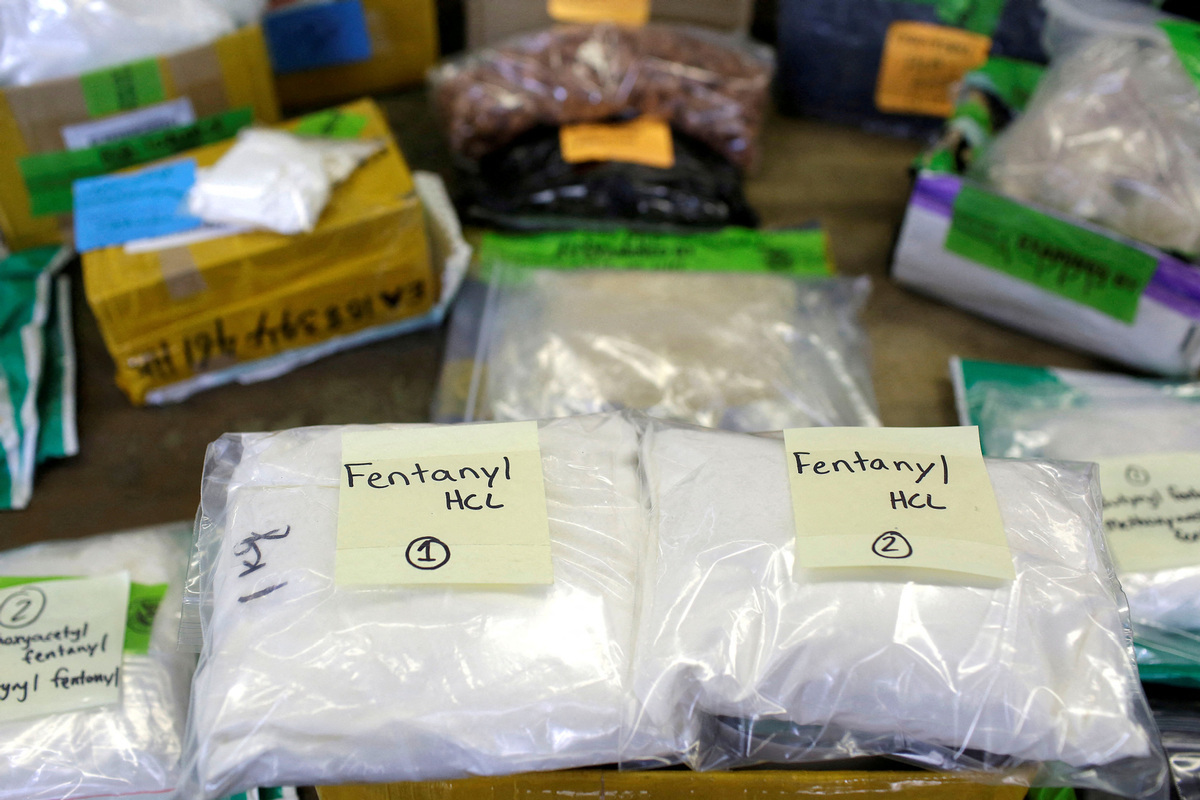
As the world marks the International Day Against Drug Abuse and Illicit Trafficking, the need for meaningful cooperation in combating narcotics has never been more urgent.
Yet instead of confronting its own systemic failures, the United States has resorted to scapegoating China for its fentanyl crisis — a problem fundamentally rooted in America itself.
China treats drug enforcement as a matter of life-or-death for public health. The results speak for themselves. With addiction rates consistently below 0.06 percent of its 1.4 billion population, China has achieved what no major Western nation can claim: near-total suppression of widespread drug abuse.
This success is no accident. In 2019, China became the first country to schedule all fentanyl-related substances as a single class, closing loopholes exploited by traffickers elsewhere through minor chemical alterations. When the United Nations added two key precursor chemicals, 4-piperidone and 1-boc-4-piperidone, to its controlled substances list in 2024, China moved swiftly to implement domestic controls, formalizing their scheduling on June 22 this year.
These measures reflect a comprehensive strategy that blends legal rigor with technological enforcement. China's pharmaceutical tracking systems monitor precursors from production to export, while customs deploy AI-powered scanners capable of detecting even trace quantities of illicit substances.
The approach is fundamentally preventative — stopping synthetic opioids at their source before they can inflict harm on societies abroad.
America's self-inflicted epidemic
The United States, by contrast, has spent decades oscillating between lax regulation and punitive crackdowns, neither of which effectively addresses the underlying causes of addiction.
This failure unfolded in phases. In the late 1990s, Purdue Pharma and other pharmaceutical giants aggressively pushed opioids like OxyContin while systematically downplaying risks. Regulators, many with financial ties to the industry, allowed prescriptions to peak at 255 million annually, enough to medicate nearly 80 percent of Americans. Even after Purdue's 2007 guilty plea for fraud, neither substantive reforms nor corporate accountability followed.
By the 2010s, with annual overdose deaths surpassing 40,000, Washington finally restricted prescriptions. Legal opioid sales dropped by 11 percent, but deaths soon doubled as users turned to illicit substitutes. Fentanyl, with infinite chemical variants and minimal production costs, became the perfect street drug. Cracking down on prescriptions didn't curb demand; without parallel measures targeting cartels, it only fueled a vast, unregulated black market.
Today, America's approach reflects political paralysis and misdirected blame: Despite fentanyl causing 60 percent of the 80,000 overdose deaths in 2024, Congress still hasn't permanently classified its analogs as controlled substances. State-level marijuana legalization further muddles federal enforcement priorities. Unlike China's integrated prevention model, only 1 in 5 US adults with opioid addiction received treatment in 2021, the rest cycling through prisons and emergency rooms.
The futility of scapegoating China
Against this backdrop of domestic dysfunction, Washington's recent tariffs on Chinese chemical manufacturers reveal a dangerous delusion — that the crisis stems from abroad rather than from corporate greed, political negligence, underfunded treatment systems, and porous borders.
Cartels producing 90 percent of America's illicit fentanyl typically obtain precursors through South American brokers, not Chinese factories. The drugs themselves enter predominantly via the US southern border, smuggled in vehicles or carried by foot. Yet instead of fortifying substance regulation or holding domestic actors accountable, US politicians redirect blame toward China — a strategy as ineffective as it is dishonest.
Fentanyl's transnational nature demands coordination among nations — a reality China acknowledged in 2019 by making itself the first country to impose blanket controls on all fentanyl-related substances. This move established a global precedent, demonstrating Beijing's commitment to combating synthetic opioids at their source.
The United States now faces an uncomfortable truth: it can no longer solve its gravest crises alone, and this is particularly true vis-à-vis the fentanyl crisis. Addressing this scourge demands collaborative solutions and, critically, humility—a quality fundamentally opposed to punitive tariffs.
As the International Day Against Drug Abuse passes, the divergent outcomes of both nations' approaches reveal a stark contrast:
China treats drug control as a matter of national survival; the US treats it as a political football. Until this changes, no finger-pointing will alter the hard truth: America, with 5 percent of the world's population, consumes 80 percent of its opioids.
Other nations may offer blueprints, but only America can decide whether it will finally confront its own failures.
The author is a commentator on international affairs, writing regularly for Xinhua News, Global Times, China Daily, CGTN etc. The views don't necessarily represent those of China Daily.
If you have a specific expertise, or would like to share your thought about our stories, then send us your writings at opinion@chinadaily.com.cn, and comment@chinadaily.com.cn.