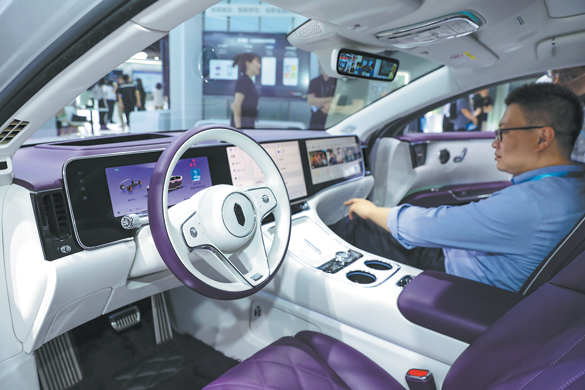
Transformation of two cities glimpse into digital prospects









Here is another tale of two cities, Beijing and neighboring Tianjin, not so much like the one Charles Dickens wrote, but one of reinvention through data and digital vision. In the two northern municipalities of China, a new code is being written, one where algorithms assist decision-makers, cloud platforms streamline governance and urban life becomes more intelligent, responsive and inclusive.
At the Global Digital Economy Conference 2025 held in Beijing this month, officials, researchers and industry leaders came together not just to showcase technological achievements, but to articulate a future where smart governance forms the foundation of sustainable and people-centered urban development. Meanwhile, the 2025 Shanghai Cooperation Organization Forum on the Digital Economy Industry will be held in Tianjin from Thursday to Friday.
The challenges facing cities today are increasingly complex and interconnected. From traffic congestion to environmental degradation, from aging populations to public health emergencies, urban problems are no longer isolated or linear, as they are dynamic systems. Hence technology can offer a new paradigm, one that is proactive, data-driven and deeply integrative.
That paradigm shift is already taking place. In 2024, the added value of core industries of China's digital economy accounted for about 10 percent of GDP, while the total data output reached 41.06 zettabytes, marking a robust 25 percent year-on-year increase. These numbers reflect the expanding digital foundation upon which modern governance is being constructed.
Take Beijing, a megacity with a 23-million permanent population, for example. It is thoroughly promoting smart city construction, from comprehensively upgrading and optimizing sensing systems for road traffic and municipal infrastructure, to accelerating the development and iterative enhancement of high-level autonomous driving pilot zones.
Tianjin as a port city has leveraged advanced AI algorithms and data analytics to enable intelligent scheduling and management of port operations, significantly improving overall efficiency. In addition, Tianjin's intelligent manufacturing sector continues to grow, integrating AI technologies to automate and optimize production processes, thereby enhancing both product quality and production efficiency.
These two cities are just examples of how Chinese cities develop smart governance in accordance with their own realities. Cities serve as comprehensive platforms for advancing the construction of a digital China. Promoting urban digital transformation and smart development is not only key to building new competitive advantages for cities in the future, but also a necessary step toward modernizing urban governance systems and capabilities.
By ensuring that data integration, development and application run through the entire process of digital transformation, cities can better support high-quality development, efficient governance and a high-quality life for residents.
Smart governance is not about replacing human judgment with machine logic. It is about expanding the capabilities of urban managers, enhancing the responsiveness of institutions, and, ultimately, improving the daily lives of residents. It means fewer forms to fill, shorter waiting times, cleaner streets, more secure neighborhoods and a greater sense of agency among citizens.
The country has unveiled a guideline on promoting the development of smart cities and urban digital transformation to make urban management smarter. By 2027, China expects to see significant progress in the digital transformation of urban areas and to have built a number of livable, resilient and smart cities.
The transformation underway in urban areas suggests that the age of digital cities is not a distant dream. It is already happening, quietly and deliberately. Every city's story is more than a tale. It is a glimpse into the future of urban China, and perhaps, the world.





Today's Top News
- China to apply lower import tariff rates to unleash market potential
- China proves to be active and reliable mediator
- Three-party talks help to restore peace
- Huangyan coral reefs healthy, says report
- PLA conducts major drill near Taiwan
- Washington should realize its interference in Taiwan question is a recipe it won't want to eat: China Daily editorial