Unit 731 atrocities a deep wound that can't be forgotten
As 80th anniversary of war victory nears, memories of Japanese crimes still vivid










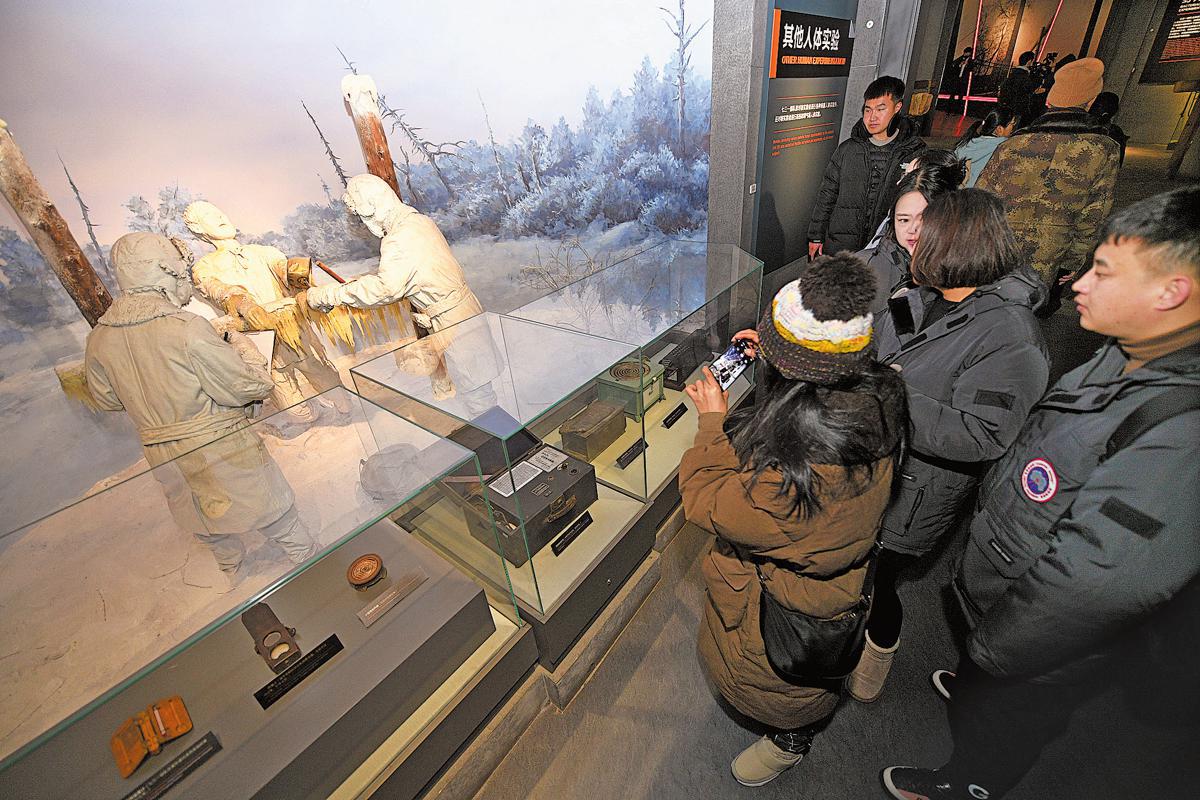
Experiments on the living
After developing various lethal infectious bacteria, such as plague, anthrax and cholera, experiments were conducted under conditions closest to a battlefield environment.
Tomio Karasawa, a former member of Unit 731, twice participated in experiments using bacteria to infect the living people. One was conducted in field conditions at a shooting range near Anda, a county around 120 kilometers far from Harbin.
"At the end of 1943, I took part in the experiments using the anthrax bacteria for the first time when 10 living people were involved in the experiment," Karasawa said in his testimony. "They were tied to the pillars at a distance of five meters and then we released the bacteria to infect them by using the broken pieces of the bomb which were 50 meters away from them.
"Some of them were infected and were sent back to Unit 731," he said. "Later I learned from the report that the infected were all dead."
The second experiment was conducted in the spring of 1944 in Changchun, Jilin province, with plague bacillus.
"A metal bucket filled with plague bacilli was put 10 meters away from the people, and then we detonated the metal bucket," he said. "However, as far as I know, the experiment failed."
In 1939, Unit 731 put biological weapons into use for the first time in the attacks against the Soviet Union in the Battles of Nomonhan. After that, Unit 731 twice organized expeditions to carry out biological warfare along the Zhejiang-Jiangxi Railway, in the provinces of Hunan, Jiangxi, and Zhejiang.
From 1941 to 1945, the Imperial Japanese Army chose to massacre people in Yuxian county, Shanxi province, by combining the release of bacteriological weapons and poison gases, historians said.
"Yuxian was an important part of Jinchaji base of resistance against Japanese aggression," said Gao Feng, director of the county's Party History Research Office. "The Japanese army carried out biological warfare in the region with the aim of undermining the Chinese people's will in resisting Japanese aggression, destroying the economic foundation of that resistance, and cutting off the logistic and troop support for the forces that were under the leadership of the Party, rendering them defenseless, and achieving their goal of long-term occupation."
He added: "There is a call to the international community to condemn and prohibit the research and use of biological weapons, providing people worldwide with a harmonious and safe living environment."