Toyota's EV plant in Shanghai has big plans









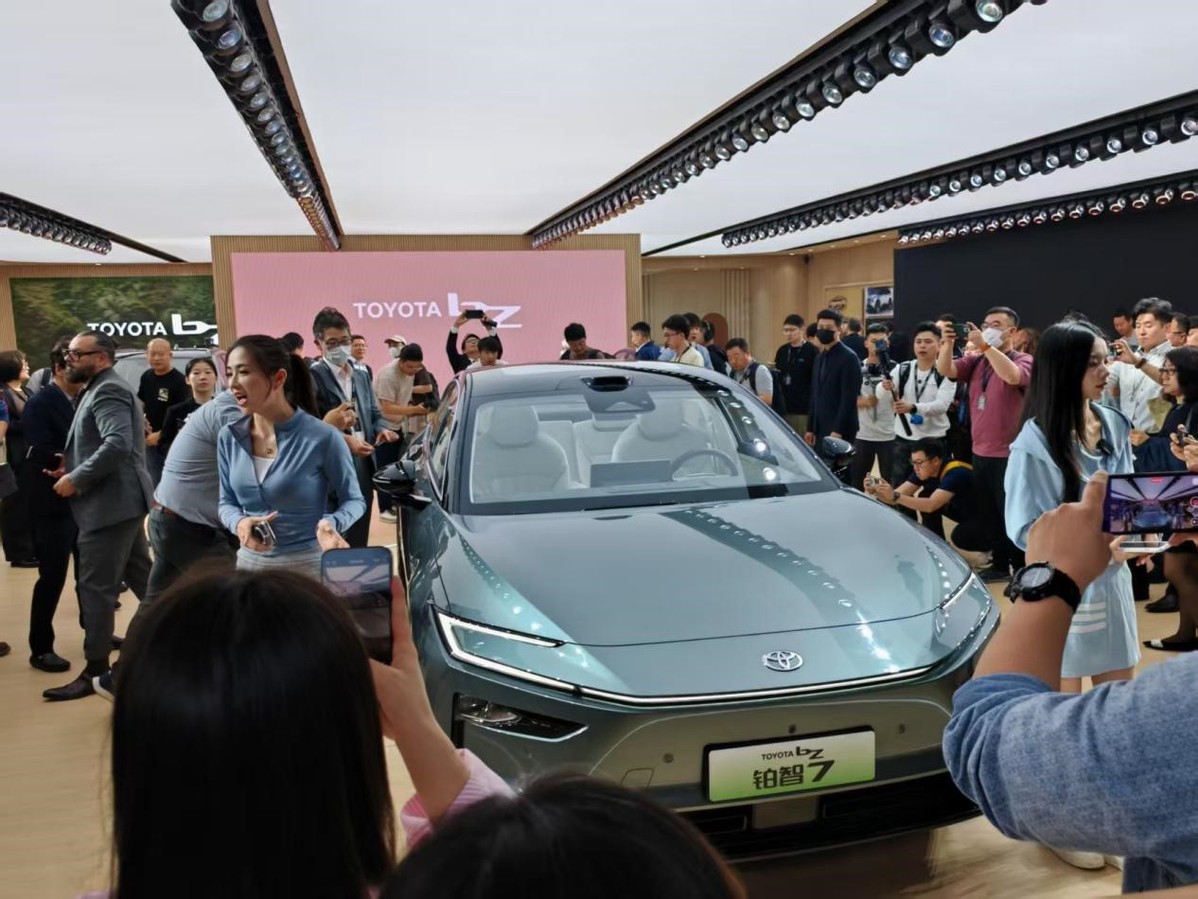
In less than five months, a wholly owned electric vehicle plant of Japanese automaker Toyota launched construction in Jinshan district, Shanghai, after the initial cooperative framework, demonstrating the Chinese economic hub's attractiveness for international investment and the city's determination to develop a world-class new energy vehicle industrial ecosystem, said officials and experts.
The project is the world's first overseas NEV production base established by Lexus, the luxury arm of Toyota. Officially breaking ground on June 27, the Lexus new energy project involves an investment of 14.6 billion yuan ($2 billion), Shanghai-based newspaper Jiefang Daily reported. It is slated for completion in August 2026 and scheduled for production in August 2027, with an initial annual capacity of 100,000 units.
Chen Jian, deputy director of Jinshan district's investment promotion office, called the project a recognition by the world's leading automakers of China's manufacturing capabilities in NEVs, including research and development, product reliability, stability, quality, as well as the overall supply chain.
"What is more important is the strong willingness and confidence of this particular investment by Toyota, especially considering the complex and sensitive global environment," said Chen, adding that the 107.1 billion yen ($732 million) registered capital was fully put in place on March 17.
The Jinshan project is set to develop and produce Lexus-branded EVs and batteries, Toyota said.
"The Lexus project is among one of the latest big-ticket foreign investments made in Shanghai and China as a whole, which is the recognition of China's prime business environment and local governments' strong commitment to serving corporations," said Qi Xiaozhai, vice-chairman of the Commerce Economy Association of China.
"On top of the fine environment, China's broad market, strong economic growth, robust industrial infrastructure and highly abundant talent pool all contribute to international investors' decision-making," Qi said.
"In the era of new energy vehicles, Shanghai, which has a complete automotive industry chain, is the natural choice for Lexus," said Peng Xijun, general manager of Shanghai New Jinshan Industrial Investment & Development Co Ltd.
Peng said the company's preliminary research found that the mature automotive industrial chain in the Yangtze River Delta region is key to price advantages of China's NEVs.
"Jinshan district alone is home to 159 support enterprises along the automotive industrial chain. Be it rear-view mirrors, interiors or chips, you can find all mature suppliers here," he said.
Sun Lijian, director of the Financial Research Center at Fudan University, said that China's opening-up is progressing into a new stage amid the complex global economy environment, and its complete industrial chain, innovative policies in supporting foreign investment, and development opportunities are all attractive to foreign investment.
Sun said Shanghai and the Yangtze River Delta region have formed the world's most complete NEV sector that has attracted top enterprises including Chinese EV battery maker Contemporary Amperex Technology Co Ltd, Chinese automaker BYD, autonomous driving brands of Baidu Apollo and Huawei, as well as all-around parts, components and service providers ranging from chip research and development to charging piles.
"In fact, within a 200-kilometer radius of the Jinshan project, there are more than 3,000 parts and components companies that have formed a new industrial chain development pattern," Sun said.
Because of the unparalleled supply chain, it is hard to make a new energy vehicle at competitive cost anywhere outside Shanghai or the Yangtze River Delta region, he added.
"In the meantime, the region's comparatively strong consumption capability also offers an ideal market for future NEVs. Thanks to the localized innovation-driven ecology, foreign-funded enterprises are shifting their business model from 'made in China' into 'made for China'," Sun said.