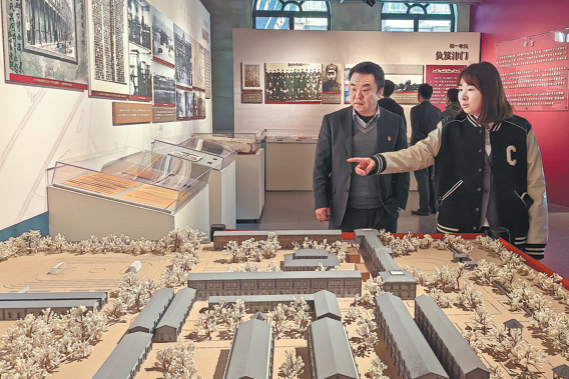
Affable president reforms governance at university









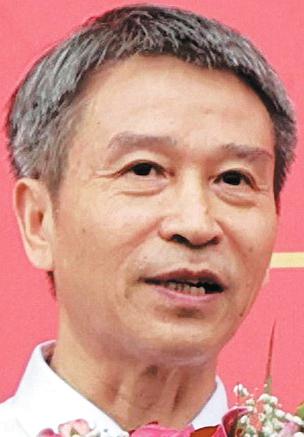
A seemingly casual move by a new university president four years ago — publicly sharing his personal cellphone number with students — became the catalyst for transforming the institution's governance model.
In September 2021, Kong Jianyi, the newly appointed president of Wuhan Technology and Business University in Hubei province, shared his cellphone number with freshmen students during orientation.
He told students, "As your president, I am very willing to listen to each of your voices. Please note down my mobile number. Whenever you encounter any difficulties or problems in your study or life, you can contact me at any time. I will do my utmost to help every student."
He added that while he may not be easily reachable by phone due to meetings or classes, he would "definitely reply" to text messages.
Over these four years, Kong has received and personally responded to more than 30,000 text messages from students. These messages covered a wide range of issues, including academic needs, teaching management, logistics services and student rights.
Upon receiving texts, the president typically replies to students before entrusting relevant departments to handle the issues as they arise. Examples included requests for more self-study rooms, extended library hours and air conditioners in study areas.
In one instance, a student texted, "What should I do, it seems I cannot get up in the morning?" Kong responded that getting up early and having self-discipline are beneficial habits. He then began running in the mornings on campus, with more students joining him.
For reasonable requests, Kong personally coordinated responses, urging relevant departments to find solutions. For example, after a student texted about being unable to enroll in a desired course, the academic affairs office speedily updated the course selection system and added the requested courses. Even a playful text asking for "roasted chicken like other universities (offer) their students" resulted in the university treating all 18,000-plus teachers and students to a crayfish meal during the university's anniversary celebrations.
Responding to external skepticism on whether sharing his number was a fleeting impulse or a publicity stunt, Kong, while speaking at a recent graduation ceremony, shared a story of how a former principal's actions inspired him.
He was among the first candidates after the resumption of China's national college entrance examination in 1977. With only about a month to prepare after the October announcement for the December exam, his high school principal in Shangrao, Jiangxi province, organized a revision class for top students.
"If the principal hadn't offered that class, I might not have gotten into university," Kong reflected more than 40 years later. "A good principal truly can change a student's fate."
He believes going above and beyond in one's duties adds warmth to education, a quality he has embodied by consistently teaching undergraduate classes throughout his career.
This dedication and people-centric approach have propelled the university into the spotlight over the past four years. Dubbed "the president from other people's universities", Kong and the institution gained unprecedented attention, with netizens hailing it as "the warmest university".
The president's initiative to make his phone number available, coupled with his commitment to respond to questions and requests, became key to unlocking university governance, prompting the integration of all 19 functional departments.
In late 2022, Kong tasked the university office and other departments with creating a separate "President's Express" platform. Launched on April 23, 2023, this platform operates within the university's WeChat system, allowing students and staff to report problems online, check on the status and receive feedback.
Within the platform, the president is not merely a figurehead but actively leads, supervises and holds departments accountable. The platform's management rules stipulate that for general matters, relevant units must provide an initial response within four working hours, with a resolution reached generally within three working days. Urgent matters require immediate action, potentially including on-site handling, and should be resolved within one working day.
Overdue cases trigger automatic reminders to the department head, the relevant vice-president and the president himself. The president's office summarizes platform operations weekly, and user satisfaction with resolutions included in year-end departmental assessments, driving efficiency and service quality.
The platform's effectiveness is evident. For example, graduate student Liu Haitao reported poor air conditioning in a library study room last year via the platform and received feedback from the logistics management department the same day. Two new high-powered air conditioners were installed by the third day. Liu, who successfully pursued postgraduate studies, said he felt like "a cherished child" throughout his years at the university.
Xu Ji'an, deputy director of the logistics management department, noted the platform eliminates bureaucratic layers, speeding up problem-solving and helping departments identify issues faster.
Since its launch, the platform has handled more than 5,600 student requests, with an average resolution time of 15.1 hours, a first-time resolution rate of 98 percent and a student satisfaction rate of 96 percent.
As the platform became more efficient, the texts Kong received evolved. Complaints and suggestions decreased, replaced by messages of gratitude and warmth. Li Yu from the School of Artificial Intelligence shared job offer news in a text, while Tang Wenjing from the logistics school thanked the university for free postgraduate training, which eased financial pressure.
zoushuo@chinadaily.com.cn