The orchid ethos illuminates a turbulent world









The Global Civilizations Dialogue Ministerial Meeting held last week in Beijing under the theme "Safeguarding Diversity of Human Civilizations for World Peace and Development", along with side events such as the ceremony for the Orchid Awards for promoting cultural exchanges, signifies a high point of China's endeavor to champion mutual learning among civilizations. The initiatives are a distinct ray of hope in today's tumultuous global landscape.
As noted by Irina Bokova, former UNESCO director-general and recipient of the second Orchid Awards for Lifetime Honorary Award, 2025 is a "year of commemorations": the 80th anniversary of the victory in the World Anti-Fascist War, as well as the Chinese People's War of Resistance Against Japanese Aggression (1931-45), and the founding of the United Nations.
Yet top Chinese diplomats, including Foreign Minister Wang Yi and China's Permanent Representative to the United Nations Fu Cong, have invoked a potent metaphor to describe a worrying situation: the obsession with power politics has unlocked a "Pandora's box" of the law of the jungle, fueling chaos across the world. This warning reflects fears that the world risks regressing to prewar conditions.
On one front, conflicts continue to rage in Europe and the Middle East, claiming lives daily. On another, tariff and trade wars escalate in battlefields devoid of gunpowder smoke. The global political and economic orders face unprecedented uncertainty, with fragility and turmoil being more acute today than at any point in the past eight decades.
"In a world where transformations and turbulences are interwoven and humanity stands at a new crossroad, there is an ever-pressing need for civilizations to transcend estrangement through exchanges, and to transcend clashes through mutual learning," said President Xi Jinping in his congratulatory letter to the ministerial meeting.
A consensus emerged that greater divergence demands deeper listening, sharper social fractures necessitate bridge-building, and heightened global instability calls for civilizational strength.
Fundamentally, both geopolitical clashes and economic confrontations stem from zero-sum logic and a jungle-law mindset. "Since wars begin in the minds of men, it is in the minds of men that the defences of peace must be constructed" — the maxim inscribed on the stone stele in multiple languages at the UNESCO Headquarters — is often cited to elucidate the bond between global peace and human civilization.
Over the past decade, China has established itself as a proponent and leader of civilizational dialogue. In 2014, President Xi first proposed the concept of "mutual learning among civilizations" at the UNESCO Headquarters. In 2019, he addressed the Conference on Dialogue of Asian Civilizations in Beijing. In 2023, following the proposal of Global Development Initiative and the Global Security Initiative, he put forward the Global Civilization Initiative, presenting a systematic Chinese perspective on civilization. In 2024, the UN General Assembly adopted a resolution proposed by China establishing June 10 as "International Day for Dialogue among Civilizations".
While achieving lasting peace involves complex theories and practices of international relations, cultural cognition and civilizational outlook remain pivotal.
In 1966, British scholar Martin Wight posed a seminal question: "Why is there no international theory?" He argued that unlike political science, international politics lacked "progressive interpretation" because it addresses an anarchic society — a mere "theory of survival" on a "recurring process" without teleological improvement.
Chinese modernization explores new civilizational paradigms, and likewise, the Global Civilization Initiative, alongside initiatives on global development and security, advocates a worldview aligned with humanity's collective interests.
"All things flourish without harming one another; paths unfold without conflicting" — that has always been a foundational tenet of Chinese culture. Yet when voiced during eras of weakness, such appeals to harmony, though morally just, often rang hollow in the past. Today, China's vigorous advocacy for cultural dialogue carries unprecedented resonance, offering the world singular significance.

The author is chief researcher at the China Watch Institute, China Daily.




Today's Top News
- China to apply lower import tariff rates to unleash market potential
- China proves to be active and reliable mediator
- Three-party talks help to restore peace
- Huangyan coral reefs healthy, says report
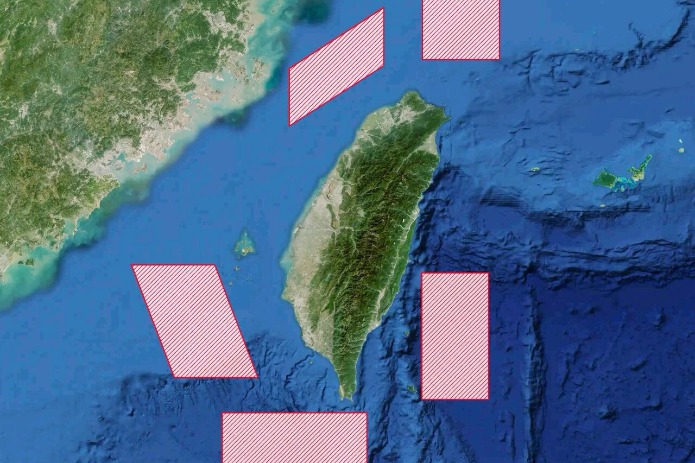
- PLA conducts major drill near Taiwan
- Washington should realize its interference in Taiwan question is a recipe it won't want to eat: China Daily editorial