In a breath of fresh air, old mines get a makeover









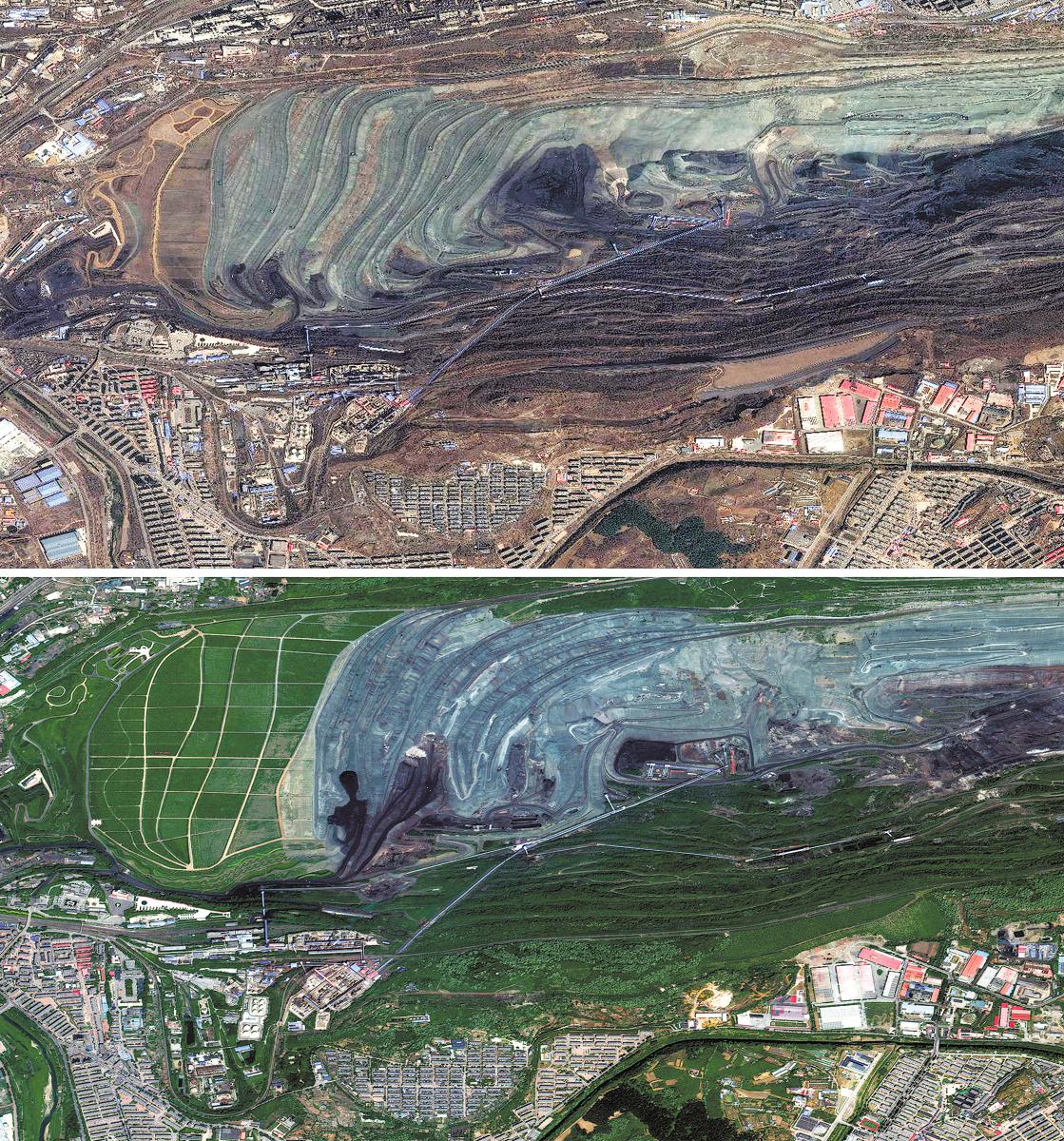
SHENYANG — Standing on the viewing platform of a coal mining museum in Fushun city, visitors can overlook a vast mine that is 6.6 kilometers long, 2.2 km wide and 420 meters deep. After years of restoration, the once dusty coal pit has transformed into a lush green space covered with vegetation and flowers, and is poised for redevelopment as a park.
Located in Northeast China's Liaoning province, Fushun's annual coal production once accounted for one-eleventh of the country's total. This mine, located west of Fushun, became operational in 1901 and had extracted over 280 million metric tons of coal before closing in June 2019.
Restoring the environment of abandoned mine pits is a common challenge worldwide. Faced with this large mine pit spanning over 10 sq km, local authorities have to address the wastelands, the exposed slopes, and ecological damage caused by mining for over a century.
In the backfilling area, workers operate bulldozers and loaders to stabilize the terrain with mudstone, lean ore and mineral waste. The soil is compacted and treated for fire prevention and water retention. It is also enriched to support plant growth and ensure high survival rates for new vegetation.
After backfilling, workers spread a one-meter-thick layer of soil. To date, over 3.9 million trees of more than 40 varieties have been planted, creating a diverse ecosystem of trees, shrubs and grasses.
"The restoration has significantly improved the environment," said Zhang Zhenyu, who worked on this mine pit restoration project for an eco-environment company. "Vegetation and biodiversity have increased, air quality has improved, and soil pollution levels — including those of arsenic, plumbum and nickel — are declining."
At the bottom of the vast pit, workers in hard hats clear dead leaves and tend to plants. On the observation deck above, locals and museum visitors pause to enjoy the lush greenery that now covers the once-barren landscape. "The sky is bluer, and there are more birds now," said Zhu Chenghao, a nearby resident. In the past, dust and waste from mining polluted the air. Today, however, tens of thousands of honey locust and ash trees thrive across the restored slopes.
"Before, the wind blew dust everywhere and every breath smelt like dust. But now, I like coming here for walks under the trees, where the shade and fragrance are refreshing."
Future plans include transforming the site into a low-carbon demonstration zone with cultural, recreational and eco-tourism facilities.
Similar transformations are unfolding across China.
In Yucun village, East China's Zhejiang province, where quarrying once dominated the local economy, abandoned mining sites have been transformed into cultural landmarks.
The former pits and old factories now house youth libraries, vibrant farmlands and trendy spots. Cafes and teahouses with cultural themes have become popular attractions, marking the village's successful transition to an economy driven by eco-tourism and innovation.
In Qian'an city, North China's Hebei province, locals have converted mine pits into cold-water fish farms. They also cultivate vegetables such as lettuce and water spinach on floating platforms, to maximize resource utilization by growing fish and vegetables simultaneously.
By the end of 2024, China had rehabilitated over 333,300 hectares of abandoned mines, including 26,200 hectares in 2024 alone, according to the Ministry of Natural Resources.
"Mine restoration must address geological risks and ecological recovery while exploring adaptive reuse, like farming or cultural industries, and maintain post-restoration monitoring to prevent land degradation," said Hu Haifeng, a professor at Taiyuan University of Technology in Shanxi province.
Xinhua






- Nobel laureate in chemistry: Give young scientists more independence
- Are Asians really better at math?
- How to navigate the potential competition engendered by AI?
- Xi to attend opening ceremony of National Games, declare Games open
- Rare bird spotted for second time in Hainan county
- Deep-sea AI tool powers up marine research, poised for global use