Across China: 80 years on, US youth carry the Flying Tigers' torch









WUHAN -- As Max Rasilla wheeled his suitcase through the bustling halls of Wuhan Tianhe International Airport in Central China earlier this week, the Alfred University student felt a reluctant tug at the thought of ending his two-week journey in China.
"I don't want to leave China," Rasilla said. "I have a 10-year visa, so I'll be able to come back, and next year when I come back, I'll be a little bit more fluent [with my Chinese]," said Rasilla, 22.
Rasilla fell in love with pandas since his childhood and once dreamed of becoming a panda keeper. That innocent fascination sparked his interest in learning Chinese, a journey that has since grown into something far more enduring. Now, as someone majoring in ceramics art, Rasilla feels Chinese philosophy and culture are very inspirational for his artworks.
He was among nearly 100 participants — mostly US students along with a few entrepreneurs — who traveled across China from July 17 to 30 to honor the legacy of the Flying Tigers, the American volunteer pilots who fought alongside Chinese forces against Japanese invaders during World War II.
As this year marks the 80th anniversary of the victory in the Chinese People's War of Resistance against Japanese Aggression and the World Anti-Fascist War, Jeffrey Greene, chairman of the Sino-American Aviation Heritage Foundation, led the delegation to retrace the footsteps of the Flying Tigers through Beijing, Xinjiang, Shaanxi and Hubei.
The participants, hailing from over 10 US high schools and universities, not only revisited a pivotal chapter in the Sino-American history but also began forging new people-to-people bonds.
"During the war, the Flying Tigers came to China and fought bravely alongside the Chinese people," said Catherine Greene, Jeffrey's wife, in fluent Mandarin. "Now, as US-China relations face many challenges, we, the younger generation, must be the new Flying Tigers of our time and contribute positively to bilateral relations."
HONORING FLYING TIGERS LEGACY
"I didn't know about the Flying Tigers before I came here," said Rasilla. "Now I think their mission is really important. The connection between the Chinese and American people is so important. For our generation, as we grow older and take on leadership roles, maintaining a good relationship is essential."
The Flying Tigers, officially known as the American Volunteer Group of the Chinese Air Force, was formed in 1941 by US General Claire Lee Chennault to help China in its fight against invading Japanese forces.
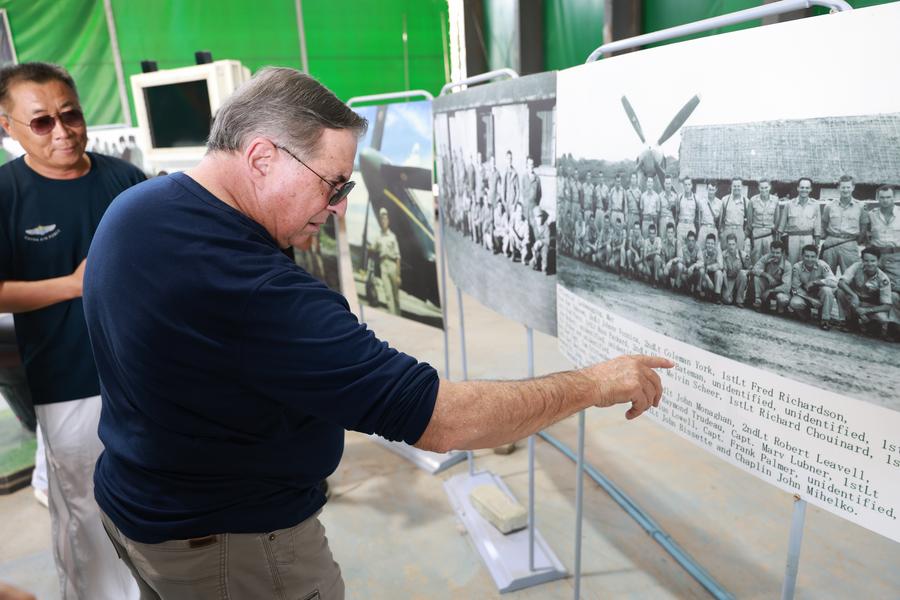
The story of Glen Beneda left a deep impression on many participants. In 1943, Beneda, then aged 19, was dispatched to China as a fighter pilot in the 14th US Air Force. During an attack on a large Japanese army base in Central China's Hankou the following year, the tail of Beneda's plane was hit and the aircraft crashed into Xiafeng Lake in Jianli county, Hubei province. Beneda survived by parachuting into a nearby rice paddy, but he was severely wounded and could barely move.
Realizing he was an American soldier, farmers and soldiers risked their lives to transfer him on a stretcher across Japanese-controlled areas under the cover of night.
After 23 grueling days, Beneda finally arrived at the Fifth Division of China's New Fourth Army led by Li Xiannian, who later served as Chinese president from 1983 to 1988. There, the US pilot gradually recovered and formed deep friendships with Chinese soldiers, even sharing games of ping pong with them.
The veteran later returned to China several times with his family. "I owe a debt to the Chinese people who have been so good to me," he said in a documentary. When he passed away in 2010, part of his ashes were buried in the memorial park of the former residence of Li Xiannian in Hubei's Hong'an county.
The sacrifices of the Flying Tigers were profound. A total of 2,193 members of the Flying Tigers lost their lives while supporting China and Myanmar during World War II. During battles, more than 200 downed pilots were rescued by Chinese civilians, and thousands of Chinese people died aiding them.
While visiting Hong'an, the student delegation laid chrysanthemums at the memorial site. Some were moved to tears while watching "Touching the Tigers," a documentary about Beneda's story.
Among the students was Lili Li, visiting China for the first time with her mother Anna Li, who is the daughter of Lieutenant Kuo Ching Li, the only Chinese-American Flying Tiger.
"I feel that the bond between the United States and China has been so strong these past decades," Lili Li said. "For me, being able to carry that connection forward, especially in today's world, is one of the most important things."
During their visit to northwestern China's Xinjiang Uygur autonomous region, the delegation learned about the heroic "Hump Route" over the Himalayas, which was used to deliver vital supplies to Chinese troops fighting Japanese invaders.
"We learned all about how they supported China and how the Chinese supported the Americans during the War of Resistance against Japanese Aggression," said Giacomo Weil, a student from the Central High School in Philadelphia.
"The Chinese made a ton of sacrifices and gave up their food so that the Flying Tigers could fly and make missions against the Japanese. It was really awesome to see that beautiful link between China and the United States," said Weil, 18.
FORGING NEW BOND
While paying tribute to wartime heroes, the members of the delegation also immersed themselves in rich and diverse cultures, experiencing a different side of the US-China relationship, one defined by youth dialogue, shared interests and mutual curiosity.
In Beijing, the students visited the Temple of Heaven and the Great Wall. In Turpan, Xinjiang, they explored the Jiaohe Ruins, one of the world's best-preserved, longest-lasting and largest clay-built city relics, as well as the Karez wells, witnessing the resilience and ingenuity of ancient Chinese civilization.
"Very eye-opening. I didn't know that China had a wild west, too. We don't learn much about Xinjiang or any of those western regions of China, which was very interesting to me," said Sarah Destiny Golovey, a junior student at California State University, Sacramento.
They also visited Yan'an, a historically significant city in Northwest China's Shaanxi province. "It was really cool, really beautiful," Weil said. "China is so vast. In contrast to the desert in Xinjiang, Yan'an has green hills, and we saw the Yellow River. I even got to visit the Hukou Waterfall. But in every city I visited, the hospitality has been absolutely amazing."
In Wuhan, cultural exchanges came alive on the students' first evening during a welcome cruise, where local university students performed traditional dances, played the guzheng (Chinese zither), and sang English pop songs.
For Vrishab Kaushik, Weil's schoolmate, the surprise came when he first downloaded WeChat. "I didn't expect it to handle payments, travel arrangements, and almost everything in one app. Pretty cool," Kaushik said.
Rasilla said the trip is just the beginning. "My goal is to pass the Chinese proficiency test level five and come back to pursue a master's degree in Jingdezhen next year," he said. "And probably I'll go back to America to teach Chinese language and culture to more American students."



- National Games vibe is everywhere in Guangzhou
- Forum unites global experts to enhance city image communication
- Miao New Year celebrations get underway in Guizhou's Leishan county
- Mainland spokesman reiterates stand on Taiwan
- Fujian county's rural development becomes a big draw for Taiwan investors
- Nobel laureate in chemistry: Give young scientists more independence