New tariff threat to ensure the chips fall to US









US President Donald Trump said on Wednesday that the United States will impose a tariff of about 100 percent on imports of semiconductors, but he offered a big exemption — it will not apply to companies that are manufacturing in the US or have committed to do so.
Although he has not clarified the terms, the mixed performances of tech companies in the stock market following the announcement clearly indicate which of them the market thinks will benefit from the exemption — mainly the big players such as Nvidia, Apple, Intel, Samsung and TSMC all of whose share price saw a marked rise — and those that will not, such as Tokyo Electron and Renesas Electronics.
The rates on semiconductors and other key tech goods have been subject to a US national security probe, the results of which are expected to be announced by mid-August. By choosing to jump the gun by making public the 100 percent tariff threat, the US administration is obviously intent on goading the tech companies that have not yet made a commitment to invest in the US into doing so.
Grabbing the initiative in market expectation management has always been a key part of the US president's "art of the deal".
Notably, the US president also warned that companies should not try to wrangle out of pledges to build US factories, exposing the coercive nature of the new tariff threat. "If, for some reason, you say you're building and you don't build, then we go back and we add it up, it accumulates, and we charge you at a later date, you have to pay, and that's a guarantee," Trump stressed.
Last year, the US produced about 12 percent of semiconductor chips globally, down from 40 percent in 1990, according to the US Commerce Department. But that's because US companies have relocated their factories to economies with lower production costs. The major semiconductor exporters to the US include China's Taiwan island, the Republic of Korea, Japan, Malaysia, Vietnam, Ireland and Israel.
Despite this, the US had a reported $11 billion trade surplus in semiconductors in 2024. If the profits US tech companies make from their localized productions for the US market in other economies are taken into account, the US actually benefits tremendously from the growing global manufacturing network its tech companies have built. It enables them to benefit from cheap labor price, low taxes, rich raw material reserves and closeness to the emerging markets.
This process also helps lower the price of semiconductors, expands their application, and enables the companies to increase their input in R&D.Demand for computer chips has been climbing worldwide for years, with sales increasing 19.6 percent year-on-year for the year ended in June, thanks to the globalized manufacturing and R&D operations of the industry, according to the World Semiconductor Trade Statistics organization.
Compared with its predecessor's approach, which relied on subsidies and tax cuts that proved hard to apply for, the US administration's tariff threat has reaped some immediate effects. Some big-name companies have invested or have promised to invest tens of billion or even hundreds of billion dollars in the US. This has left the smaller companies scrambling to please the administration for a favorable rate with the best they can offer.
But the problem is such compelled reshoring will push up the prices of not only chips but also those of electronics, autos, household appliances and other essential products dependent on the processors powering the digital age, as the Associated Press has noted.
A key reason why the US leader emphasized the investment commitments must be realized is that he is well aware the higher production costs in the US mean some of the investment promises might not be delivered on, as the rising cost will necessarily eat into the narrow margins that smaller tech companies in the industry survive on.
Such a US-centered, big company-favoring reshuffle of the semiconductor sector looks set to widen the tech gap between the US-led club and the rest of the world, as well as those between different groups of companies, enabling the former to better exploit the latter by taking advantage of their increasingly obvious technological dominance.
That will make the whole business unsustainable in the long run. The tariff threat will spur companies, big and small, to reassess their global production and supply strategies and seek more resilient diversified layouts so as to better manage the uncertainty brought about by US policies.



Today's Top News
- US?arms sale only a?'bomb' to Taiwan
- China-Cambodia-Thailand foreign ministers' meeting reaches three-point consensus
- Drills demonstrate China's resolve to defend sovereignty against external interference
- Trump says 'a lot closer' to Ukraine peace deal
- China pilots L3 vehicles on roads
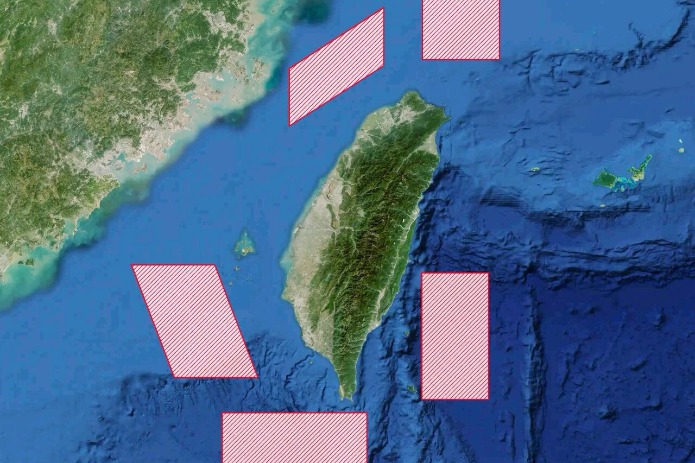
- PLA conducts 'Justice Mission 2025' drills around Taiwan