Wumart, Aldi, HotMaxx, Guanpark join discount frenzy
Move aims to attract consumers seeking low prices, high-frequency essentials amid broader shift to value-driven retail









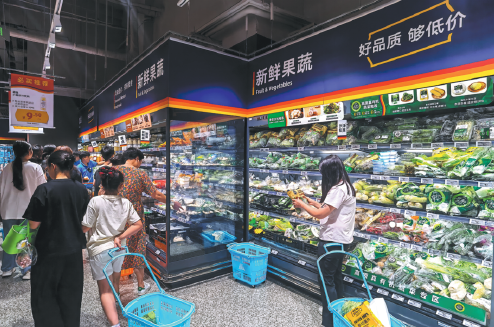
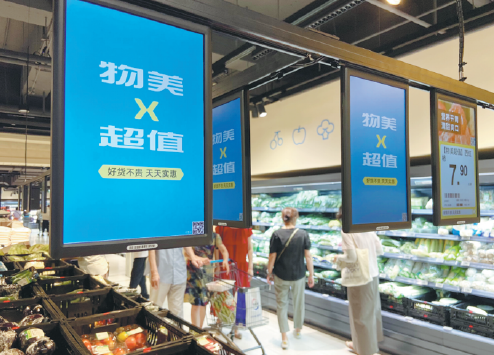
Beijing-based retailer Wumart Group recently unveiled its new hard discount supermarket format — Wumart X Super Value — with six stores opening simultaneously across the capital, aiming to attract consumers seeking low prices and high-frequency essentials amid a broader shift toward value-driven retail.
The new stores — located in five districts — mark Wumart's first foray into the discount sector and the first such chain in the Beijing market. The format emphasizes limited products, private-label dominance, direct sourcing and lean operations.
"The discount model of Wumart X Super Value is not only an innovation in retail formats, but also a pioneering breakthrough in the Beijing retail market," said Xu Lina, Wumart Group spokesperson. Hard discount stores offer products at more affordable prices by cutting down on marketing, merchandising and other operational costs, such as packaging, sales assistants, store space and air conditioning.
Each location offers fewer than 1,300 stock keeping units across six high-turnover categories — fresh produce, meat and seafood, baked goods, ready-to-eat meals, and daily-use goods. More than 60 percent of the assortment consists of Wumart private-label products, priced aggressively to undercut traditional supermarkets and bigbox chains.
In order to provide affordable prices to consumers, Wumart X Super Value follows a low-cost structure through full-chain efficiency. Products are sourced directly from manufacturers, packaged in "factory-to-shelf" formats and stocked without secondary handling. The stores run entirely on self-service systems, eliminating service counters and trimming labor costs.
"We conduct category-wide reviews four to six times a year and benchmark prices weekly across platforms," Xu said. "There are no promotions — our pricing is low every day by design."
The bakery department highlights this model in practice, said the retailer. Using exclusive recipes and imported ingredients, the stores sell small-batch, freshly-baked items throughout the day. A butter croissant made with 22 percent European fermented butter retails at 5.9 yuan ($0.82), while a maple walnut pastry made with North American walnuts and Canadian syrup sells for 7.9 yuan.
Regarding beverages, Wumart offers a 1-liter non-genetically modified organisms soy milk at 5.9 yuan and 100 percent grape juice from Spanish grapes at 9.5 yuan. Imported salmon fillets are priced at 19.9 yuan per pack.
The format aims to serve cost-conscious, time-pressed urban consumers. All six locations are in high-density neighborhoods and are designed to support one-stop shopping for daily needs, said the company.
Wumart is entering the discount sector at a time when Chinese shoppers are increasingly price-sensitive. The company's new format is seen as both a defensive move against mounting pressure on margins and a bid to stake out leadership in the discount segment.
"Over the past two years, leading discount-format retailers have continued to capture market share through format upgrades and supply chain optimization," said Jason Yu, general manager of CTR Market Research. "Traditional supermarkets have also accelerated their entry into this space."
Yu said that the strongest growth in recent years has come from snack-focused discount chains. While most specialize in vertical categories, more general merchandise players are now attempting to replicate their success.
"Aldi's success in Shanghai has validated the discount model in China. They localize effectively and prove that even demanding consumers are willing to shift if value and quality align," Yu said.
Aldi expanded beyond Shanghai for the first time in April, opening stores in Suzhou and Wuxi in Jiangsu province. Sales in Shanghai rose 56.2 percent year-on-year in the first quarter, and penetration reached 20 percent of households, according to Kantar Worldpanel China. A new warehouse in Jiangsu supports regional logistics and fresh product distribution.
HotMaxx, one of the most prominent discount players, reported more than 25 percent year-on-year growth in the January-March period. Penetration in upper-tier cities increased by 1 percentage point. The company recently diversified into discount apparel and anime merchandise to draw in younger consumer segments.
Snack-discount stores overall reached 18 percent national penetration in the first quarter, with the fastest growth seen in town-level and lower-tier markets, according to Kantar Worldpanel China. Regionally, the south region remained a crucial area for discount snack store development.
"Discount retail demands efficiency across the entire chain — SKU control, private-label research and development, and supply chain optimization. Without those capabilities, it's difficult to sustain the model," Yu said.
Wumart's new format arrives as traditional supermarket formats see eroding foot traffic and rising costs. Retailers across China are under pressure to revamp operations and offer price-based differentiation amid slowing consumption growth.
"The move is a defensive echo to the current consumption demand for value for money," said Yu. "The key to success lies in finding balance between pricing and quality, and building a sustainable profit model through supply chain alignment and omni-channel capacity building."
Other than Wumart, Fujian province-based Guanpark Supermarket has grown its discount business with a strict SKU-reduction and cost-control strategy. Chairman Lin Yongqiang said during a recent industry conference that the company's "keep it simple" approach is key, which involves limited product selection, social media-driven merchandising and complete pricing control.
Guanpark avoids traditional supplier dependency and tracks e-commerce bestsellers and local supermarket data to inform purchasing. Its opportunistic sourcing and flexible cooperation with suppliers have allowed it to maintain price competitiveness in multiple regions. "Some peers buy products at prices higher than our retail prices," Lin said at a recent industry event. "They must rethink their product architecture to survive."



Today's Top News
- China to apply lower import tariff rates to unleash market potential
- China proves to be active and reliable mediator
- Three-party talks help to restore peace
- Huangyan coral reefs healthy, says report
- PLA conducts major drill near Taiwan
- Washington should realize its interference in Taiwan question is a recipe it won't want to eat: China Daily editorial