Starbucks, Luckin brewing up success in China's drinks market









Starbucks Corp posted solid third-quarter results in China, with revenue and same-store sales rising year-on-year and operating margin recording quarterly improvement, even as local rival Luckin Coffee Inc continues to expand at a breakneck speed.
Starbucks' revenue in China grew 8 percent year-on-year to $790 million in the quarter ended June 30, marking the third consecutive quarter of year-on-year growth, according to the company's July 30 earnings report. Comparable store sales rose 2 percent, supported by a 6 percent improvement in comparable transactions.
"China continues to grow and improve profitability," Cathy Smith, executive vice-president and CFO of Starbucks, said during the earnings call.
"The market's comp growth was driven by successful product innovation, including the new zero sugar full flavor platform, a strong integrated marketing campaign and outsized delivery growth."
Starbucks ended the quarter with 7,828 stores in China, after opening 70 net new stores and entering 17 new county-level markets. The company said new stores have maintained strong profitability metrics, with locations opened in the past two years continuing to outperform averages on same-store sales. Profit margins expanded sequentially, remaining in double digits.
"In the third quarter of fiscal 2025, we achieved robust growth as our business continued to gather positive momentum, with outstanding financial performance and healthy growth in key business metrics," said Molly Liu, CEO of Starbucks China. "We have continuously innovated with agility to enhance brand value and reinvigorate the customer experience."
Brian Niccol, chairman and CEO of Starbucks, also confirmed that the company is exploring strategic partnership opportunities to accelerate its China growth while retaining a meaningful stake.
"We've received significant interest from more than 20 parties," Niccol said. "The intense interest in partnering with us is a testament to the great team, strong brand and long-term opportunity for Starbucks in China. It really is a vote of confidence."
Starbucks' performance comes as domestic competitor Luckin Coffee continues its aggressive expansion, intensifying competition in China's $15 billion coffee market.
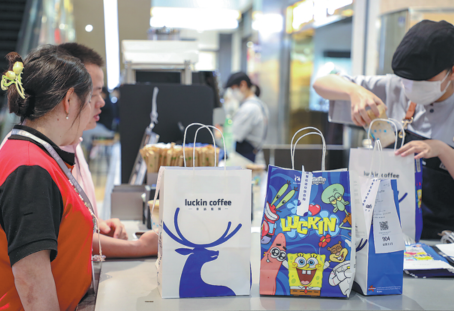
Luckin reported a 47.1 percent surge in second-quarter revenue to 12.36 billion yuan ($1.72 billion), driven by rapid store expansion and strong gains in same-store sales. The company opened 2,109 net new stores in the quarter — including 2,085 in China — bringing its total footprint to 26,206 locations globally. Store unit growth was 8.8 percent compared with the previous quarter.
Same-store sales at Luckin's self-operated stores jumped 13.4 percent, up from 8.1 percent in the prior quarter and a stark turnaround from the 20.9 percent decline a year earlier. Monthly transacting customers hit a record 91.7 million, a 31.6 percent year-on-year increase.
Revenue from self-operated stores rose 45.6 percent to 9.14 billion yuan, while operating profit from those stores grew 42.3 percent to 1.92 billion yuan. Store-level operating margin remained strong at 21 percent. Luckin also grew its partnership store revenue by 55 percent to 2.87 billion yuan.
Luckin's strong domestic momentum is allowing the brand to cautiously explore international markets. In the second quarter, the company opened six stores in Singapore, 16 in Malaysia and two in the United States.
"The US is a highly developed coffee market, and we remain in the early stages of exploration," said Guo Jinyi, Luckin's co-founder and CEO. "Through this early phase, we aim to establish Luckin's unique value propositions and customer experience in the US market, while building localized operational capabilities to support future scaled expansion."
According to market research institute Mintel Group China, both Starbucks and Luckin have reported strong growth in the Chinese market, driven by innovation and diversified beverage strategies.
What is worth noting is that amid intensifying competition and shifting consumer preferences, players in China's on-premises coffee segment are increasingly turning to non-coffee beverages and product innovation to fuel future growth, said Mintel China.
Roolee Lu, director of food &drink and food services at Mintel China, said the performance of Starbucks' iced shaken teas has more than doubled, and tea lattes continue to register solid gains. In June, Starbucks China reduced prices on dozens of non-coffee beverages as part of its "all-day beverage" strategy aimed at positioning coffee as a morning choice and tea-based drinks as afternoon staples.
"We're seeing that investment in non-coffee scenarios is beginning to pay off," Lu said.
Mintel research highlighted generational and gender-based differences in behavior. Consumers aged 18 to 24 are still in the early stages of exploring coffee, meaning what they order at coffee shops is often not coffee. Meanwhile, women aged 25 to 29 display a stronger-than-average willingness to try new products.
"After trying different products, consumers may gradually form preferences and consumption habits," Lu said. "This is why it's critical for brands to take a long-term view — accompanying consumers through their taste development journey and guiding them with diversified offerings."
The focus of the on-premises coffee industry has shifted to repurchase rates as a key operating metric, according to Mintel China.
"More than half of respondents say they're more likely to repurchase from brands whose values align with theirs," said Lu. "This value alignment ranks above even space and service."
New coffee channels are also emerging. "More food-service brands — from street beverage shops to quick-service restaurants — are adjusting their menu mixes to include more coffee," said Lu. "This not only drives up their own revenues, but also lifts the overall coffee market, especially by offsetting declines in average transaction value."
Looking ahead, the consumption potential in China's smaller cities is drawing increased attention.
"High-quality urbanization and narrowing income gaps are becoming more relevant," Lu said. "There's significant headroom for coffee house players to expand in lower-tier markets, including county-level and township areas."




Today's Top News
- US?arms sale only a?'bomb' to Taiwan
- China-Cambodia-Thailand foreign ministers' meeting reaches three-point consensus
- Drills demonstrate China's resolve to defend sovereignty against external interference
- Trump says 'a lot closer' to Ukraine peace deal
- China pilots L3 vehicles on roads
- PLA conducts 'Justice Mission 2025' drills around Taiwan