Future doctors explore transplant frontiers
From robotic arms to delicate sutures, students step into operating rooms, discovering the precision and compassion behind lifesaving medicine.









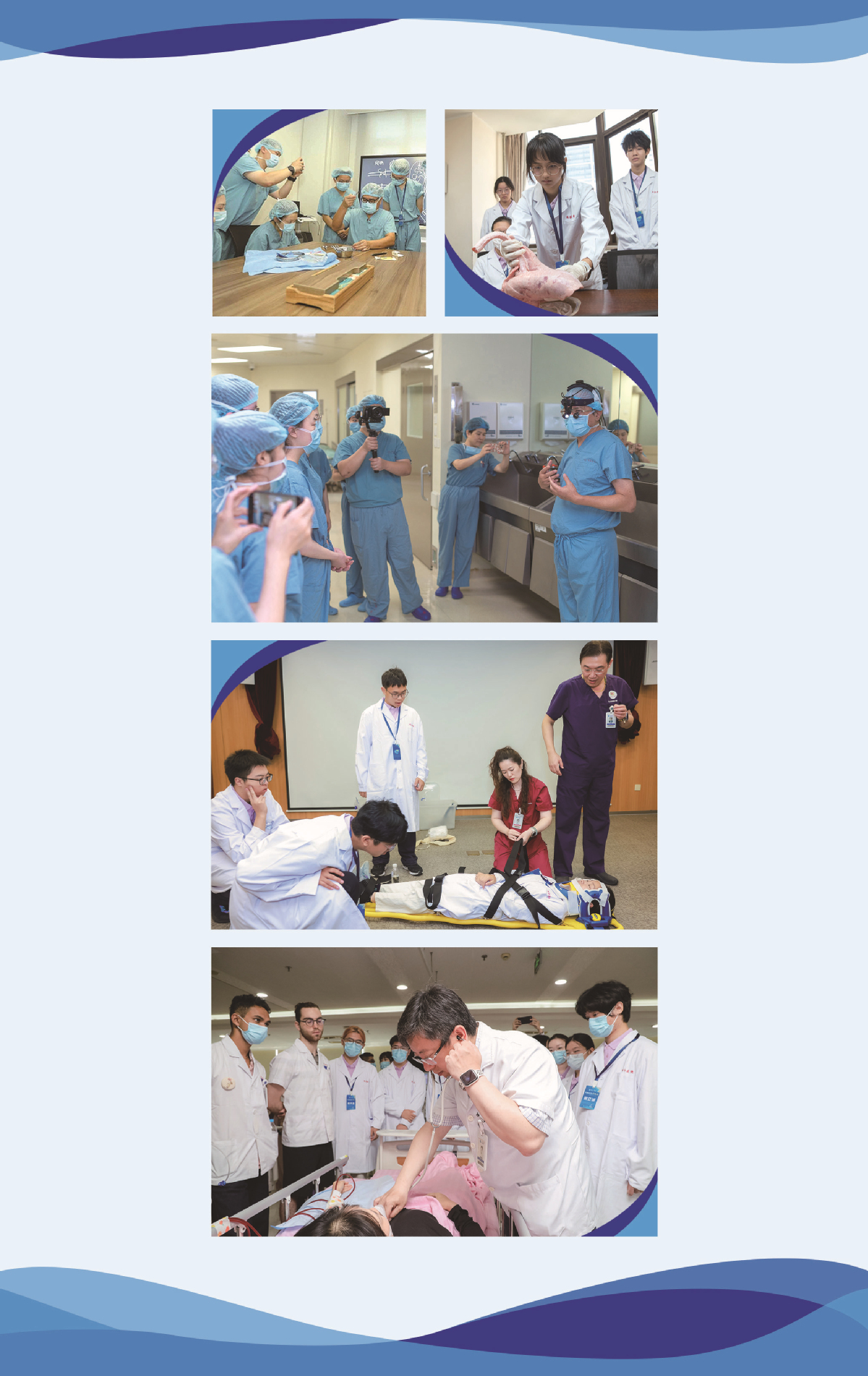
Organ transplantation has long fascinated young aspiring healthcare professionals. On Aug 13, Shanghai's Ruijin Hospital invited 60 high school and university students to its 12th Medical Experience Camp, giving them a handson introduction to the lifesaving field.
During the camp, participants explored the hospital's operating rooms, wards, and medical simulation center, guided by expert mentors through various medical scenarios that offered a close-up view of organ transplantation procedures. Many described the experience as a pivotal moment in their journey toward a medical career.
Hu Weiguo, Party secretary of Ruijin Hospital, which is affiliated with Shanghai Jiao Tong University School of Medicine, said the camp not only allowed young people to learn about medicine and appreciate the compassion of medical professionals, but also fostered a sense of reverence for life.
"Transplant surgery, as a pinnacle of medical achievement, exemplifies the perfect combination of teamwork and humanistic care," he said.
At the cardiothoracic surgery department, participants witnessed heart surgery led by Zhao Qiang, the department director. Some said observing a heart stop and restart felt like watching a "magic show of life".
The students also donned surgical attire themselves and practiced delicate vascular suturing, experiencing up close the precision required in cardiac surgery.
"I was amazed that a suture needle is even finer than a strand of hair, with operations conducted within millimeters. Yet the professor's suturing was incredibly agile and skilled. He truly has a pair of miraculous hands," said Ding Yunhan, a 17-year-old high school student from Shanghai.
Participants were also impressed by the extracorporeal circulation system, which temporarily takes over the heart's function, allowing surgeons to operate on a resting heart.
At the thoracic surgery department, students explored lung function through 3D models, examining the fine structure of the alveoli and bronchi both visually and by touch. They took turns to evaluate cardiorespiratory endurance related to lung transplantation and learned how indicators like heart rate and blood oxygen levels are monitored during the six-minute walk test.
Chen Sihan, a high school student from Shanghai and a camp participant, was captivated by the Da Vinci surgical robot demonstrated by department head Li Hecheng. Sitting at the control console, Li maneuvered the joystick with his fingertips while the robotic arm steadily entered the patient's chest cavity to precisely excise a lung tumor.
Beside him, three doctors closely monitored the screen: one handed over instruments, another assembled and disassembled the robotic arm, and the third monitored the patient's vital signs.
"What was so fascinating about all of this was that the entire procedure was completed with millimeter precision, executed so smoothly," Chen said. "This 'dance' between the surgeon's hands and the robotic arm was as precise as embroidery, quietly heralding the future of surgery."
At the urology department, students practiced kidney vascular suturing and learned the key steps of transplantation — from donor kidney preparation to the operation itself — in an immersive setting.
"When I placed my stethoscope on a patient's arteriovenous fistula, the sound of turbulent blood rushing through the vessel was astonishing — like the rumble of a train," said Xu Tianhai, a camp participant. "The doctor pointed to the throbbing pulse and told us, 'That is the tide of life'. In that moment, I realized nephrologists are not only the hydraulic engineers of the human body but also conductors of life's rhythm."
In the liver transplant ward, students observed the meticulous process of removing diseased liver tissue while preserving organ function. They also tried using a laparoscope to pick up beans — a task many found far more difficult than they had imagined.
"It was awe-inspiring," said Ding. "Scenes I had only seen on TV became reality today as I stepped into the mysterious and sacred operating room. I came away with a deeper understanding and greater respect for medicine."
Closing gaps
Throughout the camp, experienced doctors shared their career journeys and discussed both the challenges and the latest advances in organ transplantation. A recurring theme was the critical shortage of organ donors.
Experts noted that worldwide, a new patient is added to the organ waiting list every three minutes, yet only one in five receives the transplant they need. In China, the situation is even more urgent: only one in eight patients gets an organ.
This shortage has spurred research into xenotransplantation. Notable developments include successful pig heart and kidney transplants in the United States, as well as China's first pig kidney transplant at Xijing Hospital in Xi'an, Shaanxi province, in March.
As a pioneer in organ transplantation in China, Ruijin Hospital is also taking a proactive role, collaborating with Harvard University experts on a joint project focused on kidney xenotransplantation. Past milestones at Ruijin include performing China's first liver transplant in 1977 and Asia's first heart transplant the following year.
"As it currently stands, no matter how advanced the technology becomes, it cannot replace the profound generosity of donors," said Zhao.
The hospital emphasized that choosing this theme for this year's camp is a call to society to address the significant gap between the supply and demand for organ transplants and to work together to find solutions.






Today's Top News
- Mainland spokesman reiterates stand on Taiwan
- Xi to attend opening ceremony of National Games, declare Games open
- Xi urges deepening reform, opening-up during Guangdong inspection tour
- China releases white paper on low-carbon development
- What use are the humanities in the age of AI?
- Cameroon president congratulated on re-election