


President advocates for more just, prosperous world










No one left behind
It is Xi's conviction that "only when countries develop together can there be true development".
Last year in Rio de Janeiro, Xi joined world leaders at the G20 summit, whose theme-"Building a Just World and a Sustainable Planet" — sought to confront the persistent inequalities in global development.
Back in 2016, Xi chaired the G20 summit in Hangzhou, Zhejiang province. The summit for the first time in history placed development at the center of the group's macroeconomic policy coordination.
Sharing development experience, Xi told his colleagues in Rio that "China's story is proof that developing countries can eliminate poverty".
In 2020, Xi led China, the world's largest developing country, in eliminating absolute poverty, a full decade ahead of the UN 2030 Sustainable Development Agenda's timeline.
"If China can make it, other developing countries can make it too," Xi said.
Fighting poverty has always been a central focus of Xi's work for more than 40 years, over the course of his career from county and city posts to provincial and national leadership. "I have devoted most of my energy to it," he once said.
Xi championed several initiatives to end poverty, including Juncao technology — a grass used to cultivate edible mushrooms, feed livestock, and prevent soil erosion. Starting from the days Xi was a provincial official, he has begun to promote the technology to countries across the South Pacific, Africa and South America.
Part of this unprecedented journey is documented in Up and Out of Poverty, a collection of Xi's speeches, articles and interviews from 1988 to 1990 during his tenure in Ningde city, China's southeastern Fujian province.
In 2023, the Uzbek-language edition of the book was published, with Uzbek President Shavkat Mirziyoyev writing a foreword entitled "A True Chinese Miracle".
With a clear-eyed understanding of the world's predicaments, Xi has traced the turbulence in economic globalization to a major source: the lack of inclusive growth. To characterize the contradictions of today's world, he quoted Charles Dickens, "It was the best of times; it was the worst of times."
In recent years, economic globalization has encountered setbacks, with the gap between the Global North and South and the technological divide becoming more pronounced. The gap between the rich and the poor is widening rather than receding, and 60 percent of people in the world have grown poorer, equating to almost 5 billion people, according to a research paper from Oxfam, the UK-based charity, released last year.
"Development," Xi once said, "is an inalienable right of all countries, not a privilege reserved for a few." This explains why Xi has pushed for universally beneficial and inclusive economic globalization.
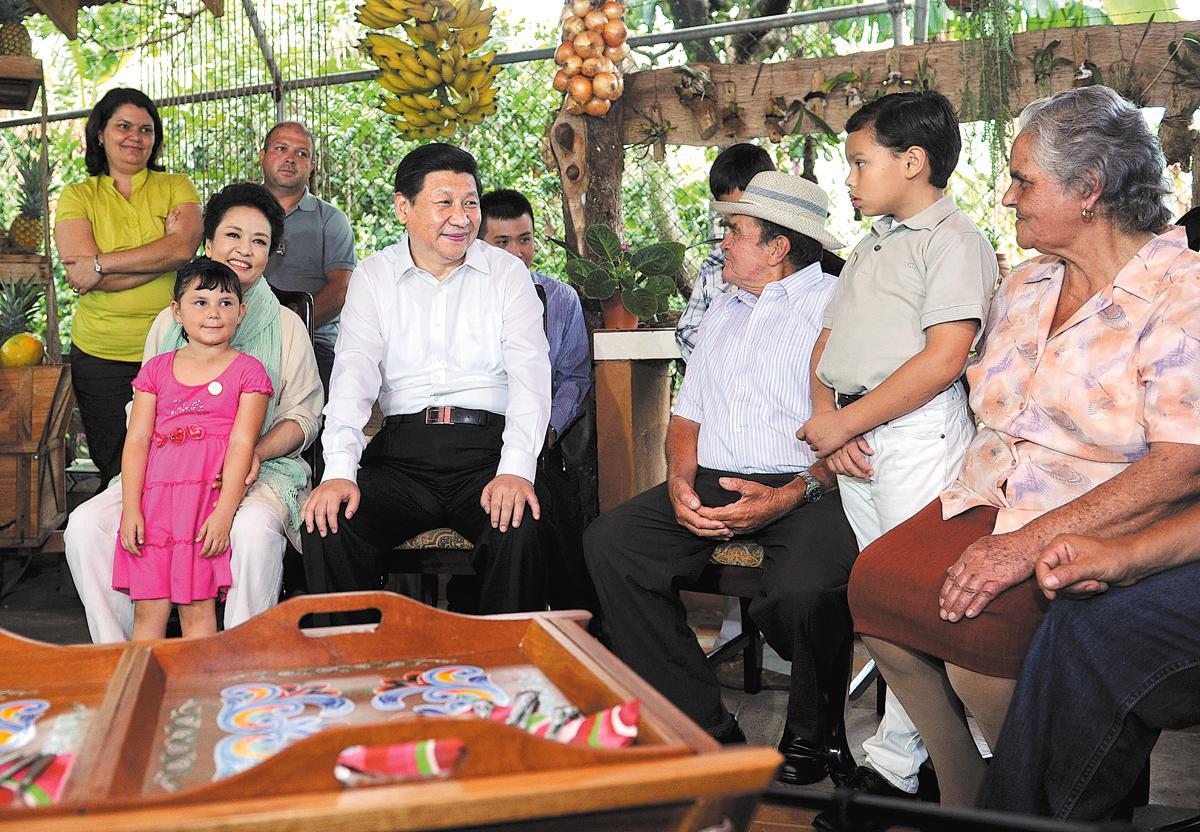
Months after taking over the Chinese presidency in 2013, Xi traveled halfway across the world and paid a state visit to Costa Rica. During the trip, he chose a coffee farm as one of his stops. Sipping a freshly brewed cup, he said: "Seems to me, there's room to export more coffee to China."
The remark foreshadowed a broader pledge. China will keep its doors open and share the dividends of growth, Xi vowed. "Welcome aboard the fast train of China's development," he stated on several occasions.
Also in 2013, Xi unveiled his signature Belt and Road Initiative. More than a decade on, the results are tangible. Freight trains now thunder between Chinese cities and European capitals. Kenya's modern railways and revitalized ports are remaking the East African landscape.
On top of deepening economic linkages, Xi promotes a governance model that breaks with what he views as an outdated relic of colonialism, the Wall Street Journal once commented.
Xi has consistently argued that development holds the master key to achieving that goal — a conviction shaped by his own life experiences. In the late 1960s, as one of China's "educated youth" sent to the countryside, Xi lived among struggling villagers in northwestern China's Shaanxi province.
"One thing I wished most all the time," he recalled decades later in a speech in the US city of Seattle, "was to make it possible for the villagers to eat meat to their heart's content."
Today, Xi is leading China on the path toward modernization. As a leader with a global vision, he also hopes that China can walk the path of modernization with all countries.
"On the road to the well-being of all mankind, no country or nation should be left behind," Xi said.










