Xinjiang boosts energy resource credentials
Autonomous region's oil, gas equivalent output tops among peers for 4 yrs in a row









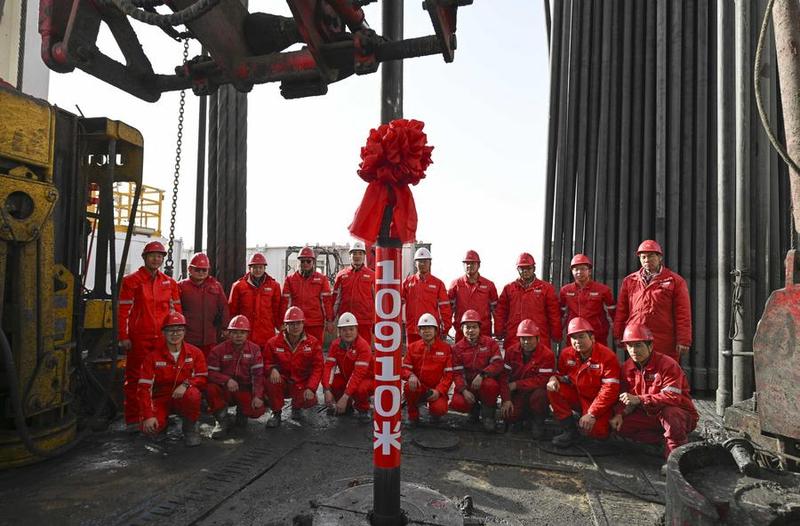
Northwest China's Xinjiang Uygur autonomous region has solidified its position as the nation's premier energy resource base, driven by accelerated oil and gas exploration, development and increased production in recent years.
Fueled by technological innovation and strategic policy initiatives, the region's oil and gas equivalent output has ranked first in the country for the past four consecutive years, underscoring its strategic importance to China's energy security.
China's Tarim oilfield, for example, the country's largest ultra-deep oil and gas production base, had achieved a significant milestone by extracting over 150 million metric tons of oil and gas equivalent from formations deeper than 6,000 meters as of March.
Successful extraction from these ultra-deep formations highlights the growing importance of ultra-deep resources in meeting China's energy demands, while demonstrating the country's advanced capabilities in accessing and developing challenging energy resources, according to its operator, China National Petroleum Corp (CNPC).
Globally, formations exceeding 6,000 meters are classified as ultra-deep, while those deeper than 4,500 meters are considered deep.
CNPC announced earlier this year that it has completed the drilling of the deepest vertical well in Asia, as a borehole reached a depth of 10,910 meters in the heart of the Taklimakan Desert in the Tarim Basin.
This milestone signifies China's advanced capabilities in deep-earth oil and gas drilling and related technologies, placing it among the global leaders in the field, it said.
Industry experts believe domestic oil and gas output has been playing a central role in the country's energy self-sufficiency, while advancements in exploration and production technology have also boosted output, ensuring stronger energy resilience in the world's second-largest economy.
"The successful drilling of the ultra-deep well in the Tarim Basin is not merely a technological feat, but also opens up new possibilities for accessing previously untapped reserves," said Lin Boqiang, head of the China Institute for Studies in Energy Policy at Xiamen University.
"Deep-earth exploration is crucial for unlocking unconventional oil and gas resources, which are becoming increasingly important as traditional reserves dwindle," he said.
"Xinjiang is at the forefront of China's efforts to secure its energy future. The region's vast geological potential, coupled with technological advancements and supportive policies, make it a critical component of the national energy strategy."
According to the National Energy Administration, China's oil and gas majors have been stepping up exploration and development efforts throughout the last year, with major new discoveries made in Bohai Bay, Ordos Basin and Tarim Basin, focusing on increasing reserves and improving extraction efficiency.
This has led to continued investments in exploration and development across both traditional and unconventional energy sources. The influx of investment, in turn, has spurred the growth of Xinjiang's oil and gas production and processing industrial cluster.
This cluster encompasses a wide range of activities, from exploration and extraction to refining and petrochemical production, creating a comprehensive value chain that supports the region's economic development.
The Xinjiang government has been actively promoting the development of the energy sector, recognizing its importance to the region's overall economic growth and stability.
Looking ahead, Xinjiang is expected to play an even greater role in China's energy security, said Lin.
According to data released by CNPC, the country's energy consumption in 2024 grew by 4 percent compared to 2023, driving global demand for primary energy up by 1.9 percent.
"The region's vast untapped reserves, coupled with its growing technological capabilities and supportive policies, position it as a key driver of the nation's energy future," he said.
"As China continues to pursue its economic development goals, Xinjiang's energy resources will become increasingly vital to powering the nation's growth."
zhengxin@chinadaily.com.cn