


Preserving the heritage of Mongolian benedictions









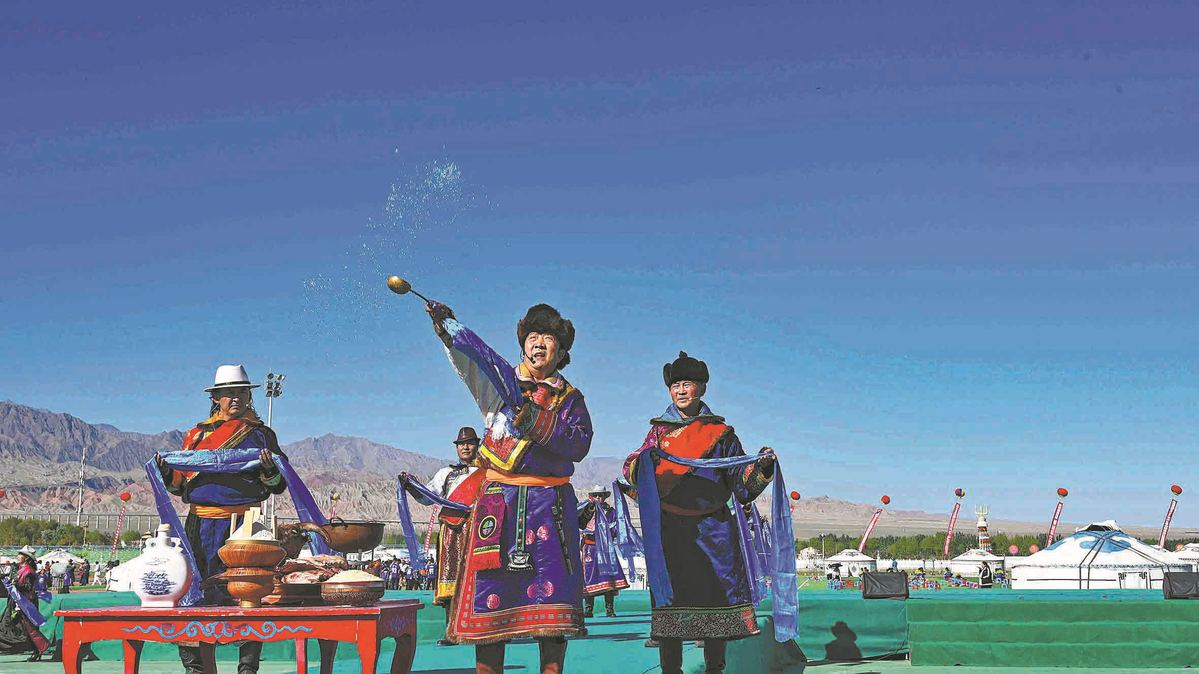
"Back in the day, I practiced wedding benedictions every single afternoon — driven by pure passion, I never felt weary," reflects Ushanxi, his eyes lighting up as he recalls his decades of dedication.
At 67, this soft-spoken yet revered figure stands as the most indispensable cultural guardian in the Subei Mongolian autonomous county of Gansu province. His chants have inaugurated countless weddings and festivals. As the sole national-level inheritor of zhuzanci, or Mongolian benediction, Ushanxi has not only preserved but also revitalized a tradition that spans over 40 years of his life.
Mongolian benediction is far more than a ritual; it is a profound expression of goodwill, weaving together aspirations for health, prosperity and happiness through melodic recitations. These performances, which blend chanting with storytelling, serve as a cultural bridge between music and literature, often gracing pivotal moments, such as weddings, seasonal festivals and ceremonial gatherings.
Ushanxi describes it as "a living archive of our ancestors' wisdom", noting that each benediction carries echoes of centuries-old oral traditions.
His journey into this art began in the 1980s, shortly after graduating from Inner Mongolia Normal University. Fascinated by his heritage, Ushanxi apprenticed under his father and uncle, documenting the oral traditions passed down through generations. At the time, he taught at a remote primary school, where lunch breaks often turned into impromptu invitations to perform at weddings.
"Those years were a whirlwind of practices and performances. Now that I'm aging, I pace myself — limiting it to a few weekly sessions, but the fire still burns bright," he says.
In late September, he officiated a Sino-Mongolian wedding, where the bride was from Subei and the groom from Mongolia. "Benediction is essential to every traditional Mongolian wedding," he explains.
Due to high demand, his two sons, along with some relatives and friends, have also learned wedding benedictions from him.
"Even in marriages between ethnic Mongolians and people of Han ethnicity, the first day of the celebration strictly follows ethnic Mongolian customs, with benediction remaining a cornerstone," he adds.
While wedding recitations focus on conjugal blessings, festival benedictions, such as those for oboo worship, fire rituals, or the Naadam Fair, hold grander significance, serving to express respect for nature and the universe, as well as to convey good wishes for the future. The content of these benedictions also encompasses history, ancestors and heroic figures.
For these occasions, Ushanxi dons elaborate traditional robes adorned with silver and gold jewelry, delivering his distinctive chants against the backdrop of grasslands or deserts.
To hone his craft, Ushanxi has self-funded trips to nationwide competitions and exchanges. In July, he participated in an international benediction contest in Mongolia, engaging with inheritors from 10 countries. "There are nuances in tone and content between our styles and those of Mongolians. I value such exchanges," he notes.
Beyond personal growth, Ushanxi is committed to passing on the tradition. He teaches students of all ages — from teenagers to those in their fifties — free of charge. Lessons often take place in school cafeterias or students' homes for convenience.
"My sincere hope is that they master this intangible cultural heritage, ensuring our ethnic Mongolian traditions endure for generations," he says.
To date, he has nurtured over 40 inheritors, safeguarding a legacy that resonates across borders.
Last September, Tsogtsaikhan Mandakh, counselor at the Mongolian Embassy in China, visited the Subei Intangible Cultural Heritage Center. After watching Ushanxi's benediction performance, he was full of admiration and said: "It's remarkable that the ethnic Mongolians here, with only a few thousand people, have preserved their traditional culture so well!"
Located in the northwestern region of Gansu province, Subei county covers a vast area characterized by diverse landscapes, including mountains, deserts and grasslands, with a total area exceeding 66,748 square kilometers. The population is less than 20,000, with the majority being ethnic Mongolians.