Coffee, tea, or free?
Beverage market this year has been an amalgamation of fire and ice









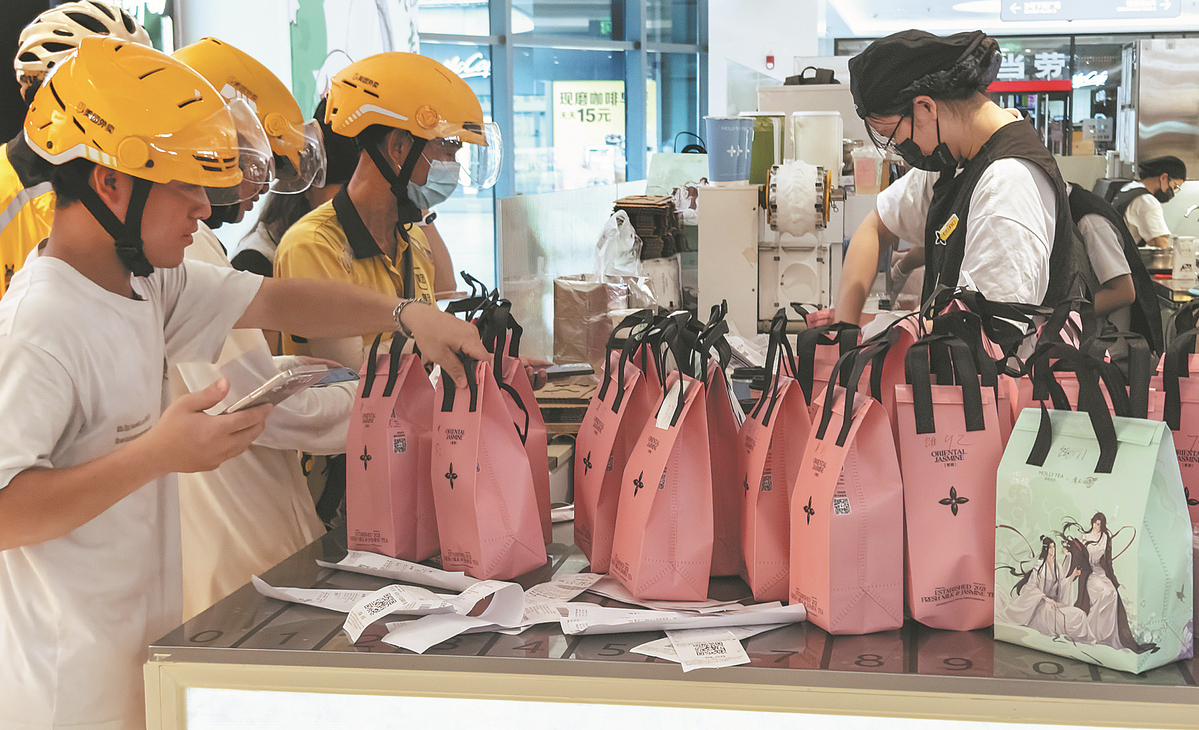
Amid the growing popularity of food delivery platforms, China's coffee and tea market this year has been an amalgamation of fire and ice.
On the one hand is the hot performance of leading players. New-style tea brands such as Luckin and Mixue released eye-pleasing financial reports one after another. Under the pressure of subsidies offered by food delivery platforms, most leading brands still enjoy palpable dividends, achieving revenue growth and scale expansion.
In contrast, small and medium-sized shops are struggling in the enhanced competitive environment in urban centers.
The "ecological differentiation" is not about the brands' own periodic evolution, but a result of the introduction of a grand turf and image war, industry experts said.
Zhao Zhe, a college student in Beijing, said that among e-commerce portals Ele.me, JD and Taobao, Taobao is the most frequently used platform, as it usually offers the lowest prices.
According to a report by Mingxi Outlook, a market information platform on WeChat, on the surface, the battle initiated by food delivery platforms is a frenzied attempt to grab consumer eyeballs and solidify brand stickiness and loyalty. It can also be seen as a rare market reshuffling. In the price war, leading brands stand firm, while small to medium-sized players on the end of the supply chain experience the most direct downside impact.
Addie Xu, a 22-year-old college student in Beijing, said that the price battle initiated by food delivery platforms enables her to taste milk teas of different brands.
"As some brands participate in sales promotions voluntarily, and there is usually a bonus for newly registered users, I was pushed to taste milk teas of different brands in order to benefit from sales promotions. In the past, when the price of milk tea was still high, I tended to buy brands that I was more acquainted with. Now that costs are lower, I have a chance to try some new untasted brands," Xu said.
She added that ever since the price war, she orders more milk teas. In addition, in the past, there was a minimum purchase price for delivery, which meant consumers often had to share orders with others. Now, the threshold has been removed, making it easier for consumers to buy a single serving of milk tea on their own. Although the unit price is lower, as there is higher order frequency, the total that she spent on milk tea is higher than before the price war.
"From a consumer perspective, I think the fiercer the battle, the better, as the more heady the competition is, the more discounts we get, and the higher quality we are offered," Xu said.
According to Mingxi Outlook, small to mid-sized stores do not have the wiggle room of franchise peers to bargain on commissions. Nor do they have the capital to digest long-term losses. What is more noteworthy is that food delivery platforms' evaluation systems, based on low prices and speed of service, are grinding down the unique values of "personalization "and "human touch" that they initially relied on to break out and survive, and the phenomenon is destroying the core competitiveness of small and medium-sized stores in a way akin to a frog gradually being boiled in increasingly hot water.
Zhan Junhao, founder of Fujian Huace Brand Positioning Consulting, said: "The fierce competition in the food delivery market has accelerated the Matthew Effect in the coffee and tea industry. Leading brands have achieved scale expansion and revenue growth by relying on platform subsidies. However, small and medium-sized stores have been forced to exit due to cost pressures, intensifying the market's ecological differentiation."
Moreover, while food delivery subsidies have stimulated consumption in the short term, they may lead to price wars and internal frictions over the long run, or even cause some brands to sacrifice quality for traffic, posing a challenge to the healthy development of the sector, Zhan said.
To solve the dilemma, he suggested that small and medium-sized brands focus on differentiated positioning, avoid subsidy competition with leading brands, and build barriers through distinctive products or niche scenarios.
Liu Yang contributed to this story.
zhengyiran@chinadaily.com.cn