Communards' Wall still worth remembering









Unlike the somber, desolate image often associated with burial grounds, many European cemeteries are serene and picturesque, set amid natural beauty. They feature elaborate sculptures and small commemorative buildings at the head of the graves.

Among them, the Pere Lachaise Cemetery in Paris stands out not only as the resting place of countless luminaries but also as a profound site of history.
Tucked within its grounds lies the Mur des Federes — the Wall of the Federates — revered by communists all over the world. It marks the site where the last defenders of the Paris Commune — the world's first proletarian government — were executed after the movement was crushed in 1871, just 72 days after its birth. These fighters were buried at the foot of the wall, and the site remains a solemn symbol of their legacy.
Located at the cemetery's southeastern corner, the wall is far from the main entrance on the west side. The distance invites visitors on a contemplative walk past the graves of numerous historical figures — a journey through Europe's intellectual and artistic memory.

For instance, a direct path eastward passes the grave of Georges Cuvier, the pioneering naturalist regarded as the father of paleontology in Europe. His name appears in science textbooks worldwide, and his work laid the foundation for modern understanding of fossils and extinction.
Those who take a northern route before turning east will encounter the final resting place of Oscar Wilde. Known for his biting wit and literary brilliance, Wilde's works remain beloved classics, with even children familiar with The Happy Prince.
So many notable figures lie within Pere Lachaise that the cemetery administration has published a guidebook listing 500 of its most famous residents, with plans to expand the entries over time. With each grave passed, the sense of walking through European history deepens, culminating at the Mur des Federes — the sacred wall where flowers continue to bloom.
Veronique, a caretaker at the cemetery, greets visitors with the pride of someone deeply connected to her place of work. Although only in her 40s, she has served at Pere Lachaise for 26 years and knows every corner and detail of the grounds intimately. When asked about the Wall of the Federates, she is unsurprised.
"A lot of people come to leave flowers," she says. She pulls out a well-worn map of the cemetery and marks out several routes to reach the wall, which are the very same paths described earlier.
Nans Barroso, a 21-year-old who was visiting with his mother, is an example of the younger generation encountering this history. While aware of the Paris Commune, he admits his knowledge of its details is limited. "In school, we learned more about the two World Wars and postwar Europe," his mother adds.
It reflects a common sentiment in France: the commune is remembered, but not deeply emphasized in public education.
Yet, the significance of the Paris Commune should not be underestimated. Although short-lived and geographically confined, it marked the first attempt to realize communist ideals in practice.
The commune also advanced democratic ideals. While universal suffrage for men was implemented, which today may seem limited, it was a radical departure from the high property qualifications still required in other parts of Europe at the time.
It is perhaps for these reasons that even those who do not support the commune ideologically still respect it historically. Although the commune receives only a modest section in history textbooks, the ever-present flowers at the Wall of the Federates speak volumes about France's attitude.
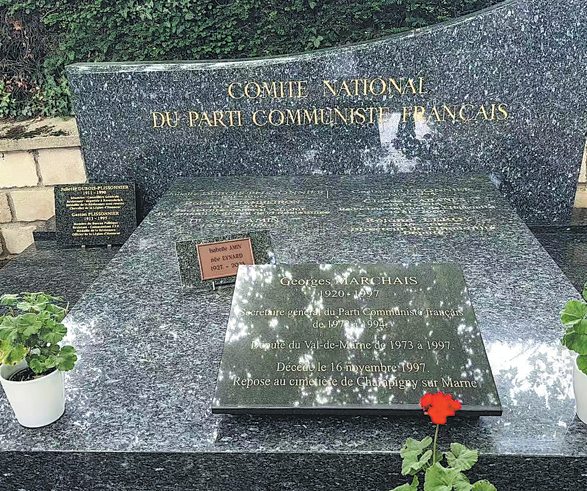
And the pilgrimage does not end there. Directly opposite the wall lie the graves of several former leaders of the French Communist Party. Nearby, monuments honor those who died in World War II, complete with sculptures featuring skulls — a tradition in French art symbolizing death and the transience of life. One visitor explained that these are not meant to frighten, but to help people accept death as part of the human journey.
Placing the communards and the World War II resistance fighters side by side shows a kind of reconciliation in French historical memory. Each group, though very different, is given space to be honored.
However, the story of the commune stretches beyond the cemetery walls. The final stand of the Paris Commune took place on Montmartre, the highest point in the city. It was here that the National Guard made its last defense, guarding the remaining cannons. Although the battle was lost, the spirit endured.
In 2004, the square in front of Montmartre was renamed Square Louise Michel in honor of one of the commune's most remarkable female leaders. A fierce combatant and eloquent speaker, Louise Michel was captured and tried after the fall of the Paris Commune.
Today, the Square Louise Michel bustles with visitors. Adjacent to the iconic Sacre-Coeur Basilica, it offers not only stunning views of Paris but also a chance to reflect on the sacrifices of those who came before. The juxtaposition of sacred church and revolutionary square encapsulates the French approach to history: honoring all facets without erasing their contradictions.
If the communards could see Montmartre now — alive with laughter, leisure and memory — they might feel that their fight was not in vain. History does not sleep in Paris; it walks alongside the living, inscribed in stone, flowers and the quiet dignity of remembrance.
The author is the China Daily EU Bureau Chief Correspondent based in Brussels.