Closer China-ASEAN trade ties bring sweet benefits to fruit dealers









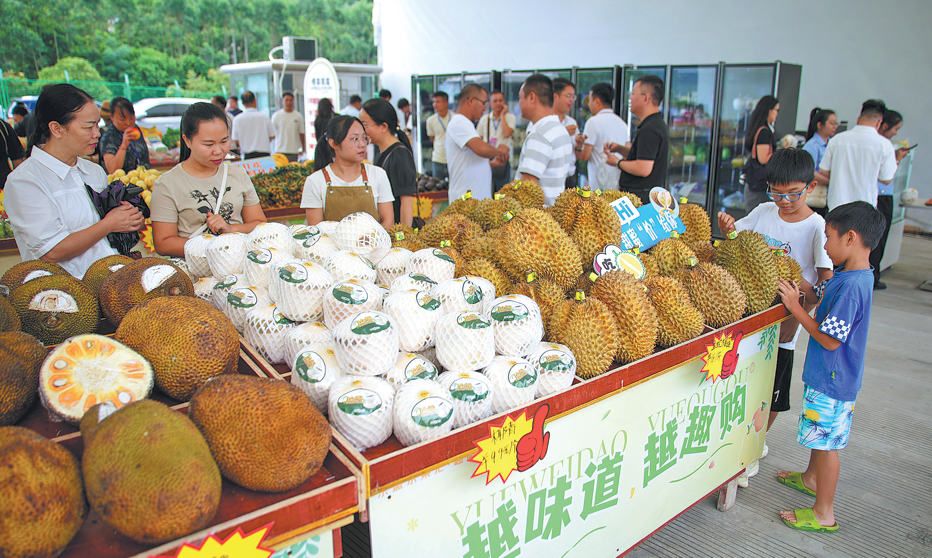
NANNING — The durian — a fruit so pungent it's banned in some Asian hotels — is gaining new status in China as a symbol of economic integration and everyday luxury.
In the bustling, aroma-heavy aisles of the Haijixing Market in South China's Guangxi Zhuang autonomous region, the spiked "king of fruits" is no longer a rare treat but a staple purchase for many. The large wholesale fruit market is located in Nanning, the region's capital, and it now piles durians high and sells them fast.
The colorful abundance of fruits on offer at the market, including durians and mangosteens from Thailand, as well as red-fleshed dragon fruits from Vietnam, masks a complex, high-stakes operation that races against time and decay every day. It is the most tangible result of the "sweet cooperation "between China and ASEAN countries, which is accelerating at a dizzying pace, reshaping diets, economies and the importance of fruit for many.
This shift from luxury to near-ubiquity is a logistic marvel engineered in border cities like Pingxiang, which is located on the China-Vietnam border and is home to Youyiguan, or the Friendship Pass. Here, the theoretical maps of regional trade agreements become a steady procession of cross-border trucks, carrying precious cargo from orchards in Southeast Asia and navigating a Customs process that has been fine-tuned to allow for speed.
This process ensures a Thai durian can move from the branch it was grown on to a dinner table in a Chinese city thousands of kilometers away while remaining fresh.
The machinery enabling this process is a blend of policy and perspiration. Guangxi is the primary gateway, and it has turned fruit logistics into a science. The region has established dedicated windows for inbound fruit, as well as fast-track green channels, according to Li Shuo, deputy director of the regional department of commerce.
The goal is for Customs clearance to take a total of six hours. The system employs a two-step admission process that allows compliant fruit imports to be released conditionally, slashing waiting times. The ports never sleep, operating on a 24/7 appointment-system basis to ensure the tropical tide keeps moving.
And trade statistics reveal its success. In 2024, Guangxi imported nearly 2.5 million metric tons of fruit from ASEAN, worth close to 35 billion yuan ($4.91 billion) in total and accounting for over a third of China's total imports.
But this process is evolving beyond mere transit. The initial import model saw fruit enter Guangxi only to be immediately trucked north, creating a "corridor economy" with limited local benefits. Today, a deeper transformation is underway.
Near the border, the journey of a fruit is being extended. Inside a local Pingxiang processing plant, whole fruits are no longer the final product but a raw material. They are washed, pulped and transformed into bottles of juice or packs of preserved fruits. A company representative highlighted the logic of this endeavor: Processing ASEAN fruits immediately after they clear Customs not only locks in flavor but also cuts costs dramatically.
This has marked a critical pivot from transit trade to local processing — a strategy that the local government is pushing actively to build a complete industrial chain integrating planting, imports, processing and sales.
Guangxi Tiandong Yisheng Import and Export Trade Co Ltd is focusing on mangoes. "We sell fresh mangoes, mango ice pops and mango juice to Southeast Asia, where they are widely popular," said Lin De'en, the company's chairman.
This creates a virtuous cycle, where local and imported fruits are digested by a new industrial base, sending higher-value products back into regional supply chains. Guangxi has cemented this shift by building dedicated China-ASEAN fruit trading centers in Chongzuo, Nanning and Qinzhou — designed to be hubs not just for trade, but for display, storage, settlement and deep processing.
Underpinning this booming trade is a strong trade complementarity between the fruit sectors in China and ASEAN, according to Wang Jubing, head of the Guangxi fruit technology guidance station. ASEAN member states send their durians, mangosteens and coconuts north, while China sends its apples, pears, oranges and tangerines south — a "sweet complementarity between temperate and tropical zones".
The China-ASEAN Free Trade Area has been a great accelerator, wiping out tariffs on some 7,000 types of goods from both sides in 2010. This policy shift made regular durian consumption financially viable for the average Chinese consumer.
Now, the largest free trade zone among developing countries is set for a version-3.0 upgrade, promising to improve consumers' freedom of choice even further. The technical jargon of the upgrade — food supply chain interconnection, Customs procedure simplification, mutual recognition of sanitary and phytosanitary standards — translates to a simple, powerful promise for consumers: fresher, cheaper fruit with more reliable quality.
What began as a simple exchange of goods has ripened into a deep relationship between countries, with the speed of fruit trucks passing through border gates and the hum of machinery in Guangxi's fruit factories directly shaping the sweetness of each ultimate bite.
Xinhua - China Daily


Today's Top News
- NPC's 4th annual session slated for early March
- Civilizational links for a fairer world
- Manufacturing in China spurs global growth
- Taiwan lawmakers vote to pass motion to impeach Lai
- Xi: Steadfastly implement conduct rules
- High-speed rail reaches 50,000 km milestone