Weifang's kites soar across the world's skies









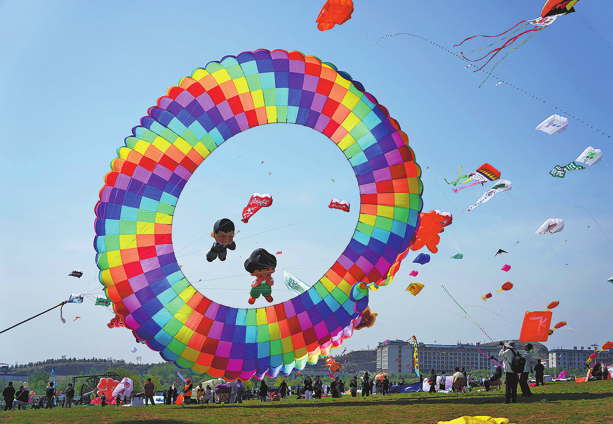
JINAN — A golden dragon twists through the blue sky, a rainbow phoenix spreads its vibrant wings, and a string of tiny swallow kites flutter in the breeze.
On the vast lawn of a kite park in Weifang, East China's Shandong province, known as the "World Capital of Kites", the air is alive with color and motion.
More than 2,400 years ago, the world's first kite took off from here. As the cradle of kite making, Weifang is renowned for its long-standing kite culture and exquisite craftsmanship.
Local records show that the city has been making kites for over two millennia. After Cai Lun invented papermaking in the Eastern Han Dynasty (25-220), paper kites began to appear among the people.
In modern times, Weifang has gained fame both at home and abroad for its distinctive kites, noted for their sound structure, bright colors, stable flight, and strong folk flavor.
In 2006, Weifang kite making was inscribed on China's first list of national intangible cultural heritage.
"Making a kite requires 36 procedures, divided into four major techniques — framework making, mounting, painting and flying — each interdependent and closely linked," said Yang Hongwei, a national-level inheritor of the craft.
Born into a kite-making family, Yang apprenticed under her grandfather in 1982 and has honed the skill for over 40 years, creating everything from giant kites 300 meters long to micro kites with a diameter of just two centimeters.
"Making kites may look easy, but it entails repeating each step day after day, and learning new things in the process," Yang said.
In recent years, she has devoted herself to passing on the craft, offering kite making classes in schools, and training over 20,000 primary and middle school students.
Attention to detail is a hallmark of Weifang's kite masters.
Wang Yongxun, a city-level inheritor and vice-chairman of the Chinese Kite Association, said he selects bamboo aged between 2 and 3 years for the kite frame, on account of its strength and flexibility.
While kites were once mounted with rice paper or silk, which are difficult to preserve, he has developed a custom-blended fabric that is lightweight, economical and colorfast. He has visited more than 40 countries and regions to showcase Weifang's kite making skills to the world.
Today, combining traditional craftsmanship with modern science and technology, Weifang continues to create innovative kite designs.
In a local kite factory in Wangjiazhuangzi village, Weifang city, dozens of workers are busy filling orders for dragon, eagle, butterfly and swallow kites bound for countries including the United States, France and Saudi Arabia.
The village is home to more than 200 kite enterprises, generating over 300 million yuan ($42.16 million) in annual sales. More than half of its 4,700 residents work in the industry, making it the largest kite processing and export base in the city.
Across Weifang, over 600 kite companies employ approximately 80,000 people, with annual sales exceeding 2 billion yuan and products sold to more than 50 countries and regions.
Each spring, kite enthusiasts from around the world flock to Weifang.
In April, the 42nd International Kite Festival in Anqiu, Weifang, attracted 257 kite teams from 51 countries and regions, including Italy, Portugal, Brazil, Russia and Belgium.
More than 2,000 colorful kites drew tens of thousands of visitors from home and abroad to enjoy the spectacle.
With its deep cultural roots and spirit of innovation, the festival has been held for over 40 years, making it one of China's longest-running international events since the start of the reform and opening-up era.
"China and the Republic of Korea have a long history of friendship. Coming to Weifang this time, I'm pleasantly surprised to see how fast China has developed. In words like 'flying dreams', I can feel China's openness to the world," said a visitor from South Korea.
Weifang's "kite wings" have already swept across the skylines of every continent. Since last year, delegations have visited countries including France, Germany, Italy, Hungary and Slovakia to promote kite culture through flying events, exhibitions and other activities, creating new opportunities for international cooperation.
"Kites are an art that crosses cultures, borders and languages. Through the unique charm of kites, people from different countries communicate and share, reflecting the integration of art and culture worldwide," said Hans Peter Boehme, vice-president of the International Kite Federation.
Xinhua


- Former envoy pushes Sino-EU cooperation on climate change
- China praised for its green transition
- Report hails rural growth in Xizang
- China's tech-empowered grain farming bolsters food security
- Joint global effort needed to foster fair low-carbon economy
- Z-20T helicopter dazzles in Tianjin, showcasing broad combat versatility