Central SOEs playing bigger roles









China's centrally administered State-owned enterprises are increasingly seen as not only pioneers in going global but also anchors of industrial security and rule-shaping, with their push into higher-value exports and overseas green-energy investment bolstering resilience across supply chains, experts said.
With the rapid advancement of China's economy and industrialization, more Chinese enterprises are seeking overseas markets.
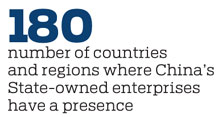
According to the Planning and Development Bureau of the State-owned Assets Supervision and Administration Commission of the State Council, SOEs now have a presence in more than 180 countries, with over 10,000 projects and institutions.
In parallel, SOEs are going global in collaboration with enterprises under diverse ownership structures, partnering with local State-owned and private firms in industrial parks, energy and power, and communications and information.
Beyond scale, experts noted that the international competitiveness of Chinese products and the resilience of supply chains provide a favorable backdrop for the overseas operations of SOEs. This competitiveness, they said, can support the stability and smooth functioning of global industrial and supply chains amid rising protectionism and unilateralism.
As one of the earliest enterprises to venture abroad since China's reform and opening-up, China Information and Communication Technologies Group has focused on three pillars: strengthening technology innovation for global markets, building localized marketing capabilities, and advancing localized overseas production and manufacturing.
Its international competitiveness and influence have steadily grown. Reviewing CICT's internationalization, He Shuping, president of CICT, said the company must keep refining its products to bolster differentiated advantages.
He added that CICT regards standards development and patent portfolio building as key to competitiveness, having led the formulation and revision of 65 ITU (International Telecommunication Union) standards. Today, CICT ranks among the global top five by market share for core product lines, including optical fiber and cable, optical components, and optical access.
Against a complex external environment, experts also observe an export structure upgrading toward new and higher-quality products. Exports of electromechanical goods and the "new trio" — electric vehicles, solar batteries and lithium-ion batteries — as well as green equipment such as electric locomotives, have maintained solid growth, indicating sustained momentum for industrial upgrading and demand for green, digital infrastructure.
At the same time, policy and market headwinds persist.
According to Lyu Daliang, spokesperson and director of the Department of Statistics and Analysis of the General Administration of Customs, abuses of tariffs by certain countries have undermined the multilateral trading system and disrupted normal production and trade. Even so, China remains committed to supporting and upholding multilateralism and promoting the stability and smooth flow of global industrial and supply chains, Lyu said.
Apart from high-quality exports, China has in recent years emphasized green energy investment and the sustainable development of overseas markets, said Xie Laihui, executive director of the division of Belt and Road studies at the National Institute of International Strategy under the Chinese Academy of Social Sciences.
Since declaring in 2021 that it would no longer build new coal-fired power projects abroad, China has progressively shifted its overseas energy investment focus toward supporting developing countries in their green energy transitions.
In Xie's view, Chinese SOEs' overseas green-energy push has distinct features. First, complete supply and industrial chains with a full range of technologies enable end-to-end solutions from production to consumption for partner countries. Second, projects are tailored to local conditions — choosing among solar, wind, and hydropower based on each country's resource endowment — while cooperation structures offer strong price advantages suited to developing countries' fiscal capacity, accelerating technology diffusion.
Xie said both China's traditional and new energy companies, under the Green Silk Road framework, are expanding overseas and using investment to spur energy transitions in Belt and Road partner countries, advancing clean-energy uptake and emission cuts while, to a degree, strengthening energy security.
Such a model offers developing countries cost-controlled, locally tailored pathways for energy development, helping foster a virtuous cycle toward energy transition, energy security, and carbon neutrality, Xie said.


Today's Top News
- NPC's 4th annual session slated for early March
- Civilizational links for a fairer world
- Manufacturing in China spurs global growth
- Taiwan lawmakers vote to pass motion to impeach Lai
- Xi: Steadfastly implement conduct rules
- High-speed rail reaches 50,000 km milestone