Humble reed now used in building panels
Hebei farmer says eco-friendly innovation is more about harmony









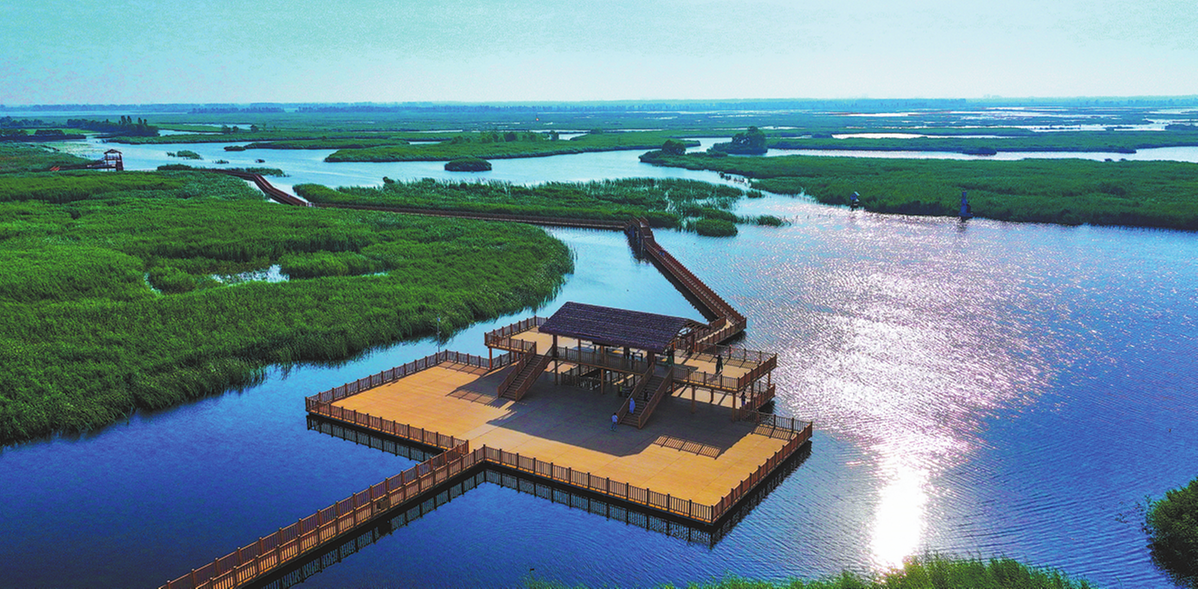
In Xiong'an New Area, Hebei province, a farmer is redefining a symbol of his homeland — the humble reed of Baiyangdian Lake.
Li Jianguang, 49, has transformed the reed, once used for simple woven mats or other ordinary items, into the core of high-strength, fire-resistant building panels now exported globally. His innovation showcases the green ethos central to the area's development.
"I never imagined the reeds I grew up with would one day build walls applied at both home and abroad," said Li, a resident of a lakeside village in Xiong'an and chairman of the Renqiu Zhaolong Reed Specialty Cooperative.
His works, the "Wei Zhu Xin Sheng" (Reed Architecture Rebirth) ecological building system, recently earned recognition at the Hebei International Industrial Design Week, receiving an award in the 2025 Goldreed Industrial Design Award competition — an initiative that underscores the new area's focus on sustainable innovation.
Heritage to innovation
Li's connection to reeds has deep roots. "My grandparents and parents used to weave reeds to make simple products like mats for supporting the family," he recalled.
After earlier business ventures failed in 2008, he returned to the material he knew best, determined to revive its value.
"Traditional reed products no longer meet modern construction needs," Li said, noting issues like susceptibility to insects in traditional uses.
Witnessing a decline of the local reed application, he was driven to innovate. "My goal was to blend the heritage with high performance, creating durable building materials from a renewable resource," he said.
The path was not straightforward.
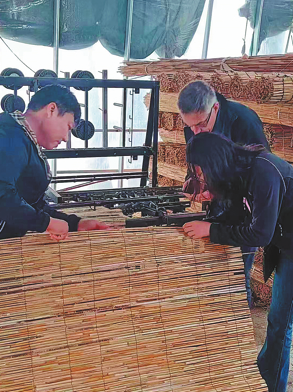
"We started almost from scratch," Li said, adding that his early attempts involved adapting bamboo-weaving machinery and developing automated processes to replace handweaving, a labor-intensive method.
After several years of prototyping, his team achieved a critical breakthrough in 2020 — a patented structural technique that compresses reeds into a steel-wire framework, giving the panels exceptional strength.
The resulting material defies conventional expectations. According to technical specifications of the Hebei International Industrial Design Week, the panels can resist winds equivalent to a Category 12 typhoon and perform well in seismic tests.
A specially developed nanosilicon coating provides a B-grade fire-resistance rating, overcoming a major barrier to reed-based construction, it added. Moreover, the natural hollow structure of the reeds is preserved, allowing the material to "breathe" and naturally regulate indoor humidity and temperature.
"Through these innovations, we addressed the key limitations — combustibility, perishability and low strength," Li said. The system now achieves moisture resistance, weather durability, and allows for rapid modular installation, meeting modern construction needs.
He added that it has been applied in a range of settings, from temporary shade structures to permanent building interiors, and has even been applied by luxury brands for high-end retail spaces seeking eco-friendly aesthetics.
His cooperative began exporting as early as 2009, and today its products reach 17 countries across the globe. Applications range from ecological villas at the 2024 Chengdu International Horticultural Exhibition to interior decoration for international brands.
"Reed has moved from being seen as outdated to a novel, eco-conscious material," Li said.
Green gains
The reason for the popularity is because environmentally, the reed-based system functions as a "zero-carbon building material". The entire life-cycle of the reed panels — from cultivation and production to installation and demolition — results in carbon sequestration of at least 35 kilograms per square meter, according to the organizing committee of the Hebei International Industrial Design Week.
Economically, the impact is equally meaningful. Raw reeds, once sold for 1,200-2,000 yuan ($168-281) per metric ton, now see their value increase up to twenty-fold when processed into midrange building panels, Li said.
His cooperative provides stable employment to around 40 people year-round, with seasonal harvesting and processing work supporting around 200 workers in the surrounding villages.
"It gives many older villagers a reliable source of extra income," Li added.
Each October, the reed harvest begins. Baiyangdian's vast 8,000 hectares of reed beds provide an abundant, renewable supply.
"With our current capacity, we have more than enough," Li said.
He added that the reed is an annual plant that regrows after cutting — it's a truly renewable resource. The harvested reeds are dried, sorted by thickness and length, and processed with a combination of mechanized weaving and manual finishing.
Waste from production is repurposed as windbreak and sand-stabilization material along highways in arid regions in some northwestern regions of the country, ensuring full resource utilization, Li said.
For Li, the effort is about more than business.
"We wanted to start from Baiyangdian and show the world the beauty of harmony between humans and nature," he said.






Today's Top News
- China suspends part of control measures on dual-use items export to US
- Andy Palmer: West can learn from China's long-term planning
- Mainland spokesman reiterates stand on Taiwan
- Xi to attend opening ceremony of National Games, declare Games open
- Xi urges deepening reform, opening-up during Guangdong inspection tour
- China releases white paper on low-carbon development