Tech innovation vital to opening door to future









Standing amid a sea of entrepreneurs, investors and inventors at the Capital International Exhibition & Convention Center in Beijing's Shunyi district, I could feel innovation buzzing in the air.
The HICOOL 2025 Global Entrepreneur Summit — my first — was more than a conference — it was a living ecosystem of technology, talent and ambition, all converging around one shared goal: to shape the future.
This year's summit, held from Oct 16 to 18, brought together participants from across the world. From artificial intelligence and quantum computing to brain-computer interfaces, frontier technologies dominated the stage, reflecting not only the pulse of global innovation, but also China's accelerating drive toward self-reliance and leadership in key tech frontiers.
HICOOL has grown rapidly into one of China's most influential innovation platforms. Through a combination of government guidance and market mechanisms, it links global entrepreneurs, investors and industrial resources through a full-chain service system that includes talent selection contests, business incubation, industrial parks, venture funds and digital matchmaking.
Over the past few years, HICOOL has attracted more than 34,000 entrepreneurial projects and 45,000 talent from 167 countries and regions. One listed company, 16 unicorns and 197 enterprises that use special and sophisticated technologies to produce novel and unique products have emerged from this ecosystem.
The energy and ambition on display at HICOOL are closely aligned with the strategic direction of China's next five-year plan. Earlier this month, Science and Technology Minister Yin Hejun chaired meetings on national science and technology innovation work for the 15th Five-Year Plan (2026-30) period.
Yin described the coming five years as a crucial period for building China into a science and technology powerhouse, emphasizing the need to seize the opportunities presented by a new wave of technological revolution and industrial transformation.
According to Yin, accurately understanding the stage characteristics of the 15th Five-Year Plan period and scientifically planning the strategic goals and key tasks of science and technology innovation are vital. It will be essential for accelerating high-level scientific and technological self-reliance and achieving the goal of building a strong innovation-driven nation.
Yang Yiyong, a researcher at the Chinese Academy of Macroeconomic Research, believes that technological innovation will be the "core driving force for economic and social development" in the years ahead.
"Technological innovation is the key to opening the door to the future," Yang said. "During the 15th Five-Year Plan period, it should be placed in a more prominent position, with greater support and investment."
Yang called for diversified funding mechanisms that encourage enterprises, universities and research institutions to increase research and development spending. The government, he said, should play a guiding role through innovation funds and tax incentives, while strengthening both basic and applied research to achieve breakthroughs in critical areas such as artificial intelligence, quantum computing and biotechnology.
"Basic research is the source of innovation," he noted. "Only by deepening our understanding of the fundamentals — in areas like machine learning and deep learning — can we provide the theoretical foundation for the next wave of technological applications."
Yang also stressed the importance of deep integration between academia and industry, proposing the creation of industrial technology alliances and innovation clusters to accelerate the transformation of scientific results into market-ready products.
"Colleges and research institutes have rich talent and research resources, while enterprises have market sensitivity and industrialization capability," he said. "By combining the two, we can speed up technology transfer and build globally competitive innovation ecosystems."
The push for science and technology innovation under the next five-year plan echoes the transformation I witnessed at HICOOL. The summit's bustling exhibition halls offered a microcosm of China's innovation landscape — from brain-computer interfaces to next-generation robotics and new materials.
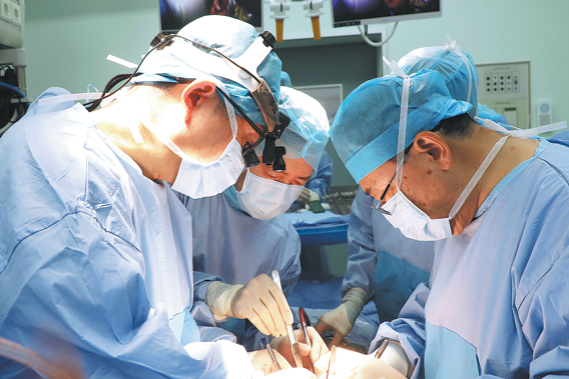
If the energy at HICOOL 2025 is any indication, the momentum is real. The convergence of talent, technology and policy is creating fertile ground for breakthroughs that could redefine industries — and perhaps, as in the case of the brain-computer interface, even redefine what it means to see.
Leaving the convention center on the final day, I looked back at the vast exhibition hall glowing under the autumn sunlight, which showed that innovation never stops.



Today's Top News
- China launches steps against US defense firms, individuals
- Militarism revival efforts criticized
- Leadership highlights Party conduct
- Forging a human-centered future in era of smart machines
- Land-sea trade corridor key to regional progress
- Local rules to be reviewed to help disabled