Solar power installations slow amid reform moves









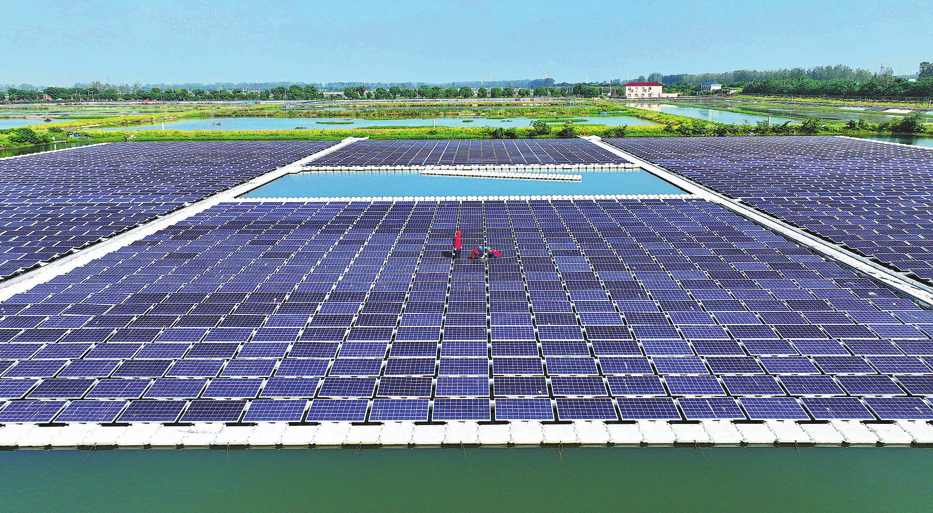
China's new solar power installations in September, though slightly up from August's near three-year low, remained sharply below levels from a year earlier, official data show.
China added 9.66 gigawatts of solar capacity last month, up from 7.36 GW in August — its lowest level since November 2022, the National Energy Administration said on Sunday.
However, the September figure represents a significant drop from the 20.89 GW installed during the same month last year.
The slowdown in recent months follows a record 92.92 GW of installations in May, when developers accelerated projects ahead of policy adjustments, said Tan Youru, a solar analyst at BloombergNEF.
These changes, enacted from May 1, ended full grid-parity subsidies for commercial and industrial distributed solar projects, with further reforms setting June 1 as a cut-off date for different pricing mechanisms for existing and new projects.
The broader solar sector has been grappling with intense competition, a situation that Wang Hongzhi, head of the NEA, pledged to address in an article published late September.
Wang said China's new energy sector, through significant scale growth and open competition, has continuously driven technological innovation and product iteration, achieving rapid cost reductions in recent years.
Photovoltaic power generation costs have dropped by more than 80 percent over the past few years. Currently, the average per-kilowatt-hour cost of new energy is 30 percent lower than that of coal power, he said.
According to the NEA, the large-scale development of new energy has significantly cushioned China against shocks from volatility in the international energy market and drastic changes in the external environment.
It has made significant contributions to enhancing the country's national energy supply resilience, stabilizing energy and electricity costs for the entire society, and ensuring the energy demands for economic and social development, it said.
However, as China's new energy development enters a new stage of comprehensive marketization, the industry needs to accelerate its shift from a resource-oriented approach to one driven by efficiency and profitability, Wang said.
Cost control, operational efficiency, bidding strategies and revenue maximization are becoming critical for differentiated competition among power plants. Cost and price will serve as the most comprehensive and intuitive benchmarks for evaluating the efficiency of industry development, he said.
It's necessary to address excessive internal competition in the photovoltaic industry, promote quality improvement and foster orderly competition and sound, healthy development in new energy power generation and related industries, Wang added.
Tan from BloombergNEF said the global solar installation market is expected to enter a more stable phase, as some major installation markets might face downward pressure next year, while emerging markets in Southeast Asia, the Middle East and Africa could present development opportunities.
BloombergNEF anticipates a slowdown in installation speed in the second half of this year, projecting China's solar installations in 2026 could decline by 19 percent compared to this year.
"The market situation will curb recent price fluctuations, putting greater operational pressure on manufacturers," he said.
"Fierce price competition will persist until at least 2026 or even 2027 as excess advanced capacity, built between 2022-2024, exceeds demand until 2030 and can only exit the market through competition."
Amidst these challenges, solar cell output, which had been on a downward trend earlier in the year, has seen a slight rebound. Production reached 70.9 GW in September, up from 69.9 GW in August, according to the National Bureau of Statistics.
"In 2024, wind and PV products manufactured by China contributed to a reduction of approximately 2.65 billion metric tons of global carbon dioxide emissions, while the international community is increasingly looking to China to provide global climate leadership as the global clean energy supply chain has faced disruptions," said Wang from the NEA.
"New energy, including solar power, has become a crucial instrument for China to reshape the global energy governance landscape and lead the establishment of a renewable energy cooperation system," he said.