President's vision for an open, inclusive Asia-Pacific










Advancing connectivity
Xi's first APEC trip coincided with another major milestone. In 2013, Xi paid a state visit to Indonesia, the host of that year's APEC meeting, and proposed the 21st Century Maritime Silk Road, a key component of the Belt and Road Initiative. Since then, the initiative has grown into a powerful growth engine linking economies across the Asia-Pacific and reshaping trade routes in the region.
More than a decade later, the network continues to expand. This April, during a state visit to Vietnam, Xi and Vietnamese leader To Lam initiated discussions on a railway linking the two countries. It will further weave the BRI railway network across the region, joining landmark projects such as the China-Laos railway, China-Thailand railway, Jakarta-Bandung high-speed railway and Malaysia's East Coast Rail Link.
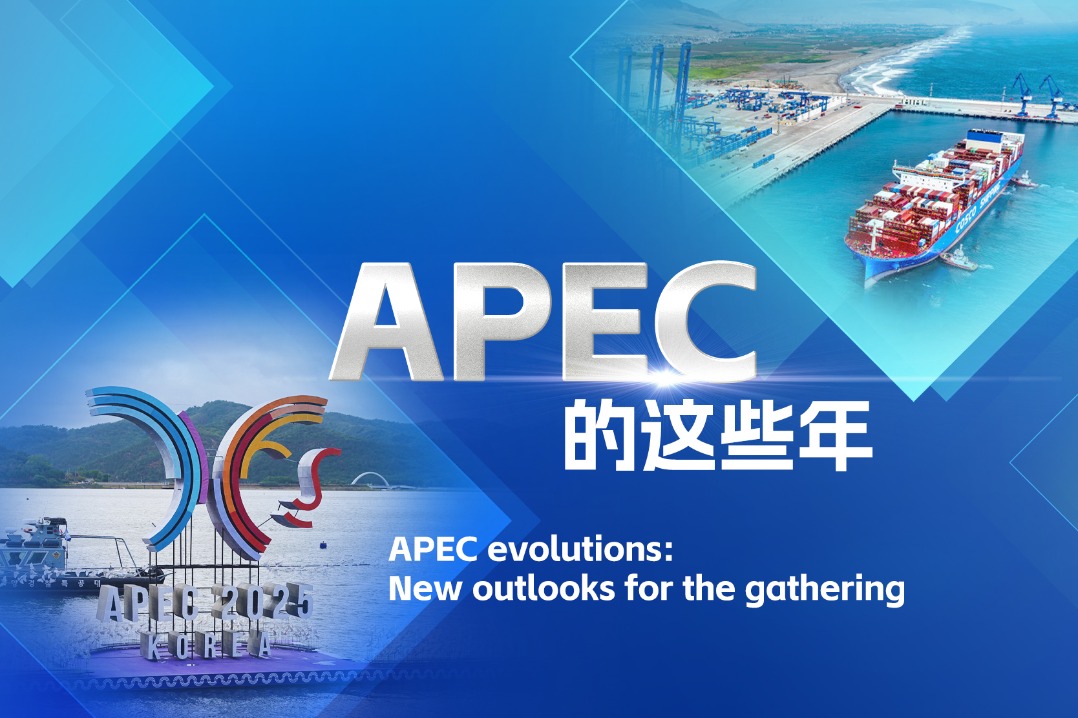
The BRI extends far beyond Asia. Last November, Xi flew to Peru to inaugurate the Chancay port, a maritime gateway linking the Asia-Pacific with Latin America. By shortening the shipping time from Peru to China to just 23 days and cutting logistics costs by at least 20 percent, the port is set to become a vital artery in global trade. Xi outlined his vision for Chancay: to "actively explore a model that drives logistics through transport corridors, boosts trade through logistics, and spurs industries through trade."
As physical connections deepen, the president often stresses the need to strengthen another type of connectivity — one that is less visible but equally critical: the stability of global industrial and supply chains.
In a world facing the rising threat of decoupling and supply chain fragmentation, Xi argued: "Countries should see economic interdependence as an opportunity to complement each other's strengths and achieve mutual benefits, not as a risk."
In Xi's view, in the era of economic globalization, what is needed is not gaps of division but bridges of communication, not iron curtains of confrontation but highways of cooperation.
At the end of March this year, Xi met with more than 40 global CEOs and business leaders in Beijing to discuss the current global business landscape. His message was simple yet resonant: "I often say that extinguishing someone else's light will not make your own shine brighter, and blocking another's path will only end up blocking your own."
Xi has repeatedly underscored the importance of foreign businesses in advancing China's opening-up. At the gathering, Xi pledged to "provide the greatest possible facilitation for trade and investment in China."
Sean Stein, president of the US-China Business Council, was among the attendees. After hearing Xi's remarks, he said, "Investing in China is investing in the future."
For Xi, connectivity is not only about steel and concrete — it is about people. He believes cultural exchanges and mutual understanding lay the foundation for lasting cooperation. China has rolled out visa-free policies and expanded cultural initiatives to further expand the world's access to China. The moves have paid off, with the number of foreign visitors to the country rising year over year.
This spirit of connection was on full display during the 2024 APEC leaders' meeting in Peru, when Xi's conversation with Chilean President Gabriel Boric took a warm, personal turn.
Boric recalled a recent moment back home. "Before this visit to Peru, I was invited to an international book fair in Santiago," he told Xi. "All your works were on display, alongside the works by Chinese poets, writers and artists." Boric presented Xi with a Spanish copy of Xi Jinping: The Governance of China, Volume IV, and asked him to sign it.
In that hall of words and ink, continents seemed to draw closer. "This makes me extremely delighted," Boric said. "The future development of relations between our two countries will benefit from our many cooperation agreements, and even more so from the cultural dialogue and educational exchanges."