
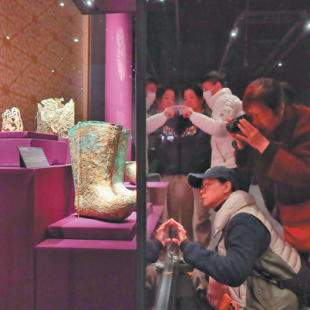



Gilded in gold
New exhibition displays seldom-seen artifacts, telling the Chinese history of this revered yellow metal, Wang Ru reports.










Gold, with its scarcity and stability over millennia, has unified the aesthetics of almost all cultures throughout human history. Exhibitions featuring gold organized by the Capital Museum in Beijing, such as one showcasing gold objects from the mausoleum of the Western Han Dynasty (206 BC-AD 24) Marquis of Haihun and another displaying gold artifacts from the Sanxingdui site, believed to be a capital of the ancient Shu state more than 4,000 years ago in present-day Guanghan, Sichuan province, have always been popular among the public.
Now, gold lovers can feast their eyes on more gold objects at the ongoing Radiance: Ancient Gold Ornaments from the Mengdiexuan Collection of the Hong Kong Palace Museum, an exhibition that kicked off at the Capital Museum on Oct 22 and runs until March 1.
The Hong Kong Palace Museum's Mengdiexuan collection was donated by private collectors. The exhibition showcases over 170 gold ornaments from the 15th century BC to the Ming Dynasty (1368-1644).None of these artifacts has ever been displayed on the Chinese mainland.
According to Zhao Jing, curator of the exhibition at the Capital Museum, by showcasing the remarkable achievements of China's 3,000-year-old gold artistry, the exhibition systematically combs through the production, use, and spread of gold in the Eurasian grasslands, China's Central Plains and the Qinghai-Tibet Plateau chronologically, unveiling gold's role as a significant witness to civilizational communication and integration.
The display opens with a section about the introduction of gold to China from the Eurasian Steppe, revealing the close interactions between the steppe and China's Central Plains.
Daisy Yiyou Wang, deputy director of the Hong Kong Palace Museum, says that in ancient times, the elite of the steppe and those from China's Central Plains used different symbols to indicate their identities. While the former favored gold ornaments with animal motifs, the latter preferred bronze and jade artifacts.

However, following exchanges in the Zhou (c. 11th century-256 BC), Qin (221-206 BC), and Han (206 BC-AD 220) dynasties, elites from the Central Plains appeared to have started using gold in daily life and rituals.
On display are two gold rings, each featuring an opening with trumpet-shaped ends. They are believed to be nose rings or armlets from around the 15th to 13th centuries BC.
Artifacts of this type are typical in the Bronze Age Andronovo cultural sites from Central Asia, according to the curators. But they have also been found in sites of the Siba culture from about 18th to 15th centuries BC in the Hexi Corridor (the main artery of the ancient Silk Road in Gansu province) and the Lower Xiajiadian culture from about 16th to 13th centuries BC around the Yanshan Mountains, indicating the possible introduction of gold objects from northern pastoral cultures to China's agricultural cultures.
"Unlike paintings, which may have inscriptions indicating their origins, when checking gold ornaments, we compare their artistic styles, use of materials, and gold-smithing techniques to judge their relations. Through such comparisons, we believe early in Chinese history, China had a very close relationship with the West, Central and South Asia," says Wang.
The second section of the exhibition displays gold artifacts from the Tang Dynasty (618-907) and the Tubo regime, which ruled the Qinghai-Tibet Plateau from the 7th to the 9th centuries.
"It's a short period, but we have a lot of beautiful artworks. You can really see the characteristics of the gold ornaments from that period; everything is big and splashy, spectacular and beautiful," says Wang.
A plaque, in the shape of a dynamic mounted archer galloping on a horse, is one of the outstanding artifacts from Tubo. The archer has two braided strands of hair streaming back with the wind. The horse's tail is tied in a decorative knot, and the leaf ornaments on the breast strap and crupper flutter dramatically, amplifying its dynamic energy.




















